"I used to work in a cold storage warehouse but left because I found driving earned more money and offered flexible hours," said Nguyen Ngoc Luan, a two-wheeled Be driver, explaining his reason for staying in the profession for nearly three years.
Luan, 32, pulled over on the sidewalk of Nam Ky Khoi Nghia street, Ben Thanh ward, TP HCM, quickly finishing a mobile game while waiting for his app to ping a new ride. Turning on the app at 5 a.m., by the end of the morning, he had earned over 200,000 VND after nearly 10 rides, including both passenger transport and deliveries.
The driver planned to continue working until 10 p.m. to earn over 500,000 VND. His monthly goal is 15 million VND in net income, so he intends to keep the app active for at least 12 hours daily. Luan admitted that compared to his time at the cold storage warehouse, his current working hours are nearly double, but his income is also higher.
"If I want more money in a month, I turn on the app more often, unlike a fixed salary at a company," he said.
However, Luan also acknowledged that if he deducted fuel costs, vehicle wear and tear, and social insurance contributions—similar to what he had at the cold storage warehouse—his actual income would decrease significantly.
Luan has thought many times about returning to his old job but has not been able to quit driving. The thought of "getting immediate cash, then I can do what I want" keeps him activating the app.
 |
A two-wheeled Be driver on a central TP HCM street. *Photo: Quynh Tran* |
Similarly, The Lam, 27, a GrabBike driver, also tried various jobs but always returned to driving. After nearly seven years in the profession, he believes the most attractive aspect is the ability to determine his income by the number of hours the app is on.
"It's hard for me to find another job with a starting salary of over 10 million VND per month that also offers such flexible hours," Lam said.
4 months ago, he spent 50 million VND to switch from a gasoline-powered scooter to an electric one to reduce fuel costs and continue in the profession.
According to Pham Mi Sen, Vice Chairman of the Binh Tan Ride-Hailing Motorcycle Taxi Union, who has been in the profession for over 10 years, this job easily attracts workers because entry requirements are "almost non-existent." New drivers also easily form income expectations from bonus programs, policies for new drivers, and shared stories of high earnings.
"High incomes do exist, but not consistently. Many people who post their earnings online often show their peak days, not what they get every day," he said.
When income does not meet expectations, many drivers do not leave the profession immediately but choose to extend their working hours. From 8-9 hours daily, they increase to 10-12 hours or more to compensate for the income shortfall, hoping to reach the levels they once earned.
The trade-off for 15 million VND
A study by the Institute for Social Life Research on over 200 two-wheeled drivers in TP HCM shows that full-time drivers earn an average of 11.07 million VND per month. After deducting costs, the remaining amount is 9.29 million VND.
To achieve this income, they work an average of 11.1 hours daily and 28.03 days monthly, equivalent to about 311 working hours per month, which is 95-135 hours more than formal sector workers.
If they only worked 8 hours daily, 26 days monthly, this group's income would be only about 6.21 million VND.
Another survey of 141 drivers conducted by the Ho Chi Minh City Confederation of Labor's Center for Labor Consulting and Support recorded that 93.6% consider driving their main job, and 35.5% work over 10 hours daily. To reach approximately 15 million VND per month, many must drive 13-15 hours daily, with almost no days off.
"The issue is not whether drivers have an income, but how that money is perceived," said Associate Professor Doctor Nguyen Duc Loc, Director of the Institute for Social Life Research.
 |
Ride-hailing motorcycle taxi drivers wait at an intersection in central TP HCM, 4/2026. *Photo: Quynh Tran* |
According to Loc, a driver can aim for an income of 10-15 million VND per month if they agree to work many hours. In contrast, some manual jobs have a starting salary of 7-8 million VND. This apparent difference in figures easily leads workers to choose driving. However, if one fully accounts for time, effort, and costs, the net amount may not be high.
Even so, Loc believes this income level still meets the "survival threshold" for some drivers, especially when compared to the living wage of over 7.5 million VND he cited from 2020 data in TP HCM.
A person might know their current job is no longer as attractive as before but still dares not quit because their family needs money for rent, tuition, utilities, and monthly living expenses.
Unlike salaried jobs, drivers can clearly see the money earned each day. According to Loc, if they drive a few extra hours today, they can get a specific amount of additional money. If they quit to find another job, an income gap could appear immediately.
He suggested that drivers are not necessarily unaware of the profession's limitations. The problem is that while they recognize these limitations, they may not have the option to choose another job without disrupting their income stream.
Similarly, Pham Mi Sen noted that the ability to receive money almost daily makes it harder for drivers to leave the profession, as this cash flow directly meets immediate expenses. After a period of working, once they become more dependent on app-based income, they find it even more difficult to accept an income gap if they stop driving.
"Some drivers want to give up but no longer have the opportunity to do so," he said.
He stated that despite realizing their income is not commensurate with the effort invested, many drivers continue to increase their working hours to maintain their earnings.
Considering long-term benefits
Nguyen Van Hanh Thuc, Director of the Ho Chi Minh City Employment Service Center (under the city's Department of Home Affairs), observed that a segment of the workforce is leaving the formal sector to become ride-hailing drivers.
In the early years, this job had clear advantages in accessibility: it did not require high qualifications or skills, could be started quickly, offered flexible hours, and provided income that could be equivalent to, or even higher than, some manual jobs.
However, according to Thuc, when comparing the two options, workers often focus on the immediate money received without fully considering the long-term accumulated values.
The "immediate money" mindset greatly influences employment decisions. A person can immediately see how much they earn from driving today, while the benefits of formal employment, such as salary increases based on skill, welfare, social insurance, or rest time, do not materialize as money on the same day.
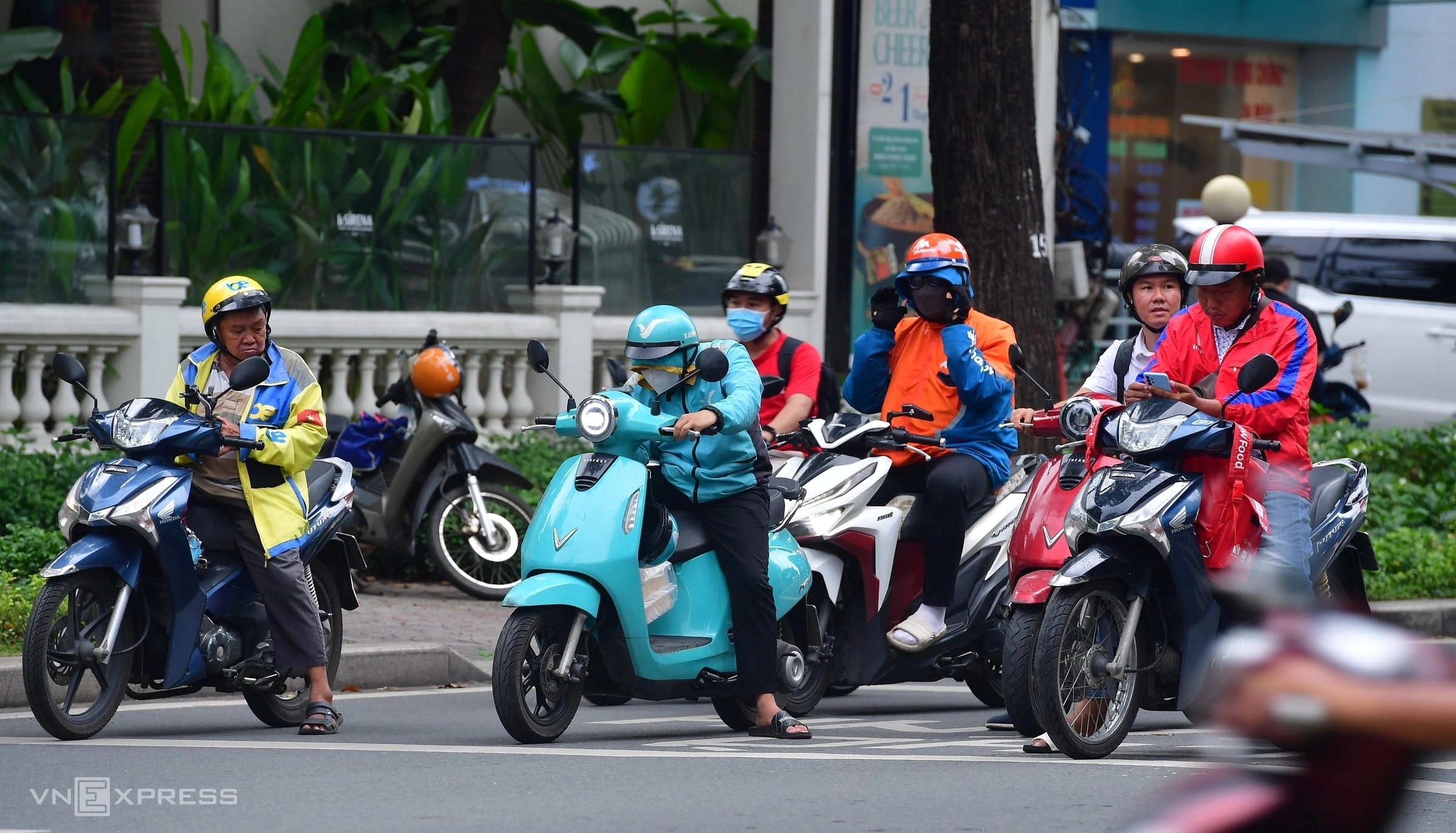 |
A ride-hailing driver on a central TP HCM street. *Photo: Thanh Tung* |
She added that over 5-10 years, workers need to consider the process of income growth and associated benefits. In the formal sector, salaries can be adjusted upward over time, based on skills and job position. Businesses also tend to improve salaries and benefits to compete for labor.
Besides salary, contract workers are also subject to regulations on working hours, rest, and social insurance, which help ensure social welfare in case of risks.
Therefore, according to Thuc, when choosing a career, workers should not just compare how much money they earn from driving in one month with the salary of a formal job. They need to consider working hours, rest time, self-funded costs, the potential for income growth based on skills, and provisions for future risks.
She believes immediate income is very important, but if workers only look at a day or a week, they easily overlook the long-term value of a job. They need a more comprehensive view to make choices that suit their circumstances and long-term goals.
Le Tuyet