After nearly two years of restoration, Minh Khiem Duong theater, a unique historical structure within King Tu Duc's tomb in Hue, has been revived to its original appearance. However, the restoration has sparked controversy among cultural researchers regarding historical accuracy, particularly concerning two eastern side doors and the ceiling's star motifs.
Minh Khiem Duong, constructed in 1865, stands as one of the most distinctive structures within Khiem Cung. This theater was specifically designed to cater to King Tu Duc's artistic preferences, as he was renowned for his love of literature, music, and performing arts. The king frequently visited Khiem Cung for relaxation, often hosting performances of royal court music, dance, and particularly tuong, a form of classical opera that reached its zenith during the Nguyen Dynasty.
According to Nguyen Dynasty historical records, King Tu Duc initiated the construction of Van Nien Co in 1864, near what is now Vong Canh hill in Thuy Xuan ward, as a retreat. This area, covered by pine forests, is close to the Perfume River. The Ministry of Public Works oversaw the construction, with Thi lang Nguyen Binh, Bien ly Nguyen Van Chat, and Thong che Le Van Xa leading the effort. The Ministry of Public Works initially projected completion in about 6-7 years, involving approximately 3,000 soldiers and workers who would rotate leave once every three months. In 1865, Nguyen Van Chat and Le Van Xa petitioned King Tu Duc to accelerate the project, aiming for completion within three years. This accelerated pace exhausted the workers, who received no rest, leading to a rebellion led by the brothers Doan Huu Trung, Doan Tu Truc, and Doan Huu Ai. The rebels, armed with lime pestles, marched directly toward the imperial palace. After suppressing the uprising, King Tu Duc renamed Van Nien Co to Khiem Cung.
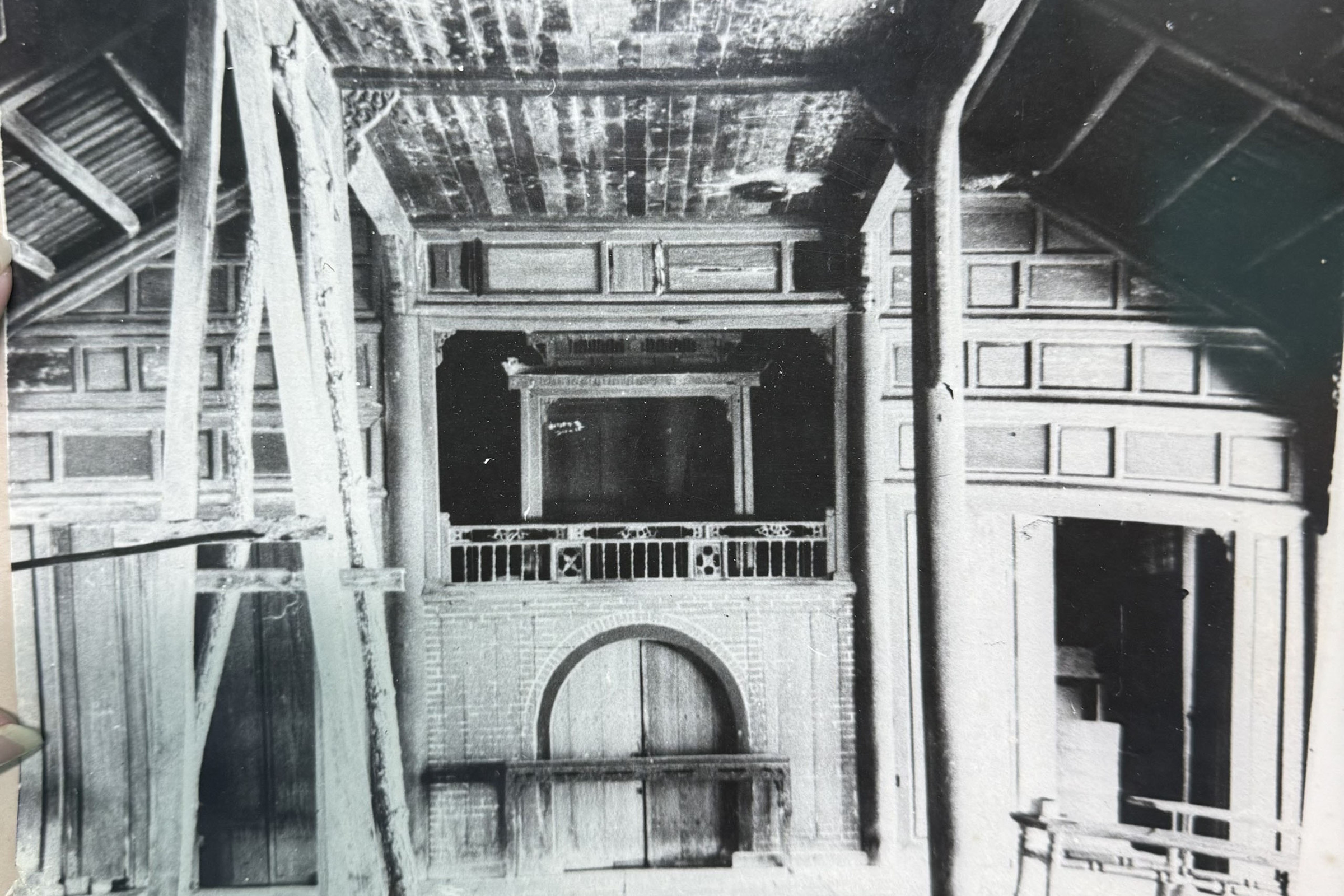 |
Minh Khiem Duong theater before dismantling. Archival photo |
Khiem Cung was largely completed by 1867, encompassing over 50 major and minor structures, including palaces, pavilions, lakes, scenic islands, and other facilities for the king's daily life and recreation. More than 40 years ago, researcher Phan Thuan An surveyed Minh Khiem Duong, describing it as a three-compartment, two-wing building with two verandas, erected on a rectangular foundation 27.57 meters long, 18.15 meters wide, and 0.65 meters high. The foundation was paved with Bat Trang tiles and bordered with Thanh Hoa stone. The western wing's foundation was 0.2 meters higher than the eastern side, where the king's seat was placed. The front and back facades featured five sets of stone steps, intricately carved with graceful kylin figures. The structure stood about 7 meters tall, supported by a column system comprising six vertical rows and eight horizontal rows.
A distinctive feature was the wooden ceiling, spanning about 40 square meters, decorated as a "cosmic dome" with a sun, clouds, and about 50 glass-covered brass stars, creating a shimmering light effect when lamps were lit. Brick walls enclosed three sides of the building, featuring seven windows and three large, airy doors. The central compartment's front and back facades were fitted with wooden doors. The roof was covered with Thanh Lu Ly tubular tiles, with a brass bagua (eight trigrams) symbol adorning the ridge. The gable ends were decorated with ceramic dragon-head leaf motifs, and blue enamel khanh (chime) patterns were affixed to the eaves.
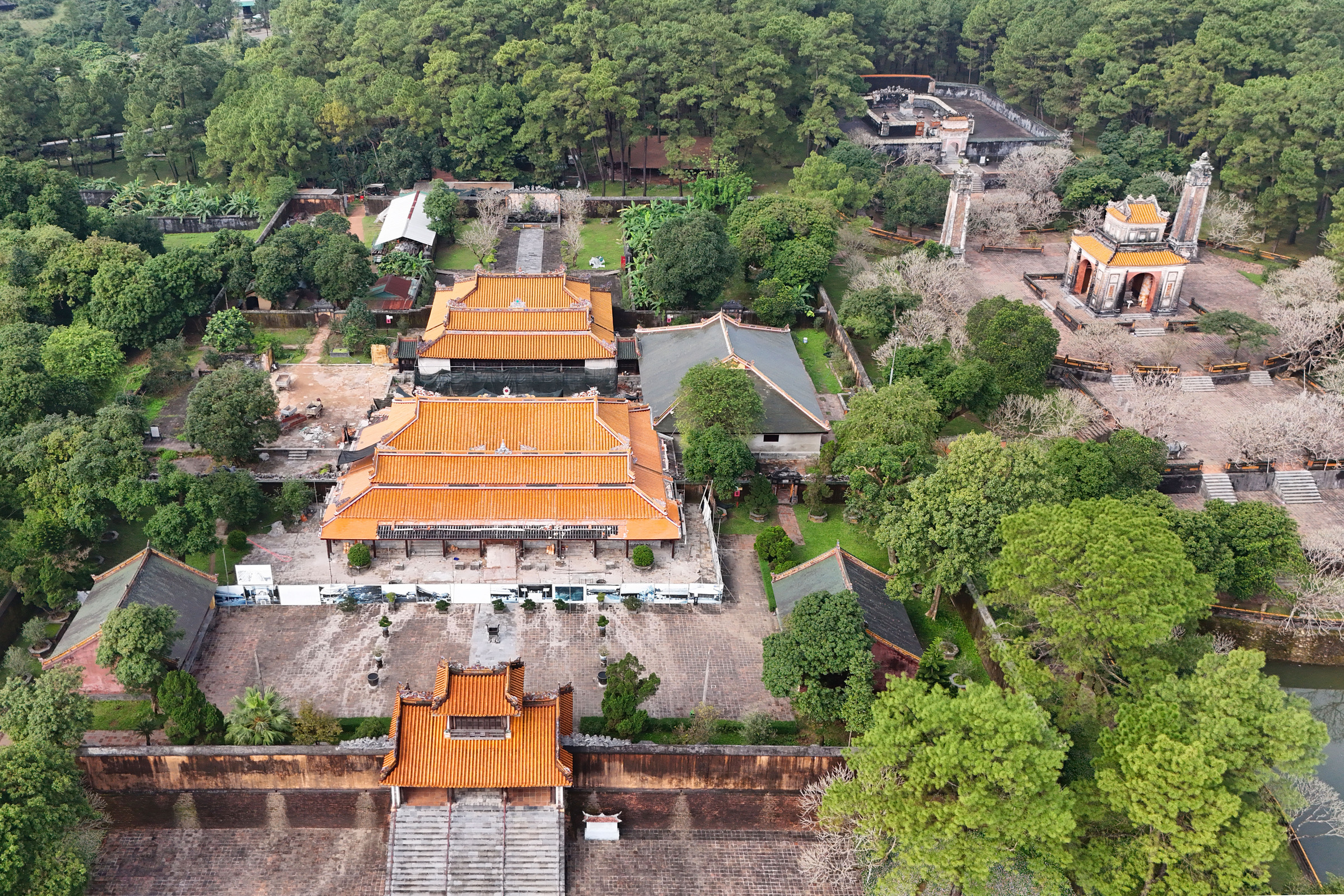 |
King Tu Duc's tomb is being restored. Photo: Vo Thanh. |
According to researcher Phan Thuan An, Minh Khiem Duong's interior was divided into three sections: a stage, backstage, and audience area. The stage occupied the three central compartments, featuring a small loft and a floor 2.7 meters high, with a railing at the front and stairs at the back for performers. Iron hooks at the front were used to draw the curtains. Behind the stage was the backstage area, comprising dressing rooms and storage for props. Opposite the stage was the audience area for the king and his retinue, situated on a low platform in the western wing. The king's seat was centrally located, beneath a horizontal lacquered board bearing the building's name, facing the stage for an optimal view of performances.
After King Tu Duc's death in 1883, Khiem Cung was renamed Khiem Lang, as per the king's wishes. Many of King Tu Duc's concubines also moved to Khiem Lang to live and offer incense. Phan Thuan An noted that before 1975, other architectural structures within Tu Duc's tomb underwent numerous renovations, but Minh Khiem Duong was notably absent from the lists of restored items. Consequently, by 1975, the theater was in severe disrepair, with a leaky roof and several main columns rotted and temporarily propped up. Many decorative wooden panels on the connecting beams had long fallen off and were lost.
In 1978, Pierre Pichard, a UNESCO expert investigating historical sites in Hue, reported that Minh Khiem Duong was 60 percent damaged. Recognizing its significance, Pichard placed Minh Khiem Duong in priority I for initial restoration efforts in Hue, to be funded by international sponsorship mobilized by UNESCO. Subsequently, the Hue Monuments Conservation Center dismantled the roof over the three main compartments and temporarily covered it with corrugated iron, donated by UNESCO, to protect the remaining wooden framework while awaiting full restoration. The management agency frequently used dozens of wooden poles and bamboo stakes for urgent support, temporarily bracing the structure to prevent collapse.
Despite these reinforcements, the wooden structure's age led to rapid deterioration, making the monument vulnerable to collapse at any moment. At one point, a sign was placed in front of Minh Khiem Duong prohibiting visitors from entering due to safety concerns. In 1990, Minh Khiem Duong was assessed as 80 percent damaged. After decades of struggling to stay upright, in 6/2024, Minh Khiem Duong was dismantled for restoration, along with Hoa Khiem palace and On Khiem Duong. Before restoration, the construction company, Hue Monuments Restoration Joint Stock Company, marked the wooden components of Minh Khiem Duong for comparison. The restoration effort considered the existing condition of the structure and consulted archival images.
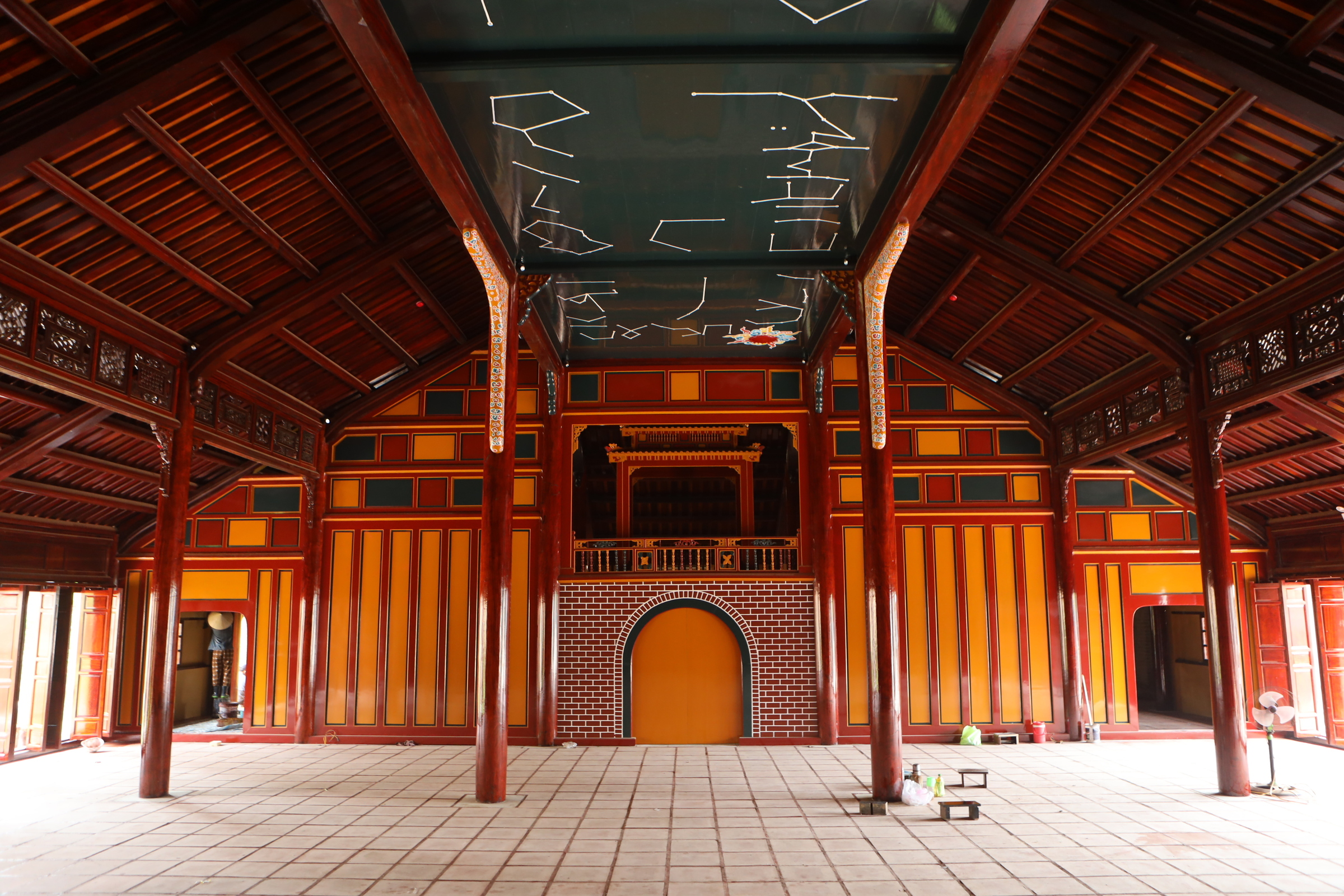 |
Minh Khiem Duong theater after restoration. Photo: Vo Thanh |
After nearly two years of restoration, the construction company revived Minh Khiem Duong to its original appearance. However, controversy arose when the company sealed two doors on the eastern wing, asserting that these large doors did not exist during King Tu Duc's reign. This closure, however, faced strong objections from cultural researchers. Some also questioned the accuracy of the decorative star patterns on Minh Khiem Duong's ceiling after the restoration.
During a meeting with the construction company and cultural researchers, Nguyen Phuoc Hai Trung, Deputy Director of the Hue Monuments Conservation Center, stated that during King Tu Duc's era, the two doors on the eastern wing of Minh Khiem Duong served as entry and exit points for performers. Hoang Viet Trung, Director of the Hue Monuments Conservation Center, subsequently instructed the Hue Monuments Project Management Board and Hue Monuments Restoration Joint Stock Company to adjust and reinstall the two large doors on Minh Khiem Duong's eastern wing, as they were before dismantling. Hoang Viet Trung also requested adjustments to the decorative star clusters on Minh Khiem Duong's ceiling. However, the construction company's representative refused, stating that during the dismantling process, neither the ceiling nor archival photos showed glass-covered brass stars, making restoration difficult. Hoang Viet Trung then assigned the design and installation of the ceiling stars to the Hue Monuments Project Management Board for completion.
Vo Thanh