On the morning of 20/5, General Secretary and President To Lam affirmed that the nation possesses significant foundations to enter a higher development phase. He made this statement during a working session with the Central Policy and Strategy Board and related agencies, focusing on evaluating national development resources linked to the goal of double-digit economic growth and establishing a new growth model.
To achieve the goals outlined in the 14th Party Congress Document and the 2026-2030 five-year socio-economic development plan, a fundamental change in how development resources are organized and operated is essential. According to General Secretary and President To Lam, "double-digit growth cannot be the result of merely extending the old growth model."
The Party and State leader emphasized that growth cannot rely solely on traditional methods such as increasing investment capital, expanding credit, exploiting more land, adding projects, utilizing cheap labor, processing, assembly, or attracting foreign direct investment (FDI) through simple incentives. Continuing with these old approaches might yield temporary growth but struggles with sustainability, productivity improvement, self-reliance, and escaping the middle-income trap.
General Secretary and President To Lam advocated for an innovative mindset regarding resources. He urged viewing resources not as static assets to be divided, but as something to be created, enriched, connected, and multiplied. The state's role, he explained, extends beyond merely allocating resources; it must also foster an environment, shape development spaces, reduce initial risks, and activate societal resources, public resources, private resources, data, intellect, and culture.
"Double-digit growth is a goal of high-quality development, not growth at any cost," General Secretary and President To Lam stressed. He added, "growth cannot come at the expense of stability; speed cannot diminish quality; scale cannot overlook efficiency; and short-term gains cannot undermine long-term foundations."
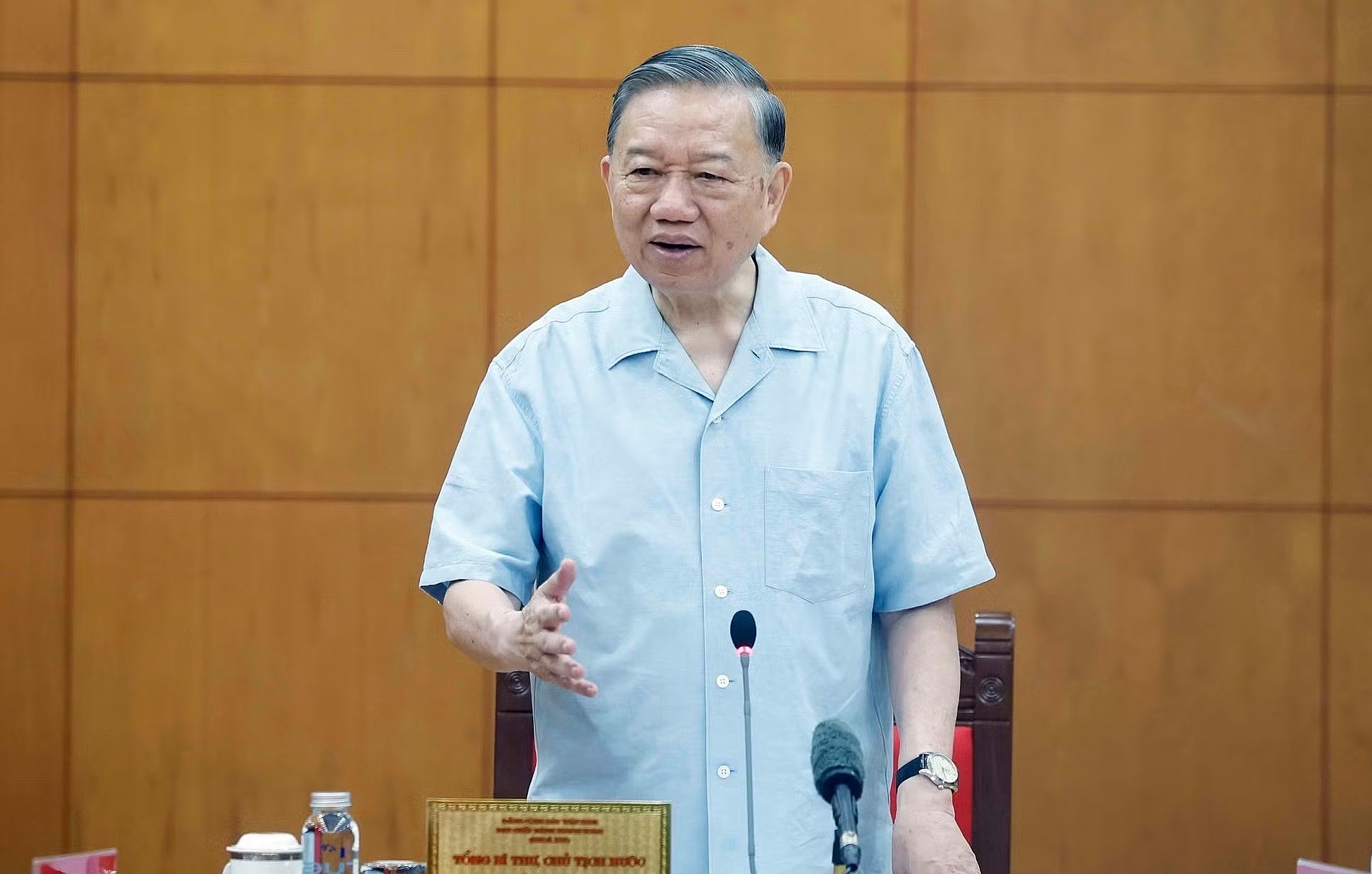 |
General Secretary and President To Lam speaking at the working session with the Central Policy and Strategy Board, on the morning of 20/5. Photo: TTXVN |
General Secretary and President To Lam requested a thorough and accurate assessment of the nation's development resources. This assessment should clarify which resources are prominent advantages, which can be mobilized immediately, and which remain potential yet to be transformed into development drivers.
He also called for identifying the strengths, limitations, and solutions for leveraging various resources: economy and finance; land, public assets, infrastructure, and development space; science and technology, innovation, and data; human capital, culture, national brand, and social trust; institutions and governance.
The focus, according to General Secretary and President To Lam, must be on the mechanisms for mobilizing, allocating, utilizing, and transforming resources. He clarified that the critical question is not merely what resources are available, but what mechanisms will enable these resources to contribute effectively to development.
"Many resources are trapped," he stated. "If not unblocked, this will lead to a situation where resources exist but cannot be used; potential remains untapped; correct policies yield slow results; and ambitious goals lack sufficiently strong implementation tools."
Therefore, functional agencies must review, categorize, and definitively address resources that are slow to be utilized. National resources must not be left dormant in procedures, disputes, fear of responsibility, or slow inter-agency coordination.
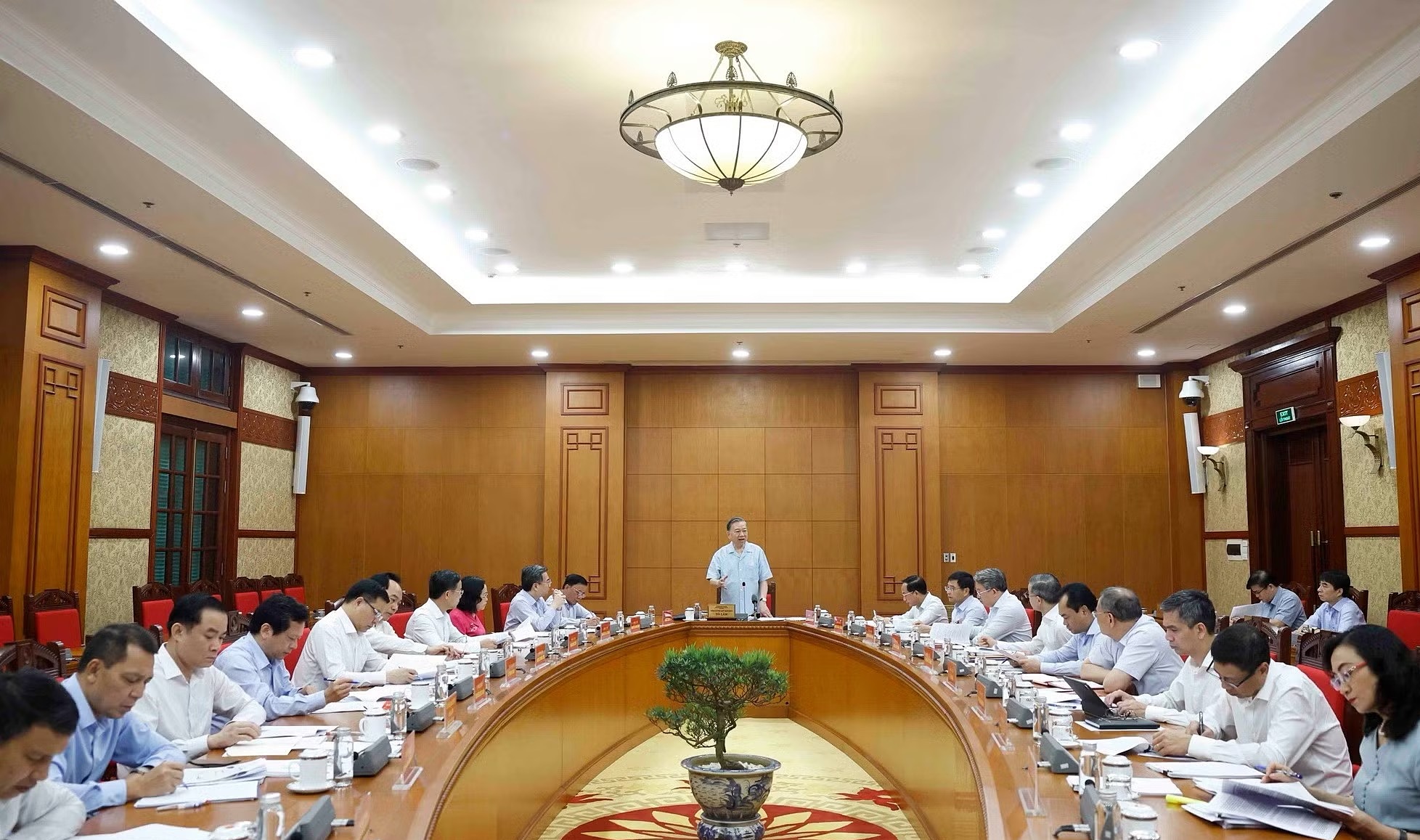 |
Delegates attending the working session with General Secretary To Lam and the Central Policy and Strategy Board, on the morning of 20/5. Photo: TTXVN |
Regarding resource allocation, General Secretary and President To Lam called for a significant shift. He urged moving away from fragmented, average, localized, term-based, and administrative boundary-based distribution to allocation based on efficiency, productivity, spillover effects, and output results.
He further specified that public resources must lead private resources, and public investment must activate social investment. Foreign direct investment (FDI) should attract domestic enterprises, infrastructure must open up development spaces, and science and technology must translate into products, revenue, productivity, quality, and competitiveness.
General Secretary and President To Lam emphasized that the new growth model must rely more on productivity, science and technology, innovation, digital transformation, and data. "This must be a primary driver, not just a slogan," he asserted.
The new model must also rely on stronger Vietnamese enterprises, with the private sector being a crucial driver. State-owned enterprises should focus on key sectors, strategic infrastructure, and leading large investments. Foreign direct investment (FDI) should shift from attracting by quantity to absorbing by quality, technology, and domestic linkages.
General Secretary and President To Lam assigned agencies to develop an institutional package to unlock resources, focusing on land, investment, planning, construction, public assets, capital markets, science and technology, and new economic models. He demanded a decisive abandonment of the "if you can't manage it, ban it" mindset. He also called for one issue or content to be regulated by only one law, maximum administrative procedure reform, and a strong shift from pre-inspection to controlled post-inspection.
Vu Tuan