On the afternoon of 24/8, the National Assembly voted to approve two resolutions establishing Quang Ninh City and Bac Ninh City. These new cities will be formed based on the entire natural area and population of the current two provinces.
Quang Ninh City spans an area of 6,231 km2 and has a population of 1,52 million. It will comprise 30 wards, 22 communes, and two special zones. The city shares borders with Hai Phong, Bac Ninh, Lang Son, China, and the East Sea.
Bac Ninh City covers an area of 4,713 km2 and has a population of 3,99 million. It will include 45 wards and 54 communes. The city borders Hanoi, Hai Phong, Quang Ninh, Hung Yen, Lang Son, and Thai Nguyen.
Upon the resolutions' effective dates, all agencies, organizations, and units currently named Quang Ninh province and Bac Ninh province will be renamed to Quang Ninh City and Bac Ninh City, respectively. Legal documents in effect will also adopt the new designation from province to city.
Documents issued before the two localities become cities will remain valid if they have not expired or reached their usage limit. Specific mechanisms and policies currently applied to the two provinces will continue until their expiration or until competent authorities decide to change them.
The National Assembly assigned the Government, People's Councils, and People's Committees of the two localities to organize and consolidate their administrative apparatus. Their mandate includes stabilizing residents' lives and ensuring socio-economic development, national defense, and security.
The Government stated that both localities have developed plans to announce the resolutions, consolidate their administrative structures, and address any arising issues. This preparation aims to ensure the city administrations become fully operational once the resolutions take effect.
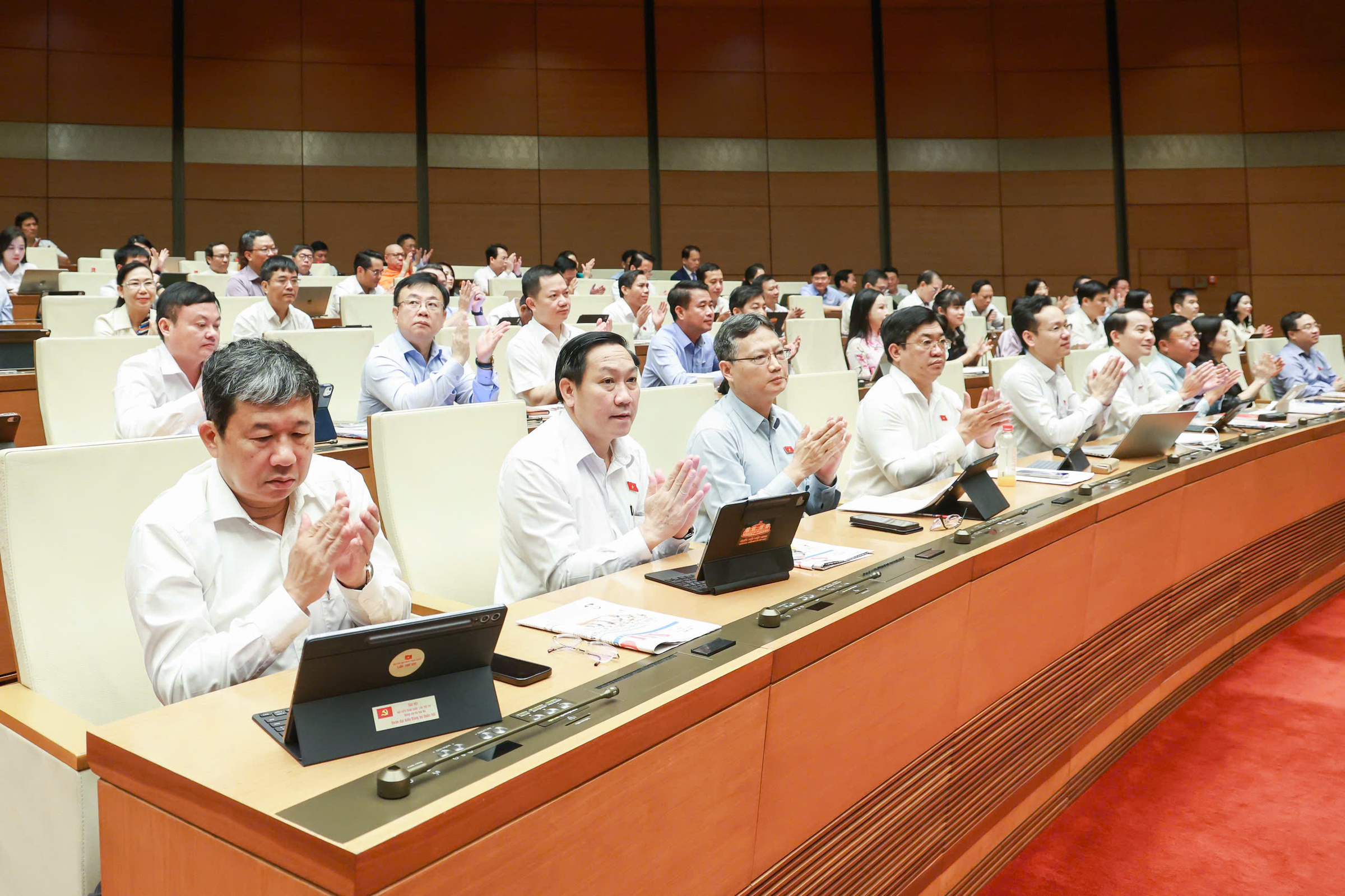 |
Delegates at Dien Hong Hall, National Assembly House. Photo: Hoang Phong |
Quang Ninh is strategically located in the key economic region of the Northern Delta, sharing land and sea borders with China. It boasts robust road, air, and sea transport systems. The region is oriented to become a modern, green, smart, and internationally competitive coastal urban area, serving as a hub for marine economy, tourism, and services.
Bac Ninh, situated at the northern gateway of Hanoi, connects to Noi Bai airport, Hai Phong seaport, and the Gia Binh international airport, which is currently under construction. The locality aims to develop into a high-tech industrial city, fostering innovation, preserving its rich Kinh Bac identity, and integrating more deeply into global value chains.
The Government stated it will direct the two cities to transform their growth models, linking economic development with environmental protection. Science, technology, and innovation will serve as the primary drivers for this transformation.
Specific mechanisms and policies for centrally-run cities are expected to be regulated within the Urban Development Law. These policies focus on attracting strategic investors, financial and budgetary management, science and technology, digital transformation, land use, site clearance, and land fund development.
Following their establishment, Quang Ninh and Bac Ninh will continue to research specific mechanisms and policies tailored to each locality. These proposals will then be submitted to competent authorities for consideration.
Regarding Ha Long Bay, the Government requires strict control over construction activities in coastal and buffer zones. This measure aims to minimize large-scale projects, high-rise buildings, or any architecture that could obstruct views of the bay.
Bac Ninh is tasked with preserving its system of 9 special national relics, traditional festivals, craft villages, and Quan Ho spaces. The city will also develop cultural-tourism villages that integrate the preservation of traditional architecture.
The establishment of these two cities is expected to create additional growth momentum for the Red River Delta and the Northern region. This development aims to expand job opportunities, increase income, and improve the quality of life for residents.
Vietnam currently has seven centrally-run cities: Hanoi, TP HCM, Hai Phong, Hue, Da Nang, Can Tho, and Dong Nai. By September, this number will increase to nine with the official establishment of Quang Ninh and Bac Ninh.
Son Ha