One of the highlights of this year's clay court season has been the increased use of underhand serves, as players increasingly adopt deep return positions. Faced with a match point during the Barcelona Open quarterfinals last month, Nuno Borges opted for a bold strategy. The Portuguese player executed an underhand ace, leaving Tomas Martin Etcheverry completely stunned. The ball dropped short, and Etcheverry rushed forward but couldn't reach it in time. The match concluded with a 6-3, 7-6 victory for Borges.
However, that point was not celebrated as an innovative play. When the two players shook hands at the net, Etcheverry turned away, while many spectators in Barcelona booed the winner. For them, Borges had committed an unforgivable "sin": winning with an underhand serve.
The underhand serve on match point by Borges, during his match against Etcheverry in the Barcelona Open quarterfinals, on Rafa Nadal Court, Barcelona, Spain, on 15/4.
Such reactions highlight that the underhand serve remains one of tennis's most controversial shots, but for increasingly outdated reasons.
In Borges's case, he was experiencing cramps and a problem in one leg. He was unable, or unwilling, to jump and generate power for a conventional serve. However, he didn't need a justification for his choice.
In modern tennis, the power of serves causes many returners to stand far behind the baseline. In this scenario, an underhand serve becomes a perfect surprise attack, especially for players who possess a powerful regular serve. Alexander Bublik is a prime example, often seen as a master of this technique.
Serving this way unsettles an opponent's mindset. They cannot comfortably stand deep, waiting for the ball to come. And in Borges's situation, it was an ideal option for a player unable to serve at full strength traditionally.
Criticizing the underhand serve is akin to criticizing Carlos Alcaraz for hitting a drop shot while his opponent expects a powerful forehand from the Spanish player. The element of surprise is the essence of the play.
Historically, the underhand serve was often considered a shot for recreational players who didn't know how to serve properly. However, by the late 2010s, this serve began to gain popularity, partly because many players, like Rafael Nadal, often stand very deep to return, especially on clay courts.
Daniil Medvedev even takes this to an extreme with a return position so deep that opponents have to practice underhand serves before facing him.
"Against Daniil, if you serve normally, it’s quite difficult because he has too much time to read your serve. Before the match, I practiced underhand serves," Alexandre Muller recounted when playing Medvedev at Wimbledon. "I tried it two times because he was standing too far back. That was the first time in my life I did that. I won both of those points."
The underhand serve is therefore not an act of disrespect towards an opponent. It is a clear intention, a reminder that in tennis, strategy isn't just about hitting the ball powerfully, but also about making opponents wonder: what will the next shot be?
Players like Bublik or Nick Kyrgios have a particular advantage when opponents almost always have to stand deep to return, because both possess incredibly powerful serves. They are also skillful enough to execute the underhand serve with precision, concealing their intentions, and then exploiting their colleague's deep position to create an advantage.
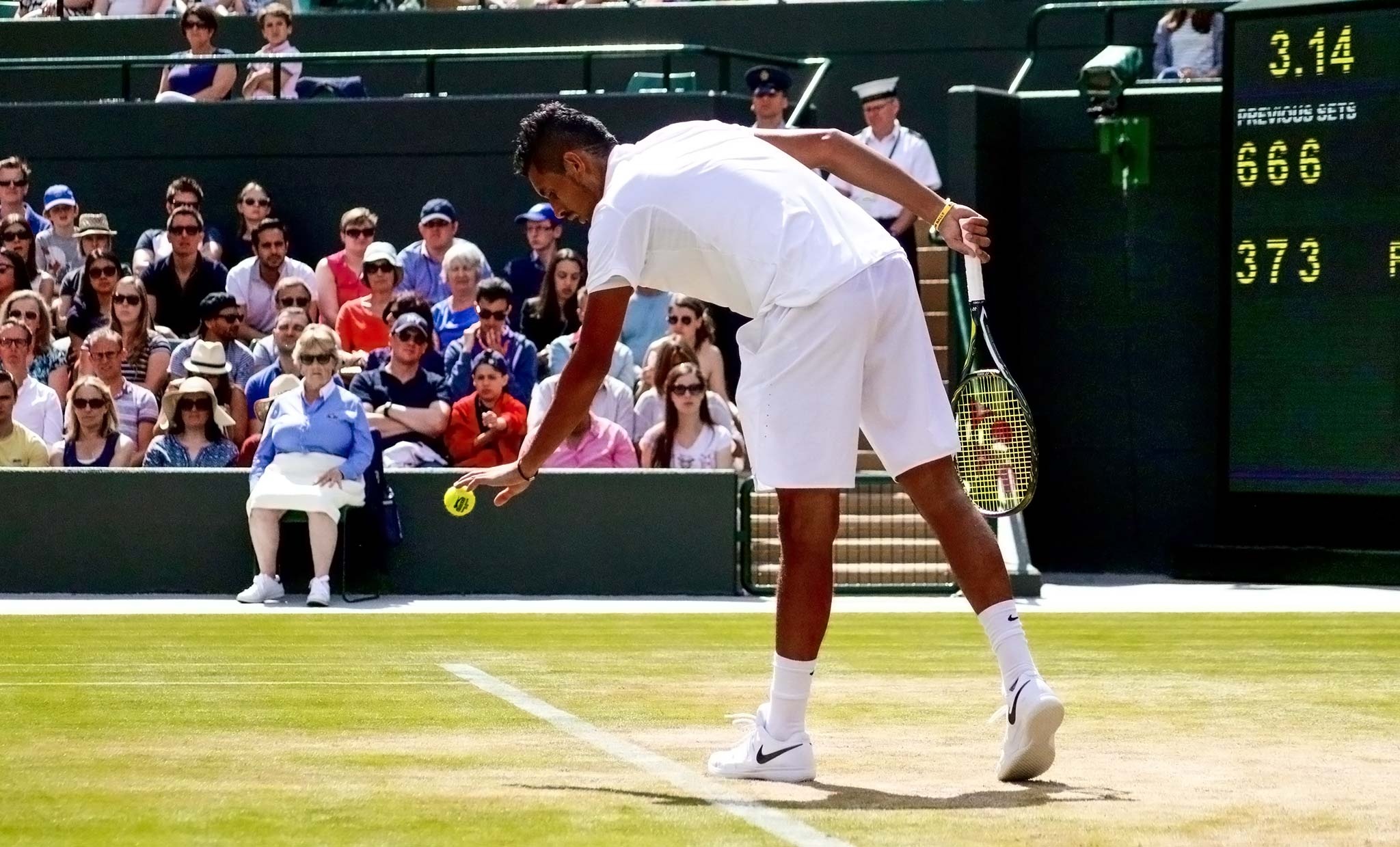 |
Kyrgios prepares to serve during a match at Wimbledon, where he reached the final in 2022. Photo: Reuters
"It shouldn't be overblown. It's just a bit of a silly shot to give a player an advantage," Bublik said after serving underhand 6 times in one game against Giovanni Mpetshi Perricard. "Your chances of executing it perfectly are only about one to two times out of 10 attempts. If you don't do it well, you give your opponent an easy situation. Anyway, it's just another type of shot. We don't criticize drop shots, but we keep talking about underhand serves."
As someone who frequently uses this shot, Bublik's defense is understandable. But what do his opponents think?
"I've never understood why people boo the underhand serve, because it's part of the game," Jack Draper said at Roland Garros 2025. "If you have that shot in your arsenal, when many players stand very deep to return, it's a good option."
Medvedev, often a "victim" of this unconventional serve, stated at Wimbledon 2024 that he sometimes uses the technique himself: "I think that serve should be judged more fairly. In my opinion, this tactic has its limits, and that's why no one uses it too much. It's good for surprising one or two times. But if you do it a third time, I think it will be difficult to win the point."
Another player who won a match with an underhand serve is Pablo Cuevas, once known as the "king" of exhibition shots in tennis. In an interview about his favorite career shots, Cuevas mentioned a second serve on match point in the 2017 Brazil Open final, which helped him defeat Albert Ramos-Vinolas.
"I don't use it much," Cuevas said. "But if someone does it to me, I don't feel annoyed, because I understand some players stand very far back to return, and you're just trying to make it a little difficult for your opponent. I don't think it's cheating at all. I see it as strategy."
For Cuevas, that shot came from a fear of losing the point. He didn't want to make his 13th double fault. The most famous underhand serve in history probably belongs to Michael Chang, when the 17-year-old executed that serve in a shocking victory over Ivan Lendl at Roland Garros 1989.
The underhand serve does not break rules, does not insult opponents, and does not degrade the match. The player who executes it is certainly not a coward. This technique simply states: tennis is not just a game of power, but also a game of mind, rhythm, and creating moments of surprise.
Vy Anh