On 26/2, a video captured by Salah Abdelhadi depicted locusts covering the entire road. Large swarms struck windshields, obscuring visibility, and the road surface was almost completely covered by the insects.
Locust swarm covers road in the Sahara desert. Video: Salah Abdelhadi
Abdelhadi stated he was participating in a long-distance off-road race, which began in Budapest, Hungary, and was set to conclude in Bamako, Mali. He recorded the scene near Boujdour, a coastal city in Western Sahara, on the Atlantic coast.
"We drove through several dense locust swarms and happened to capture the most intense one", Abdelhadi stated.
The recent incident echoes similar events in the Canary Islands, Spain, a popular Atlantic resort destination. Previously, the New York Post reported large-scale locust swarms also appeared there, described as a "locust plague disaster".
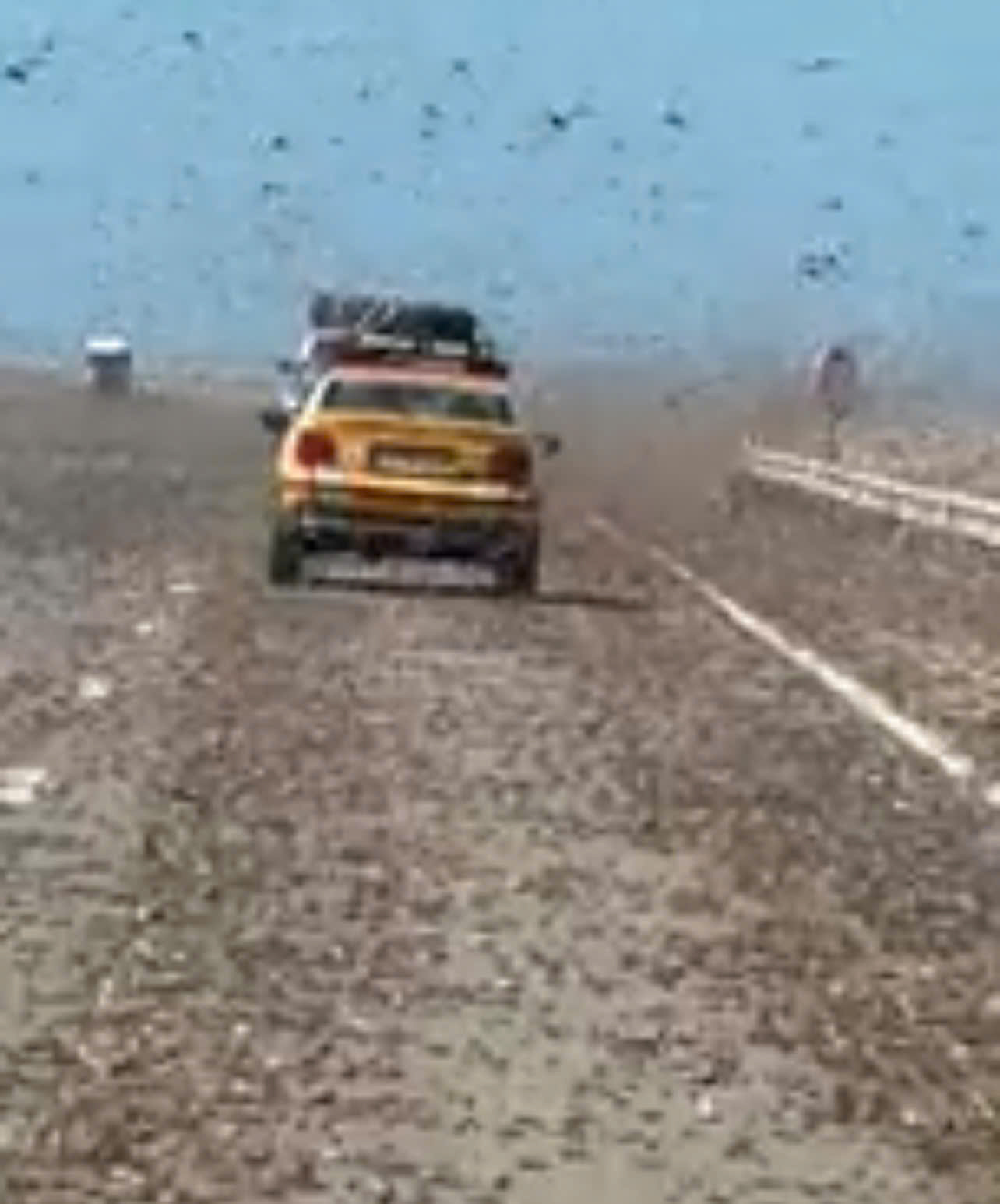 |
Moment locusts covered the entire road. Photo: Screenshot from video
The islands of Lanzarote, Tenerife, Gran Canaria, and Fuerteventura were inundated with short-horned locusts for several days. These pests, originating from the Sahara desert, were carried by wind and humid, mild weather conditions.
Lanzarote experienced severe impact, with insects appearing in areas including Arrecife, Costa Teguise, Famara, Uga, and Tahiche. Videos circulating on social media depicted skies darkened by locusts, creating a cinematic scene.
While not a direct threat to humans, locust swarms can cause significant damage to agriculture, particularly vineyards, if they develop into a large-scale plague.
 |
El Duque beach in Tenerife, one of the islands affected by the locust swarm. Photo: Adobe
According to the Food and Agriculture Organization of the United Nations (FAO), desert locusts are the world's most destructive migratory insects. A swarm spanning approximately 250 acres (over 101 hectares), equivalent to 80 million individuals, can consume enough food to sustain 35,000 people for one day.
The Canary Islands have experienced severe locust plagues in the past. In 1958, desert locusts from Africa devastated crops in Tenerife, forcing authorities to conduct aerial spraying, while residents used fire, noise, and poison bait to combat them. Four years prior, another outbreak destroyed approximately 10,000 hectares of crops in the region.
Tuan Anh (According to Storyful, New York Post)