On 17/12, several Korean newspapers, including The Chosun Daily and Jose Ilbo, reported that a Korean tourist was asked by Vietnamese airport security to leave a flight from Ho Chi Minh City to Busan. This occurred after he was accused of harassing a female passenger seated beside him on the aircraft.
A passenger on the flight reported the incident happened around 0:05 AM on 14/12. Initially, other passengers believed the victim was the male tourist's girlfriend. However, the female passenger's frightened demeanor exposed his actions. As the plane prepared for takeoff, security personnel and the flight crew requested the male passenger to vacate his seat and escorted him from the cabin.
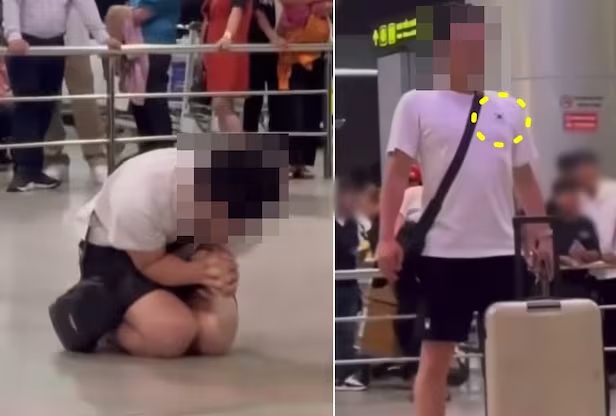 |
The male Korean tourist was asked to leave a flight from Vietnam to Busan on 14/12. Photo: chosun |
The incident caused a delay of over one hour. During this time, overhead baggage compartments were opened for inspection, impacting the schedules of many other passengers. According to Airportal data, flight VJ982 was scheduled to land at Gimhae airport, Busan, at 6:55 AM on 14/12, but arrived around 8:20 AM. The airline did not disclose the specific reason for the delay.
Videos showing the male tourist being pulled from his seat and removed from the cabin quickly circulated on social media platforms, drawing attention from online communities in Vietnam and Korea. Another video, filmed after he had left the plane with his carry-on luggage, showed him kneeling in a state of panic, clasping his hands in supplication, and speaking with ground staff.
Many online comments criticized the tourist's behavior, stating it affected the overall passenger experience and presented "a shameful image when traveling abroad." Some users suggested that such actions require strict handling to deter future incidents.
On Korean forums, many expressed disappointment regarding their compatriot's behavior. They also discussed how the flight crew and Vietnamese airport security handled the situation. Most agreed that the crew followed proper procedures, with some suggesting the need for enhanced guidelines on international passenger conduct during air travel.
Incidents involving disruptive passengers on flights are not uncommon, often requiring intervention from the flight crew or security forces. In february, Singapore Airlines flight SQ826 from Singapore to Shanghai faced an issue when a pair of passengers assaulted and verbally abused flight attendants. This led to their removal from the flight just before takeoff to ensure the safety of other passengers and the crew.
On 4/11, the Daily Mail reported that a woman was removed from HK Express flight UO559 from Da Nang to Hong Kong for continuously shouting and demanding to sit next to her boyfriend. On 18/12, a passenger on an Alaska Airlines flight from Deadhorse to Anchorage, Alaska, US, exhibited unusual behavior by attempting to open an emergency exit at an altitude of 11,000 m. After landing, US authorities arrested and charged the individual with interfering with flight crew duties, an offense that could carry a prison sentence of up to 20 years.
According to the Tokyo Convention of 1963, a United Nations international convention on offenses committed on aircraft, the aircraft commander and authorities at the landing location have the right to take necessary measures against disruptive passengers who threaten flight safety.
In Vietnam, the Civil Aviation Law stipulates that offending passengers may be forced to leave the aircraft, face administrative penalties, and be banned from air travel for three to twelve months. Serious cases may result in criminal liability.
Mai Phuong (According to The Chosun Daily, Jose Ilbo)