Quick navigation:
Getting there
Accommodation
Attractions
Cuisine
Suggested itinerary
Notes
Quynh Son community tourism village, located in Bac Son commune, Lang Son province, was recognized as the "Best Tourism Village 2025" by the United Nations World Tourism Organization (UN Tourism) last october. This model is highly regarded for its integration of sustainable rural tourism development with cultural and natural preservation, alongside improving the livelihoods of local residents.
The ideal time to visit Quynh Son is from july to october, when the valley's rice fields ripen to a golden color. During other times, the area offers fresh air and tranquil scenery.
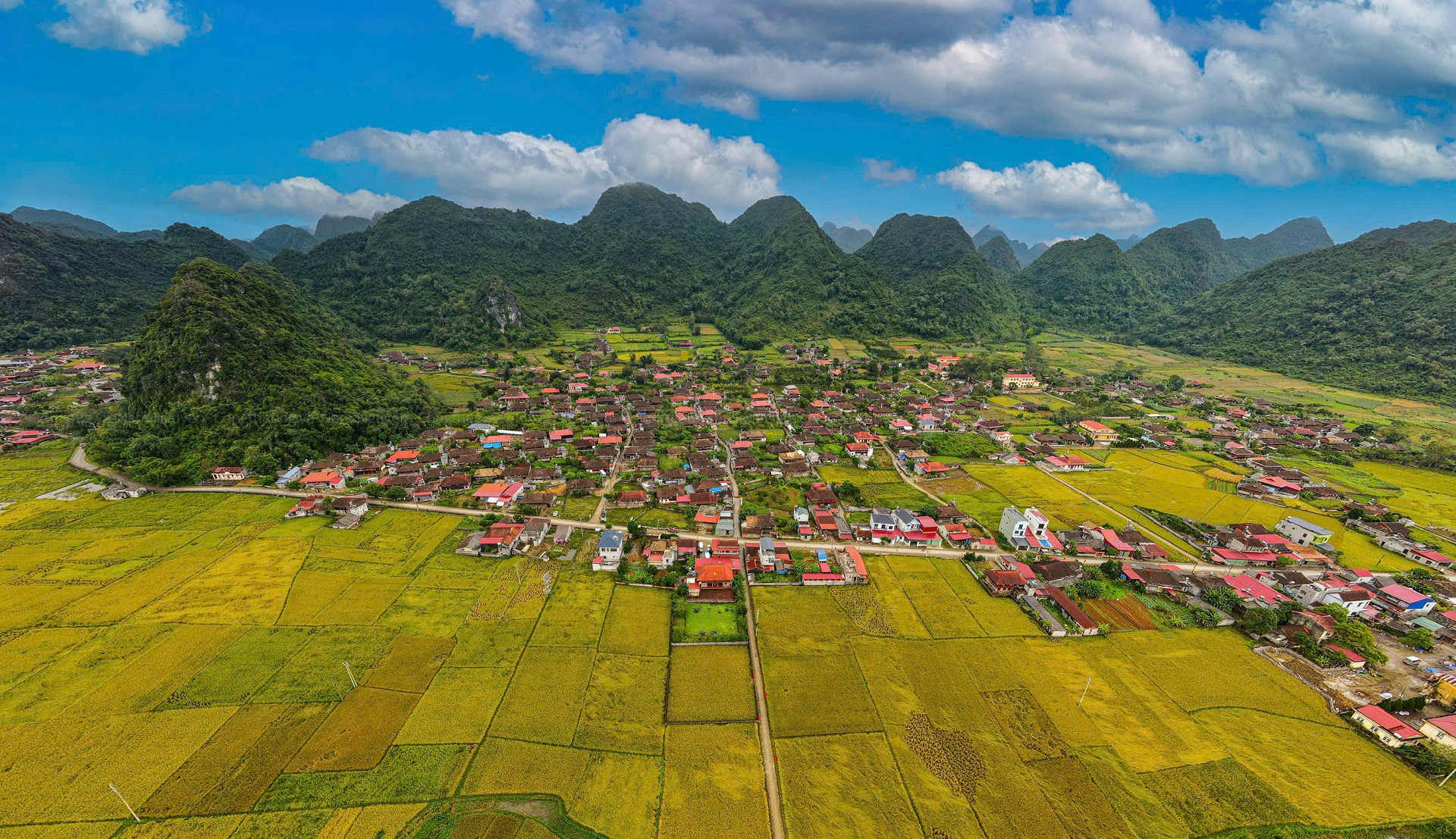 |
An overview of Quynh Son tourism village. Photo: Nam Nguyen |
Getting there
Quynh Son village is situated in the heart of the Bac Son valley, within the Bac Son Uprising Special National Relic site and a UNESCO Global Geopark. The village is approximately 170 km from Hanoi's center and 85 km from Lang Son's center. From Hanoi, traveling by oto is the most suitable option, taking about 3,5 to 4 hours via expressway CT01 then onto DT243, or via expressway CT07 and QL1B. The roads are convenient, and the scenery along the way is picturesque.
Accommodation
Currently, about 10 households in Quynh Son village operate homestays, all maintaining traditional stilt house architecture. Guests can live with local families and participate in farming and cooking activities. These accommodations meet basic standards and include places like Duong Cong Chich, Duong Cong Trong, Duong Cong Co, and Duong Dinh Hanh's houses. Visitors can choose between communal or private rooms, with prices ranging from 100,000-200,000 VND per night. Some homestays are also available for booking on Agoda and Booking.com.
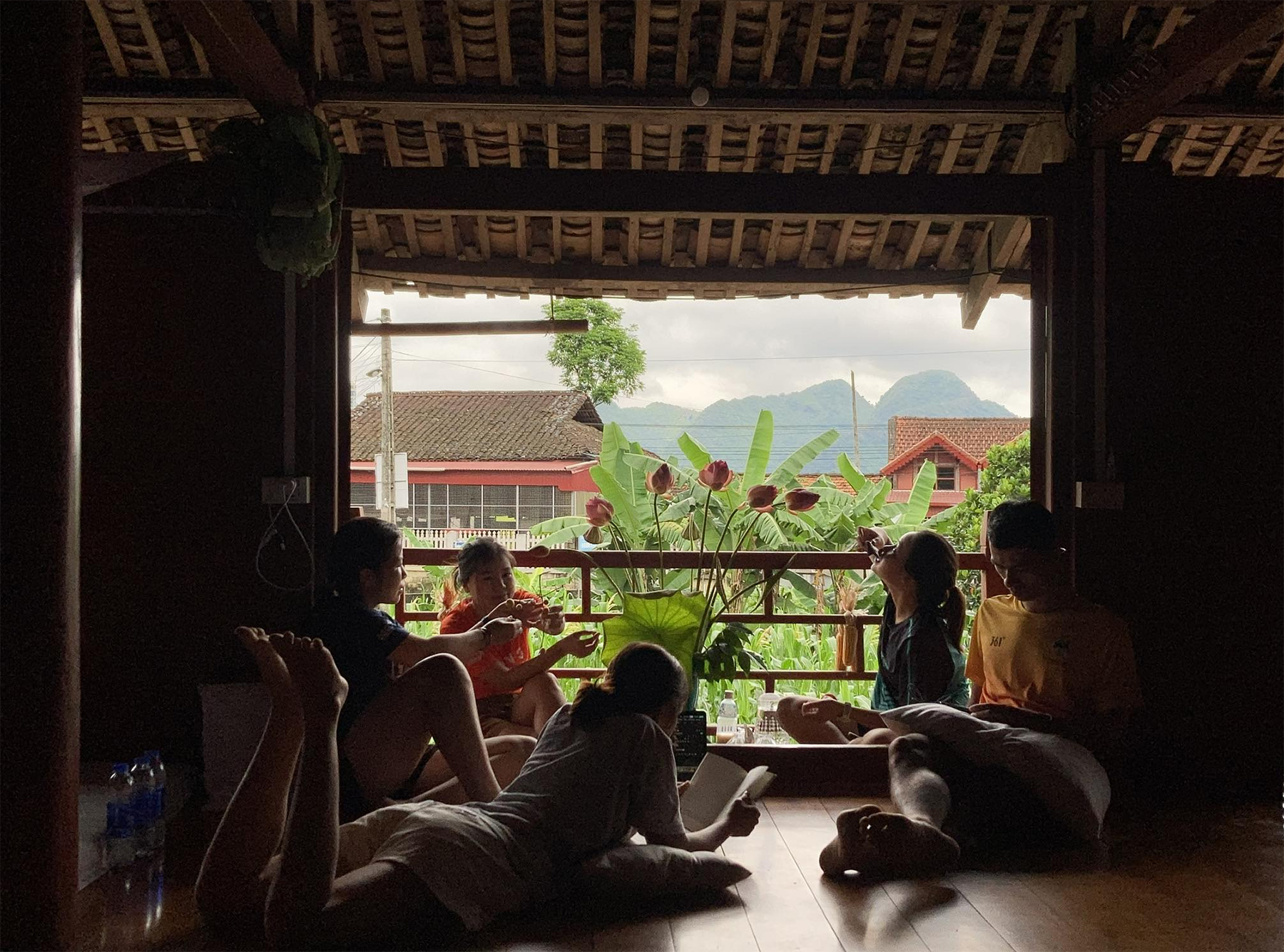 |
Inside a homestay in Quynh Son village. Photo: Le Thanh Hien
Attractions
Quynh Son is renowned for its beautiful natural scenery and rich cultural identity, especially the Tay culture, which is preserved and promoted in daily life. The village focuses on community-based tourism. Notable attractions and experiences include:
Historical sites
Bac Son served as a resistance base (Bac Son - Vo Nhai base), where the Bac Son Uprising against the Japanese and French colonialists by Viet Minh forces erupted in the 1940s. The Bac Son region is also where numerous prehistoric archaeological sites, representing the ancient Vietnamese civilization known as Bac Son culture, were discovered. Visitors can also explore the Bac Son Museum for a deeper understanding of the area's history.
Traditional stilt houses
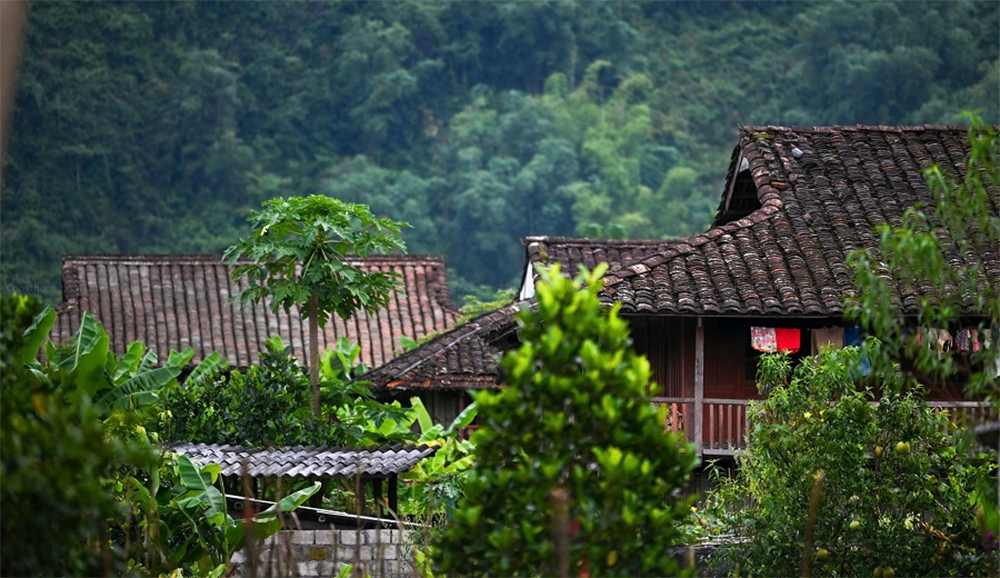 |
Stilt house with yin-yang tiled roof. Photo: Nam Nguyen
Quynh Son village features approximately 400 traditional stilt houses, many of which are hundreds of years old and have housed three to four generations. Over 90% of the residents share the Duong family name. Uniquely, all stilt houses face south, backed by rocky mountains, and are covered with yin-yang tiled roofs, each having three to five compartments. The Tay people believe that houses facing south bring vitality, luck, and prosperity. The yin-yang tiles keep the house cool in summer and warm in winter.
Visitors can walk or cycle around the village, passing through rice fields, admiring the majestic mountains, and enjoying the fresh air.
Na Lay mountain climb
Na Lay mountain, the "roof" of Bac Son commune, stands over 600 m high. It is an ideal spot for sunrise views and cloud hunting. To reach the summit, visitors must ascend 1,200 stone steps and navigate rugged paths. From the top, guests can admire the wild, majestic natural landscape and a panoramic view of Quynh Son village.
Tile-making village
Tile-making village in Quynh Son. Photo: Giang Ngoc
Just a few minutes from Quynh Son village, visitors can explore the traditional craft village that produces yin-yang tiles – the same type of tile used by locals for generations to roof their stilt houses. Here, guests learn about the eight steps involved in making these tiles: selecting and purifying clay, then fermenting, kneading, shaping, and firing them in a wood-fired kiln. The tiles are sun-dried naturally before being continuously fired for over 20 days. Each tile embodies the Tay people's yin-yang philosophy: one tile facing down, one facing up – symbolizing the harmony of heaven and earth.
Keng Tao cave
Keng Tao cave stretches 300 m long with a dome tens of meters high. It is a mixed cave featuring both dry and wet sections, adorned with natural stalactites. As visitors venture deeper, the cave widens, offering cool air with temperatures around 18 to 20 degrees C. An underground stream flows along the cave floor. Keng Tao cave has been equipped with lighting, signposts, and walkways to ensure visitor safety.
Golden rice season festival
Every november, the golden rice season festival is held, featuring activities such as rice harvesting competitions, rice pounding, and black banh chung making. Teams compete to harvest rice with sickles, thresh rice with traditional tools, and bundle straw in the fields, all while wearing traditional ethnic attire. Organizers judge based on criteria such as grain yield, clean rice free of straw, and beautifully bundled straw. The team with the highest score wins.
Ra Rieng bridge
Beside the stream flowing through the fields of Quynh Son commune lies the Ra Rieng bridge relic. Before the 1940s, this was a wooden bridge spanning the stream, covered with a thatched roof. In preparation for the Bac Son Uprising, on a night in september 1940, Bac Son guerrillas ambushed a convoy of weapons and provisions belonging to the French colonialists passing through, setting the bridge on fire. They seized many weapons, contributing to the victory of the attack on Mo Nhai post on 27/9/1940, which was the opening victory of the Bac Son Uprising movement.
Experience traditional Tay culture
In the evening, visitors can participate in bonfires, enjoy traditional Tay "Then" folk songs, and listen to the "tinh" lute.
Additionally, visitors can engage in activities such as visiting Quynh Son communal house, paddleboarding on the river, or paragliding for aerial views of the valley.
Cuisine
Tay cuisine in Quynh Son is quite appealing, featuring dishes like black banh chung, roasted pork/duck, khau nhuc, lap suon (sausage), banh ngai (wormwood cake), xoi cam (purple sticky rice), Bac Son golden tangerines, and corn wine fermented with leaves.
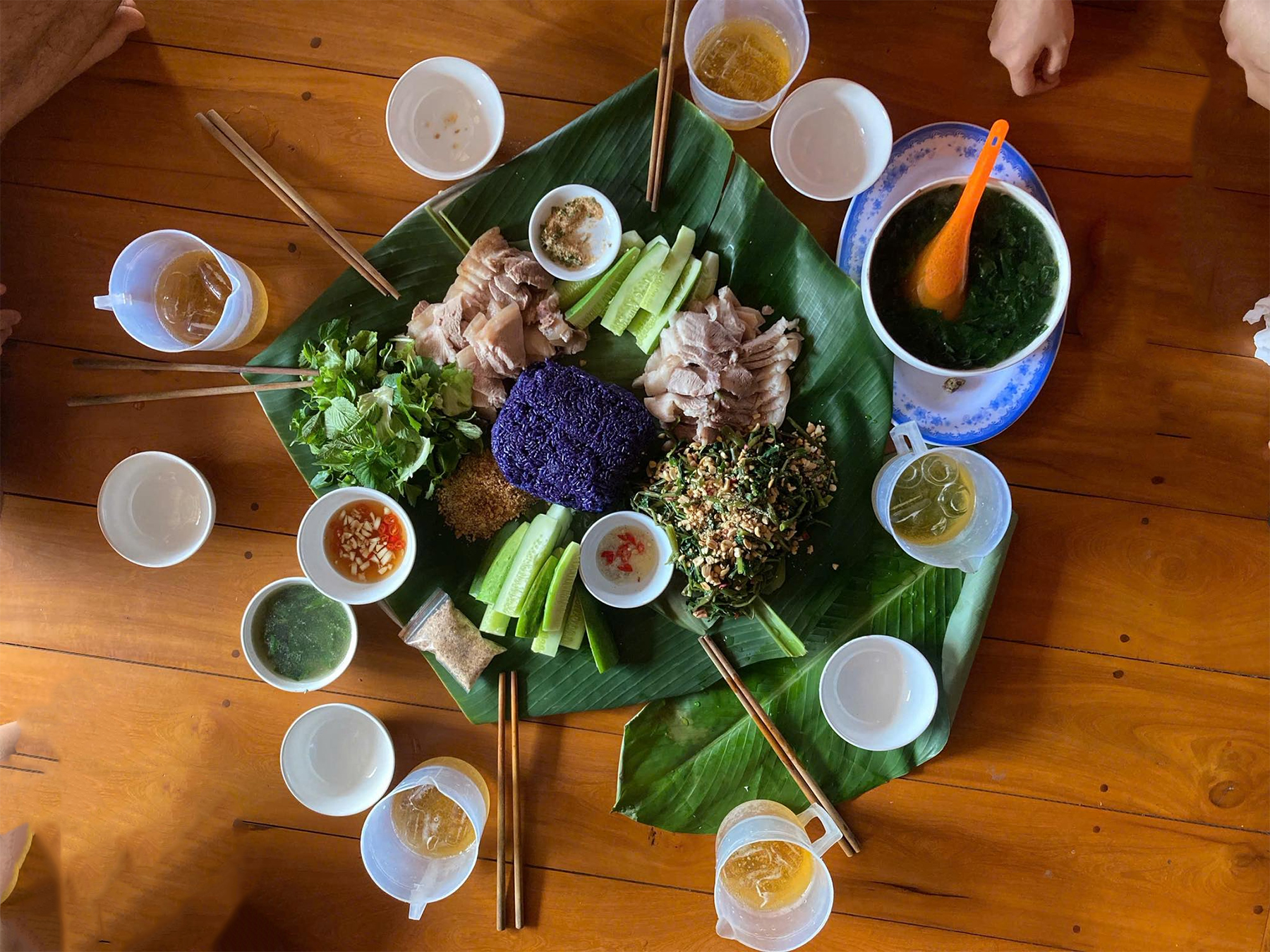 |
A simple meal with many traditional dishes at a homestay in Quynh Son. Photo: Thanh Hien
Black banh chung
Glutinous rice is soaked in a special ash water to give the banh chung its black color and aroma, with cardamom added to the filling. Black banh chung has a fragrant, chewy texture and is easy to digest. Locals consume this cake most frequently during Tet (Lunar New Year). Besides boiled black banh chung, visitors can also enjoy it grilled over charcoal.
Xoi cam (purple sticky rice)
One of the rustic and famous dishes of the Bac Son mountainous region is xoi cam. This common and easy-to-make dish is an essential part of festive meals and Tet celebrations. Xoi cam is made from the best glutinous rice of the season, soaked in cam leaf water, then drained and steamed. Xoi cam is typically served with boiled chicken or roasted peanuts with salt.
Grilled meat in bamboo tubes
This dish uses fresh pork shoulder or belly, marinated with spices like mountain ginger, salt, MSG, and pepper, then stuffed into bamboo tubes and grilled. Once cooked, the meat has a distinct ginger aroma; each piece is tender, and the retained juices give the meat a sweet, slightly spicy flavor.
Lap suon (sausage)
This dish is distinctive for the fragrant flavor of Bac Son mountain ginger, a spice that also helps preserve the food longer and enhances its color, making it suitable for winter weather. There are various ways to prepare lap suon, including frying, grilling, deep-frying, or stir-frying with fresh garlic leaves.
Tangerines
Towards the end of the year, tangerines often appear as dessert in village meals. This variety of tangerine grows in mountain crevices, has thin skin, and a golden color. When peeled, the skin emits a distinctive fragrance. The tangerines are not overly sweet, with a light, refreshing tartness. Visitors can pick the fruit themselves when visiting local tangerine gardens.
Suggested itinerary
Visitors should combine a trip to Quynh Son with Huu Lung and Dong Lam, other famous destinations in Lang Son, for a three-day, two-night itinerary. If visiting only Quynh Son, a two-day trip is suitable. Travelers can use motorbikes, private otos, limousines, or coaches.
 |
Quynh Son village seen from above. Photo: Giang Ngoc
Day 1: Travel from Hanoi to Quynh Son, go hiking in the hamlet, and visit the Bac Son Museum. Typical dishes to try: khau nhuc, roasted duck, hill chicken stewed with ginger, grilled stream fish, banh chung cam, and banh ngai.
Day 2: Visit Na Lay mountain, have breakfast with special banh cuon, then travel to Huu Lung, approximately 40 km away.
Day 3: Explore Huu Lung and Dong Lam steppe, go rafting or enjoy the steppe (depending on the season). Return to Hanoi in the late afternoon or evening.
Notes
Quynh Son village currently does not have luxury resorts or high-end hotels. The village focuses on cultural experiences and nature conservation, so amenities are modest.
The time to reach the summit of Na Lay mountain ranges from 30 minutes to one hour, depending on individual fitness. Visitors who are less active should prepare appropriate footwear and gear, and be cautious when moving in the rain as paths can be slippery.
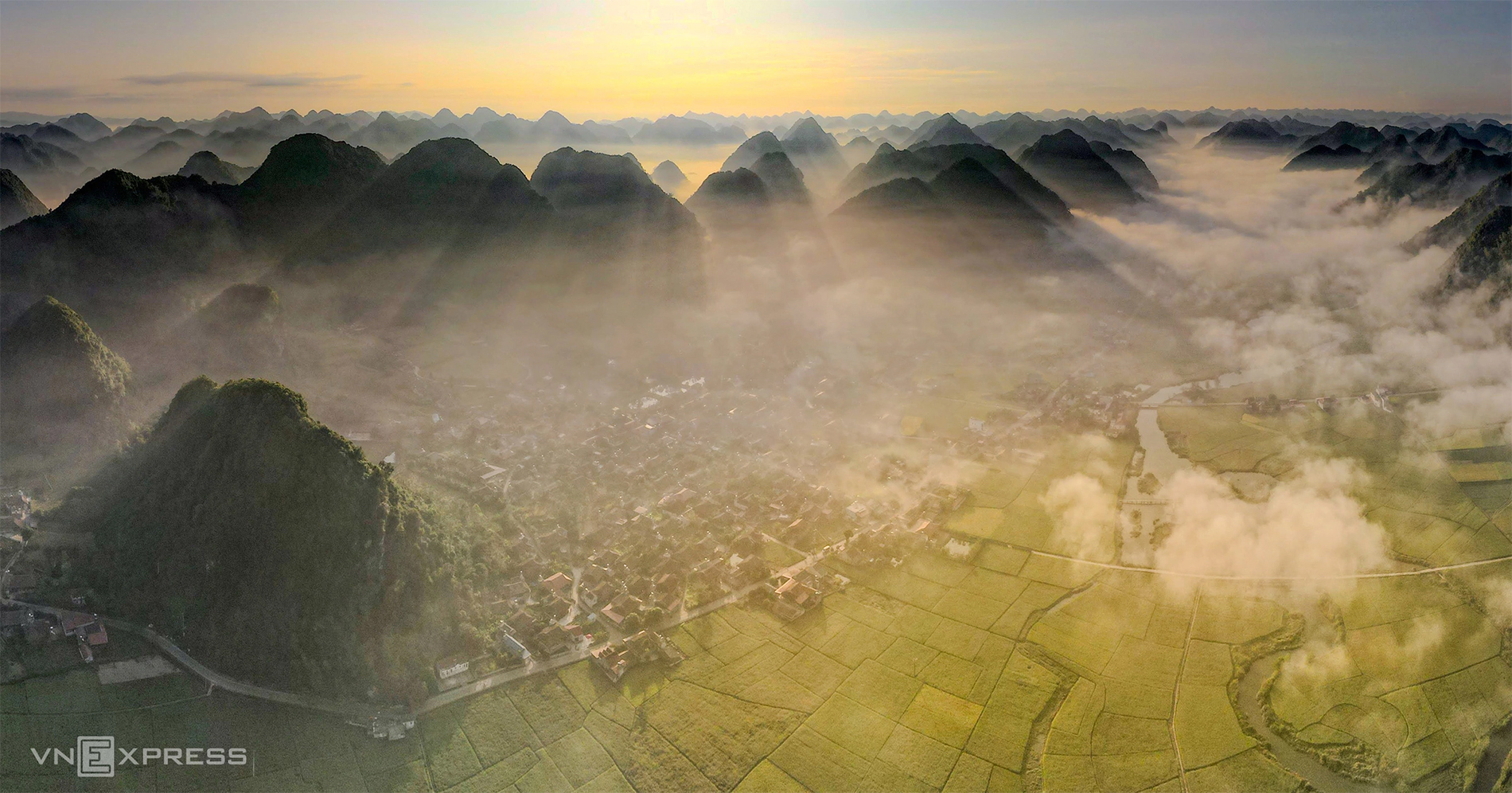 |
Quynh Son village at dawn. Photo: Giang Ngoc
Tam Anh