About 24 km north of Ecuador's capital, Quito, visitors can find the Mitad del Mundo (Middle of the Earth) monument. A yellow painted line runs along the walkway, dividing the structure and marking the 0-degree latitude line. This is how Ecuador proudly showcases its most unique feature to the world: the equator.
The equator is an imaginary line of latitude encircling the Earth's circumference at 0 degrees latitude. It is equidistant from both the North and South Poles, serving as the boundary that divides the planet into the Northern and Southern Hemispheres.
The first scientific measurement of the equator was conducted by a team of French and Spanish scientists during an 18th-century expedition. Led by Charles Marie de La Condamine, Pierre Bouguer, and Louis Godin, they departed from France in 1735, arriving in Quito in 1736 after traveling through Colombia and Panama.
After many years of persistent measurement using triangulation, they proved that Earth is not a perfect sphere but bulges at the equator and is slightly flattened at the poles. They identified the location of the equator, a line over 40,000 km long that circles Earth's circumference at 0 degrees latitude, equidistant from the north and south poles. The Mitad del Mundo monument was also erected to commemorate this expedition.
Vlogger Joe HaTTab once visited "Middle of the Earth" and was surprised when a guide demonstrated several unusual phenomena unique to the location. In this area, anyone can become an "egg master" by easily balancing an egg upright without support.
Additionally, when flushed, water drains straight down, without swirling clockwise as it would north of the equator or counter-clockwise south of the equator. This is known as the Coriolis effect, a result of Earth's rotation and curvature. Objects moving freely in the Northern Hemisphere tend to deflect to the right, and in the Southern Hemisphere, they deflect to the left. At 0 degrees latitude, this effect does not occur. This is why tropical storms weaken and dissipate when they move too close to the equator.
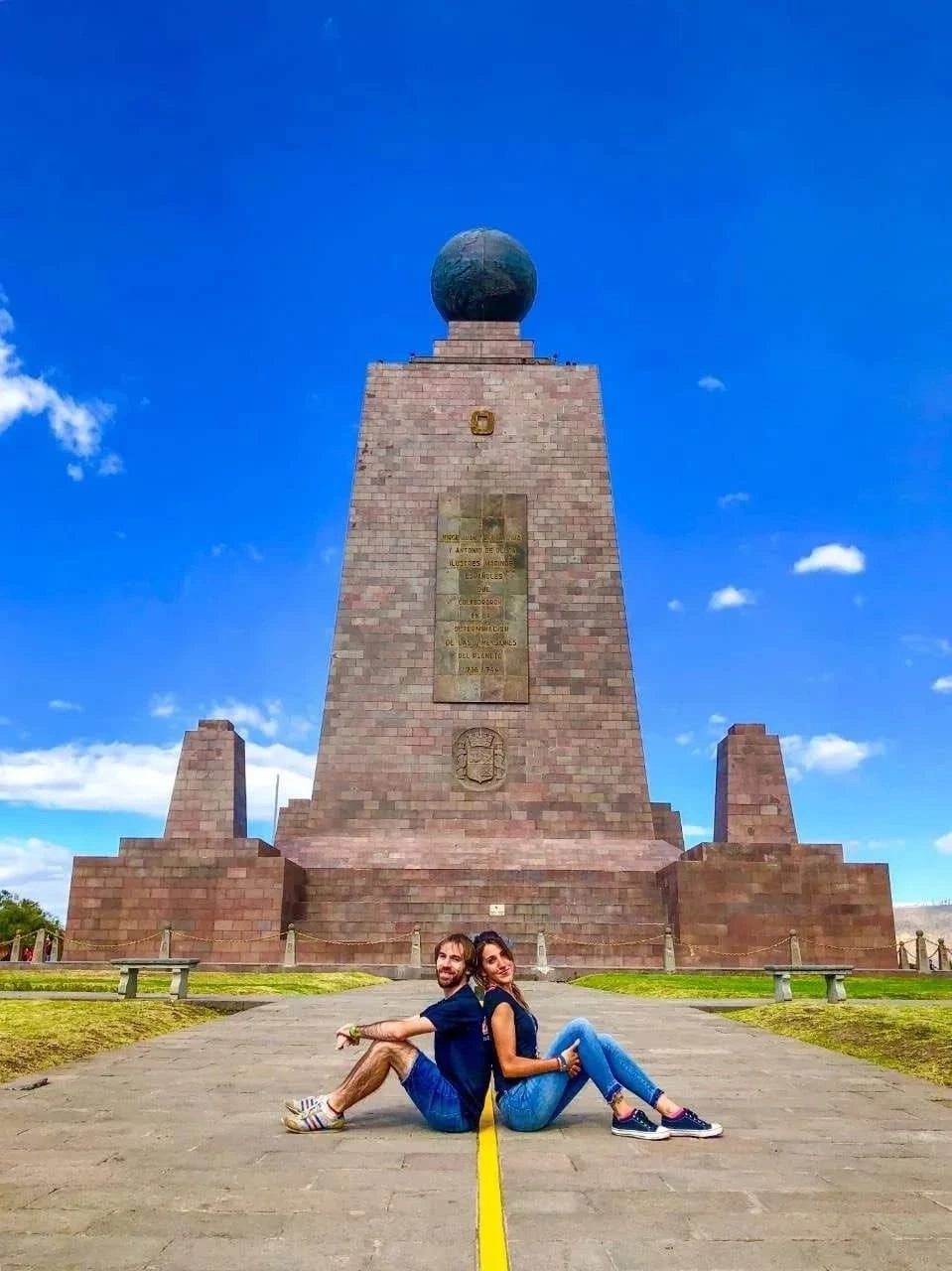 |
The yellow painted line in front of the Mitad del Mundo monument. Photo: Quito Bus |
According to Lonely Planet, later measurements using modern GPS technology indicate that the actual equator is located approximately 240 m north of the monument. However, some scientists argue that the equator should be visualized as a wide strip spanning kilometers, due to the fact that the north and south poles are not entirely fixed. Furthermore, some scientists suggest that the Coriolis effect is difficult to demonstrate accurately with draining water experiments.
Despite ongoing debates surrounding the designation "Middle of the Earth", it remains a popular tourist destination in Ecuador.
Visitors should also consider visiting the Intinan Solar Museum, less than a 10-minute walk from Ciudad Mitad del Mundo. The museum's founders claim this to be the authentic location of the equator. The museum features interactive exhibits and outdoor activities based on equatorial scientific phenomena.
Hoai Anh (According to Joe HaTTab, Smithsonian, Lonely Planet)