In its guide to traveling in Vietnam, leading global travel magazine Lonely Planet reviews various modes of transport, including trains, boats, motorbikes, bicycles, passenger buses, and airplanes, offering detailed insights and advice. While highlighting the limitations of buses and flights, the Australian magazine praises bicycles and trains.
passenger buses: frequent stops and slow speeds
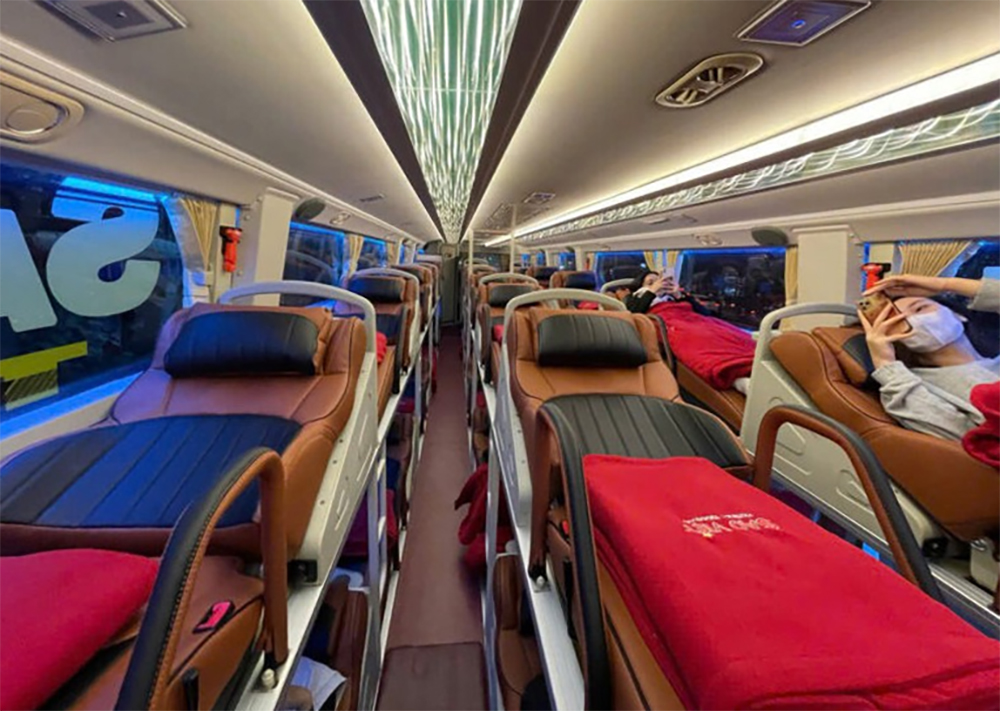 |
Sleeper buses often offer good quality. Photo: Chinhphu.vn |
Traveling by passenger bus between major cities is convenient and comfortable, but in remote areas, services are often slow and crowded. Despite these drawbacks, buses remain a low-cost option.
In popular tourist destinations like Hanoi and Ho Chi Minh City, you will find many "Open Tour" signs for buses operating fixed routes between major cities, allowing passengers to board and alight freely. Buses typically depart from designated stations. Most stations sell tickets, with prices and schedules clearly displayed. To secure a seat (especially during holidays like Tet), it is advisable to purchase tickets at least one day in advance. In major cities, bus stations are often located far from the city center. It is recommended to ask your hotel or locals for the nearest pick-up point.
Bus companies vary in quality. Premium options include inter-provincial sleeper buses, which make fewer stops and feature deeply reclining seats or even bunk beds. However, passengers should bring earplugs, as most trips involve karaoke or martial arts films.
In remote areas, many buses frequently stop to pick up and drop off passengers at various points, extending travel times. Buses are often packed with both passengers and goods. Travel speeds in some areas are low, averaging around 50 km/h or even slower due to heavy traffic from motorbikes, trucks, pedestrians, and livestock. "Do not expect to travel as quickly as in Europe or the US," Lonely Planet notes.
Domestic flights are often delayed
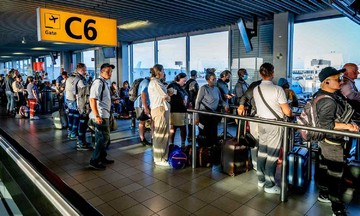
If you have limited time, domestic flights offer the quickest way to travel. However, cancellations and delays are common. To avoid the risk of missing connecting international flights, passengers should not book domestic flights too close to their international departure time; it is best to depart one day earlier.
The Vietnamese market currently features airlines such as Vietnam Airlines, Vietjet Air, Bamboo Airways, and Pacific Airlines. Vietnam Airlines offers stable flight schedules, while Vietjet Air provides cheaper fares but has a higher frequency of schedule changes. For important journeys or international connections, passengers should prioritize choosing Vietnam Airlines or Bamboo Airways.
Motorbikes are only for brave travelers
Riding a motorbike across Vietnam is a dream for many backpackers. However, traffic conditions are not suitable for inexperienced riders. The Northwest region presents challenges with steep passes and continuous sharp turns. Travelers need a powerful motorbike (at least 150 cc) to navigate slopes and potholes. In coastal areas or major tourist spots like Hoi An, Nha Trang, Mui Ne, and Da Lat, you can rent a scooter or a light manual motorbike for approximately 200,000 to 300,000 VND per day.
Motorbike rentals are often based on verbal agreements, and the owner typically holds the customer's passport. Travelers should seek out professional rental services that offer insurance and clear contracts, and always wear a helmet to avoid fines. If a customer does not possess a valid motorbike license (A1/A2 or an International Driving Permit IDP 1968), travel insurance will refuse coverage in the event of an accident. Many tourists still take the risk, but it is a gamble. If you are not confident, consider hiring a local driver.
Negotiate cyclo fares for city rides
Buses are an inexpensive public transport option in city centers, but routes can be complex, and pickpocketing may occur. For more comfort, travelers should opt for reputable taxi companies or book ride-hailing services (cars and motorbikes) through apps like Grab, Xanh SM, or Be.
A more interesting way to explore the city is by cyclo, although these vehicles are becoming increasingly rare. It is advisable to negotiate the fare beforehand. For quicker travel, tourists can try a xe om (motorbike taxi). Drivers are adept at navigating through dense city traffic; passengers must hold their luggage on their lap or wear it on their back.
Cycling to explore village roads
 |
Tourists cycling on a village road. Photo: Chay Lap Farmstay |
Cycling is a pleasant way to travel in Vietnam, especially on quiet, flat rural roads. Bicycles can be rented from hotels and tour companies anywhere, but quality varies greatly. For long-distance trips, travelers should join organized cycling tours or book with specialized cycling tour companies such as Vietnam Cycling or Indochina Bike Tours. You can also transport bicycles on the roof of a bus or send them by train.
Thong Nhat train for cross-Vietnam travelers
The Thong Nhat train is ideal for tourists wishing to visit both Hanoi and Ho Chi Minh City, along with beautiful destinations in Central Vietnam. Vietnam's main railway line runs along the coast, connecting these two bustling cities, and stops at nearly every desired location. Travelers can choose an overnight journey to sleep on the train and arrive in the morning, saving on a hotel night while enjoying scenic views along the way. In addition to the main North-South route, there are also train services from Hanoi to Hai Phong, Lao Cai, or into China towards Kunming and Nanning.
Boat travel to islands or Mekong exploration
Vietnam has many rivers and islands. The largest river system is the Mekong. Locals use boats for transportation throughout the region. Additionally, travelers can take sea routes departing from Ho Chi Minh City, Hoi An, Nha Trang, Da Nang, Hue, and Ninh Binh, with diverse destinations such as Phu Quoc island, Cu Lao Cham, Ha Long Bay, Bai Tu Long, and Con Dao. Sea travel may be disrupted during typhoon season, which runs from may to december. Travelers should regularly monitor weather forecasts and have contingency plans.
Tam Anh (according to Lonely Planet)