At 5 a.m. on a monday in early September, Ben Vos's phone rang. On the other end, air traffic control at Amsterdam Schiphol Airport reported that a passenger on a flight from Asia had died of a heart attack. Vos, the mortuary coordinator at Mortuarium Schiphol (MOS), immediately began a familiar yet demanding process: handling the body directly at the airport.
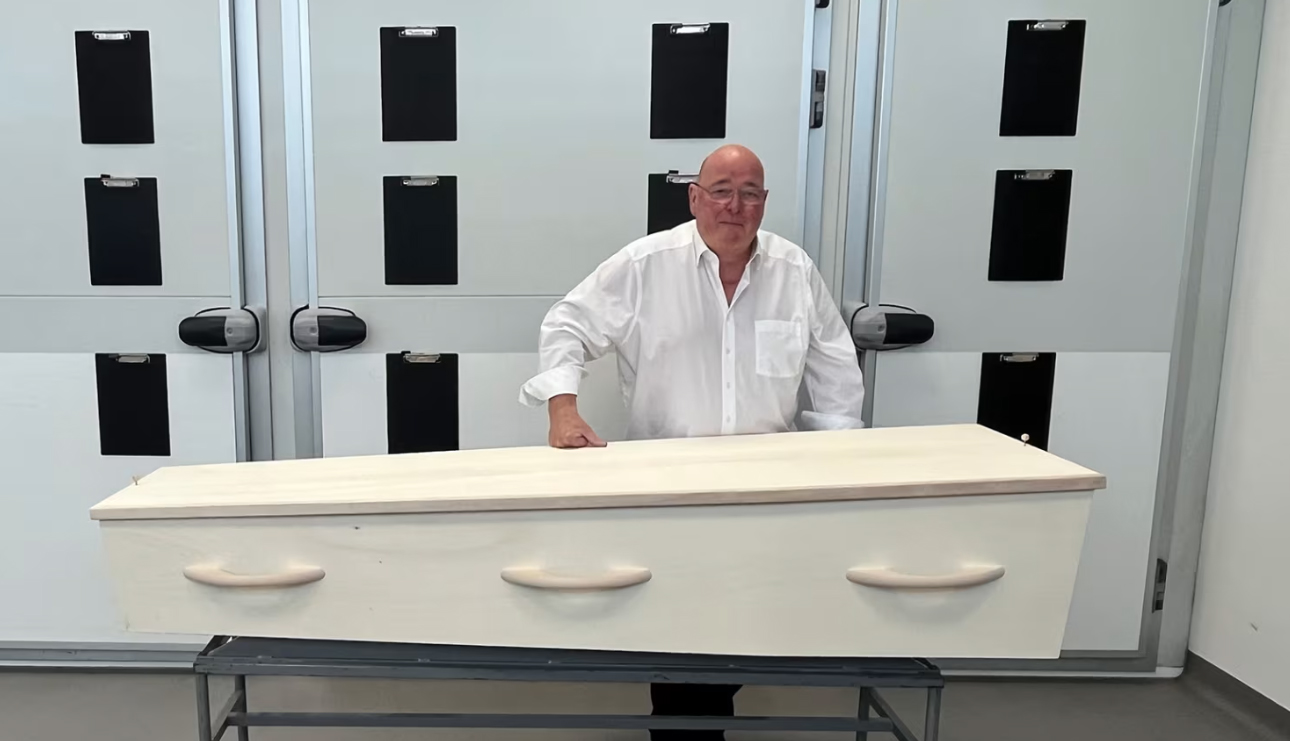 |
Ben Vos next to an empty coffin at his workplace near the Dutch airport. Photo: CNN |
Ben Vos next to an empty coffin at his workplace near the Dutch airport. Photo: CNN
When the plane landed at 6 a.m., Vos, along with border control and forensic examiners, boarded the aircraft after other passengers had disembarked. To ensure privacy, the body was placed in a specialized bag, moved through a rear emergency exit, and immediately transferred to a vehicle parked next to the plane. The entire process was discreetly managed, avoiding the attention of passengers in the terminal.
Vos and his three staff members at Mortuarium Schiphol are specially trained to handle this procedure, known in the industry as "repatriation of remains" (RMR). Every department at the airport "takes care of every small detail", and his team is no exception.
MOS, which began operations in 1997, is the world's first full-service airport mortuary. Located not far from the departure gates, the facility spans 900 square meters and includes an embalming room, an area for religious washing of bodies, and a viewing room. Its cold storage facility can accommodate 36 bodies, maintained at 4 degrees Celsius, and can expand to 400 spaces in an emergency.
The work of the MOS team, known as "repatriation of remains" (RMR), involves handling approximately 2,500 cases annually. These include foreign nationals who die in the Netherlands and Dutch citizens who pass away abroad. Winter is often the peak season, as many older tourists encounter incidents at warm holiday destinations such as Spain or Portugal.
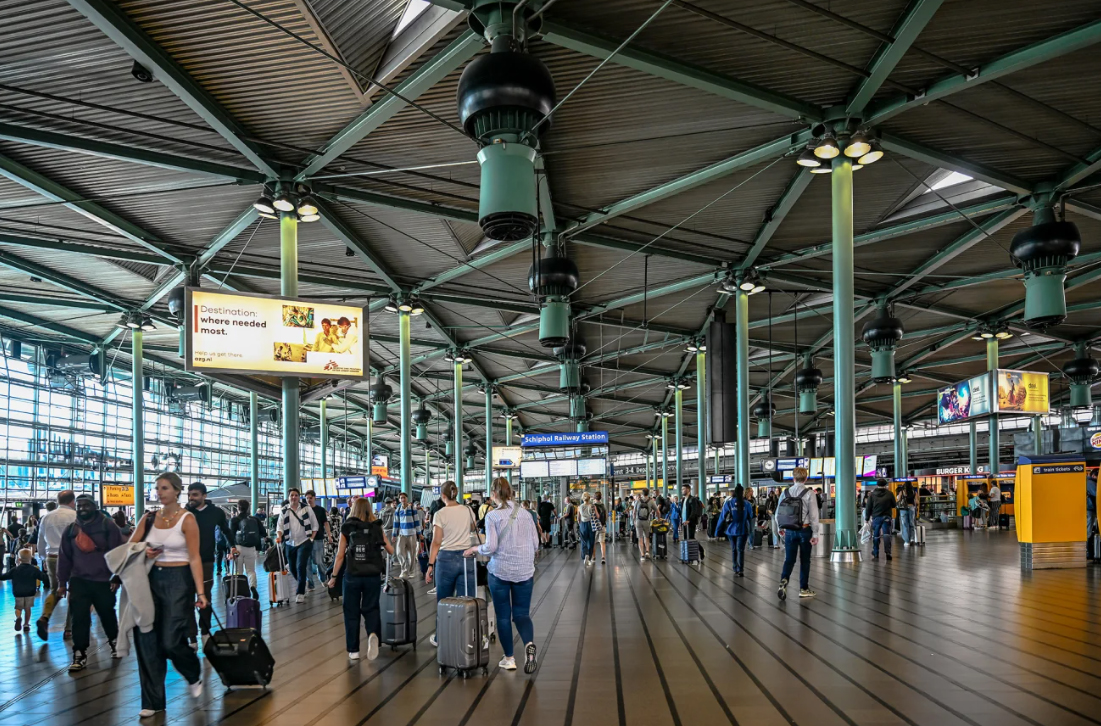 |
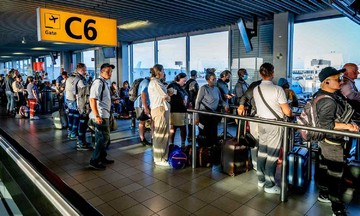
Amsterdam Schiphol Airport, Netherlands. Photo: CNN |
Amsterdam Schiphol Airport, Netherlands. Photo: CNN
Vos and his team skillfully manage the RMR process, which requires many strict procedures. They receive transit bodies, prepare bodies for departure from the Netherlands, or arrange transport within a 1,600 km radius. They collaborate with doctors, airlines, airport control, examiners, government agencies, and embassies to obtain death certificates and customs declarations. They also coordinate with embalming teams from various countries, including the US, and tissue donation organizations (eyes and skin are taken at MOS, internal organs at medical facilities). MOS does not have a crematorium but connects families with service providers.
The mortuary operates 24/7 with at least two staff members on duty, because "death never waits". Vos is accustomed to answering calls at any time.
Vos's team is familiar with diverse multicultural funeral rites, working alongside priests, rabbis, monks, and Schiphol Airport to support relatives from around the world.
One of the most memorable ceremonies for Vos involved the Surinamese community, a South American country that was once a Dutch colony.
"There was a brass band and drums. They sang, cried, laughed, drank. They arrived at 10 a.m. and stayed for four to five hours. They celebrated the life of the deceased and sent them off. It was very moving", Vos said.
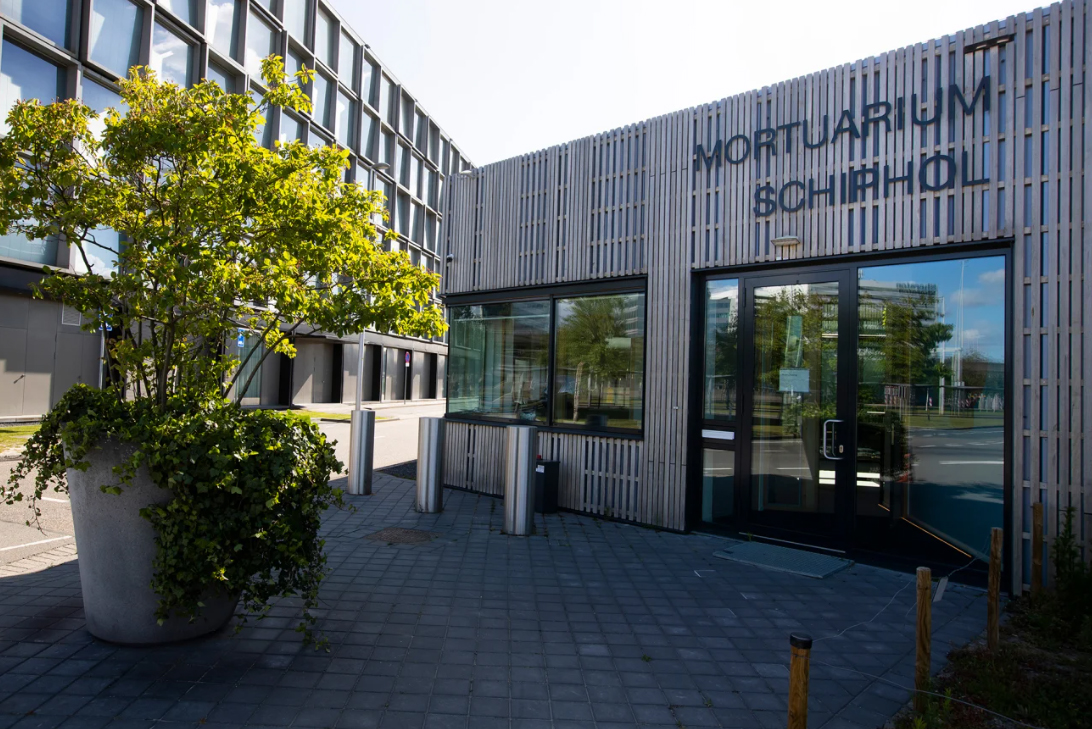 |
Vos's workplace in the Netherlands. Photo: CNN |
Vos's workplace in the Netherlands. Photo: CNN
There is no universal law for transporting human remains across borders. Airlines, medical regulations, and industry standards, both from the place of death and the final destination, collectively determine the process. However, in 1937, the first multinational treaty establishing standards for the transport of bodies, the Berlin Agreement (International Arrangement concerning the Conveyance of Corpses), was signed.
This agreement created a special document for the deceased, a laissez-passer, commonly referred to as a "mortuary passport", which includes the full name and cause of death. It also set requirements for coffins, such as minimum thickness and waterproof capability. In 1973, the Council of Europe updated and simplified the Berlin Agreement into the Strasbourg Agreement on the Transfer of Corpses.
Elements like the laissez-passer are still used today, though the aviation industry primarily adheres to procedures and guidelines issued by the International Air Transport Association (IATA). One such document is the Manual for Compassionate Travel, first published in 2019.
The manual, priced at USD 167, is updated annually and includes specific RMR requirements for each country, along with procedures for funeral industry professionals. In accordance with many government regulations, IATA guidelines require bodies to be placed in sealed bags. Previously, zinc-lined coffins, which are heavier and more expensive, were commonly used.
MOS can provide coffins. Over a dozen simple coffins, some made of poplar wood, others of plywood, lean against a wall in a back room. For incoming coffins, all MOS staff hold air cargo security certification, allowing them to conduct mandatory security checks to ensure the coffin contains only the body and no prohibited items.
In the final steps before a body leaves MOS, all paperwork is re-checked, and Vos or a team member will close the coffin lid. The coffin is then sealed with a red wax stamp bearing the mortuary's unique emblem, which also confirms the completeness of the documentation. If the body is transported by plane, MOS staff wrap the coffin in a thick black plastic layer for protection and to ensure the journey through the cargo hold is as discreet as possible.
The cost of RMR is substantial. According to De Luca, expenses typically range from 5,000 to 10,000 euros. Reputable travel insurance companies often cover RMR-related claims. However, Jeff Rolander, Vice President of Claims at US-based travel insurance company Faye, advises buyers to carefully read policy details to ensure RMR is included, usually under medical evacuation benefits.
This benefit may be part of medical evacuation or listed separately, but according to Rolander, the keyword travelers need to look for is repatriation of remains.
Experts also recommend that travelers truthfully declare their medical history when purchasing insurance. "Unfortunately, some claims are denied because the buyer did not declare pre-existing conditions", said Brett Wheatley, Executive President of Global 24 Advisory and Assistance, an emergency medical assistance company based in Australia and Thailand. It is crucial for travelers to understand what they have purchased, what benefits they are entitled to, and what factors might invalidate coverage in the event of a serious incident.
"I always say buy insurance before you travel the world", Vos said.
Vos's work is not always smooth. While most workdays follow familiar routines, Vos and his team occasionally encounter unique situations. One such challenge involves the repatriation of asylum seekers, who may lack passports or identification documents, or individuals from countries with stringent government procedures.
Repatriating bodies to Russia often takes longer due to complex and costly embassy approval procedures and paperwork, Vos noted. Coupled with airspace restrictions over Russia, the entire process can extend to 10-12 days, instead of the typical two to three days for many other countries.
Other cases involve suspected murder or criminal acts. MOS has a dedicated autopsy room for forensic investigations, and occasionally, reporters appear at the mortuary seeking leads. Vos recalled one instance, during a high-profile case involving a Dutch citizen who died abroad, where about 200 people waited outside the doors for information.
In such situations, he contacts the Marechaussee (Royal Netherlands Marechaussee) for assistance in dispersing the crowd from the area; they typically arrive within two minutes.
Social media also presents its own challenges. MOS has a TikTok account, posting about a dozen videos documenting employees' daily work: receiving bodies, sealing coffins, and moving the deceased into cold storage. In these videos, no identifying information such as documents, faces, or clothing appears. In the comments section, many people express genuine curiosity and gratitude.
However, some videos caused a stir in late 2024 when several clips featured a former MOS employee who had participated in the Dutch version of the reality TV show "Love Island". This led to numerous curious individuals flocking to the mortuary to see firsthand what they had seen online.
As a result, Vos had to act as a security guard again. "I told them this is not Efteling", he said, referring to the famous amusement park in the southern Netherlands.
Throughout his 35 years of work, Vos says the greatest compliment he can receive is the feeling of knowing that he and his team have helped alleviate some of the pain during one of the most difficult moments in many people's lives.
Anh Minh (According to CNN)