A Boeing 767-300 cargo plane operating for Amazon, originating from San Juan, Puerto Rico, skidded off the runway while landing at Miami international airport, Florida, on the afternoon of 6/9.
The aircraft careened across the grass at the end of the runway, crashing into a van carrying seven cleaning company employees. It then breached the airport fence and struck an SUV on a public road outside. The force of the impact trapped the two pilots in the cockpit as the plane came to a halt.
"I must describe it as an absolutely catastrophic accident," Jennifer Homendy, chair of the national transportation safety board (NTSB), stated on 7/9, adding that at least five people died and five were injured in the incident.
Homendy noted that U.S. officials have launched an investigation into the cause of the accident, examining factors such as speed, weather conditions, and airport infrastructure. This is particularly relevant as video footage of the landing raises questions about the aircraft's unusual state before it veered off the runway.
Moment the Amazon cargo plane landed at Miami airport on 6/9. Video: X/Combat_learjet
Based on witness video, experienced pilots observed the aircraft approaching the runway at over 330 km/h, significantly higher than the normal range of 240-296 km/h.
"With that kind of speed on approach, the pilot should have opted to abort the landing, climb, and go around. It had to go around," Bob Thomas, a commercial pilot with 43 years of experience, told the Miami Herald.
The flight, operated by Amazon, was flown by 21 Air, a cargo airline based in North Carolina. According to Flightradar24, the aircraft involved was 32 years old, initially operating as a passenger plane from 1994-2015 before being converted for cargo use.
Mary Schiavo, a former inspector general for the U.S. Department of Transportation, stated that the NTSB will thoroughly examine the aircraft's maintenance history, particularly since it was previously owned by multiple foreign entities.
Former American Airlines captain Steve Scheibner echoed pilot Thomas's assessment. He estimated the aircraft landed approximately 55-65 km/h faster than appropriate. Scheibner also highlighted the condition of the aircraft's spoilers.
Spoilers are located on the main wing surface and typically deploy upon touchdown. This component reduces lift while increasing downward pressure on the runway, enhancing tire grip and assisting the braking system during deceleration.
According to Scheibner, the spoilers on the accident Boeing 767-300 did not appear to be raised during landing. He also suggested that the nose landing gear seemed to touch the runway first, while the left main gear did not immediately make full contact. By the time the left gear touched down, the aircraft had only about 790 m of runway remaining and was still traveling at high speed.
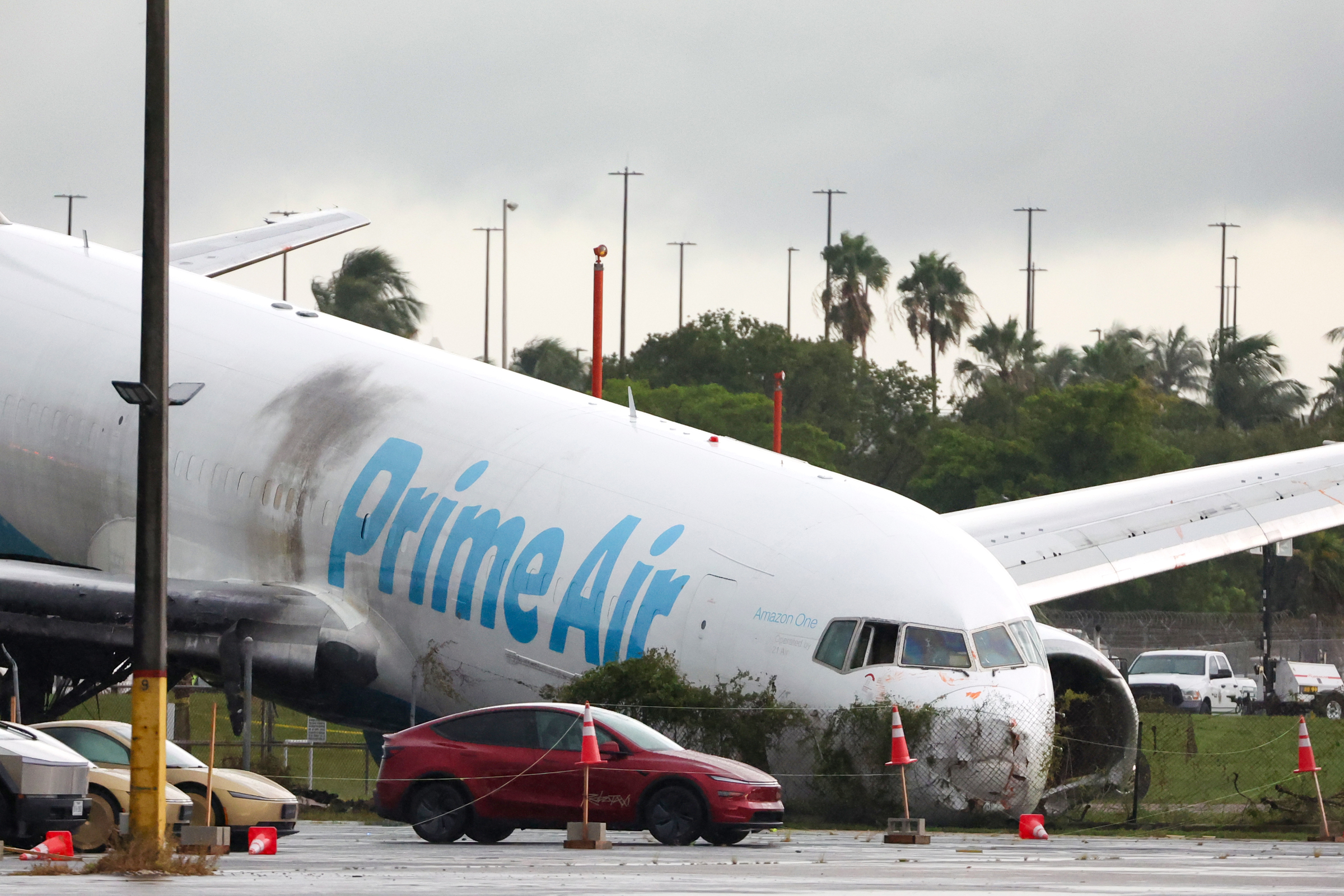 |
Amazon cargo plane at Miami international airport after overrunning the runway on 7/9. Photo: AP
It remains unclear where the aircraft first touched the runway, or if it landed within the typical touchdown zone of the first 914 m of the runway.
If the aircraft had overshot this area before touchdown, the pilot should have aborted the landing and gone around for another attempt, stated aviation safety expert Steve Arroyo.
The NTSB has not yet confirmed whether the aircraft's spoilers malfunctioned or were not deployed. The investigation will determine the status of this system, along with the landing gear, brakes, and other components during the landing process.
Weather at Miami during the accident included thunderstorms and gusty winds. Flightradar24 data showed the aircraft moving at over 200 km/h when it overran the runway. Weather data recorded winds of approximately 31 km/h, with gusts near 50 km/h at the time of landing.
David Soucie, a CNN aviation safety analyst, suggested that wind and the potential for wind direction or speed changes are factors requiring consideration.
According to Schiavo, videos indicate the aircraft "floated" above the runway for a considerable period without pitching the nose down to bring the main landing gear into contact with the surface. There was no rain at the time, but the area was covered by dark storm clouds and strong winds.
"A tailwind would certainly make it harder if the pilot lost a significant portion of the runway by not touching down and landing immediately," Schiavo told ABC.
Boeing 767 aircraft moving on the runway and a plume of smoke rising at Miami international airport in the U.S. on 6/9. Video: PTZtv
The investigation will also examine the role of safety measures at the end of the runway. The NTSB confirmed the aircraft overran the runway by approximately 400 m, destroying nearly everything in its path.
"The van carrying seven cleaning employees was torn apart. That moment must have been horrific," Homendy stated.
Miami international airport does not have an engineered material arresting system (EMAS) at the end of its runway. This system uses crushable materials to create drag under an aircraft's weight, helping to decelerate it if it overruns the runway. According to the federal aviation administration (FAA), EMAS has stopped 26 aircraft since 1999.
NTSB Chair Homendy stated that whether EMAS could have limited the consequences of this accident will be a significant part of the investigation. Miami airport currently meets all FAA runway safety area standards, so it is not required to install such a system.
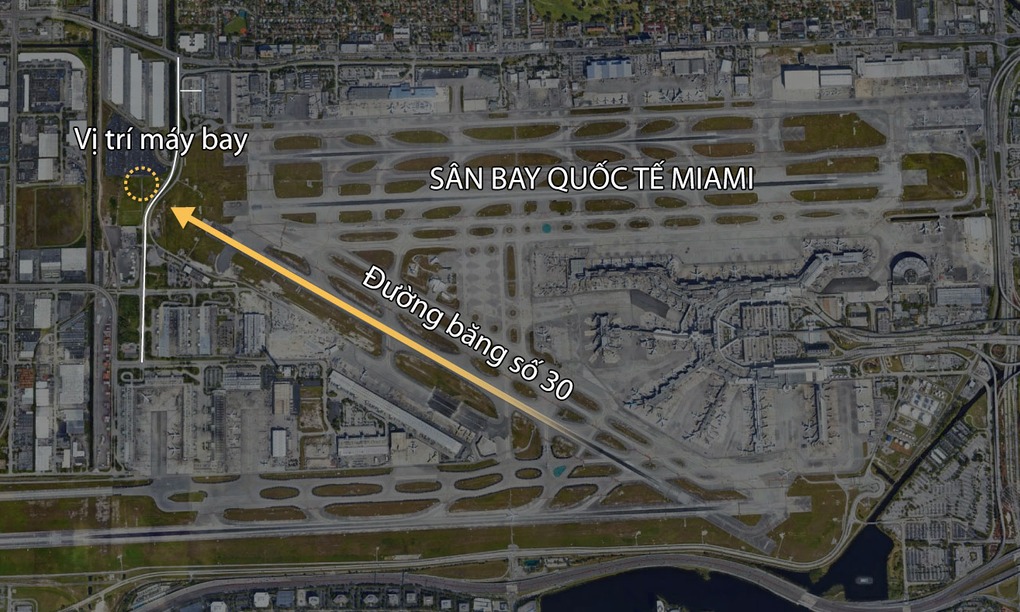 |
Aircraft position after the accident. Graphic: CNN
The NTSB has not yet determined if the crew had sufficient time to execute a go-around. The agency has also not concluded whether speed, weather, pilot actions, technical condition, or a combination of factors led to the accident.
Officials recovered the two black boxes and sent them to Washington for analysis. These will be crucial sources of information for investigators to determine the exact speed, system status, and events in the cockpit before the aircraft overran the runway.
"We can only prevent the next tragedy if recommendations from each investigation are implemented," Homendy said.
Nhu Tam (According to Miami Herald, BBC, WSJ)