Researchers have known about the presence of bees at East Lawn Cemetery in Ithaca, New York, since 1935, but the exact number of individuals living there remained unknown.
A team of experts from Cornell University decided to collect bees at various points around the cemetery over approximately 45 days in 2023, aiming to determine the number of bees nesting underground.
The results revealed an "unusually high" density of bees living beneath the cemetery, with approximately 5.56 million bees having "emerged"—meaning they climbed out of the ground to forage and mate—across an area of about 6,500 square meters, the research team wrote in an article published on 13/4 in the journal Apidologie.
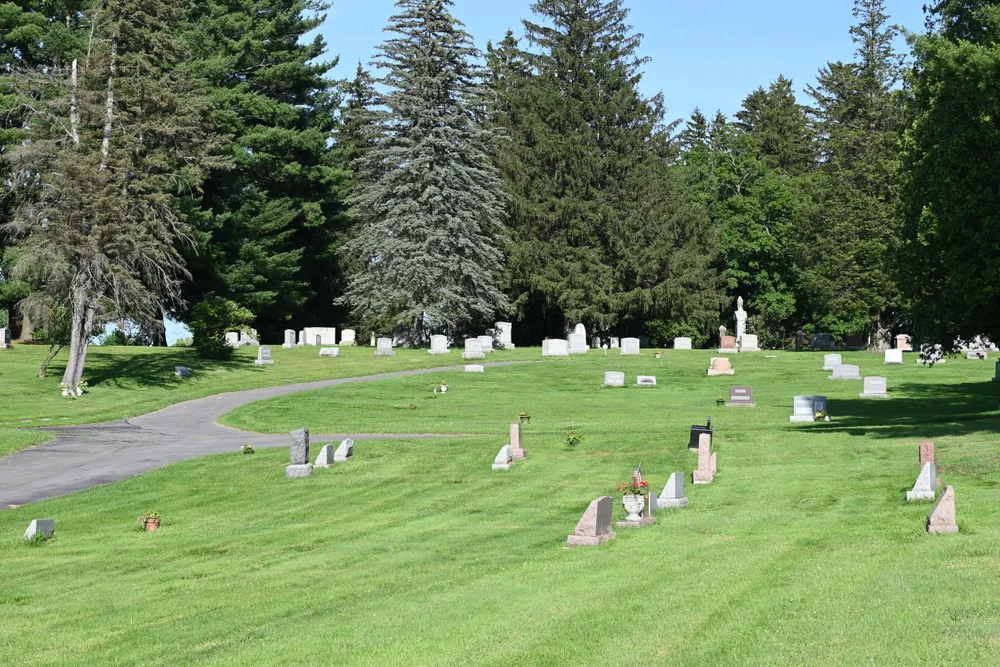 |
East Lawn Cemetery in Ithaca, New York. Photo: SCIAM. |
Experts noted that a typical honeybee colony usually contains about 30,000 individuals. In apple orchards, each hectare typically supports only two to three bee colonies.
"When I finished the calculations, I was truly stunned. I had seen estimates of bee concentrations reaching several hundred thousand at this cemetery, but I never imagined the number would be 5.56 million," said Bryan Danforth, a professor of entomology who led the study.
Experts believe East Lawn Cemetery provides an ideal ecological environment for bees because its sandy soil is minimally disturbed, pesticides are not used, and it is less than one kilometer from Cornell Orchards, which offers a massive source of pollen every early spring.
This is one of the largest bee populations ever recorded in the United States, and also the oldest. The National Wildlife Federation (NWF) states that about 98% of native bee species in the United States are solitary, not living in colonies, with 70% being ground-nesting bees.
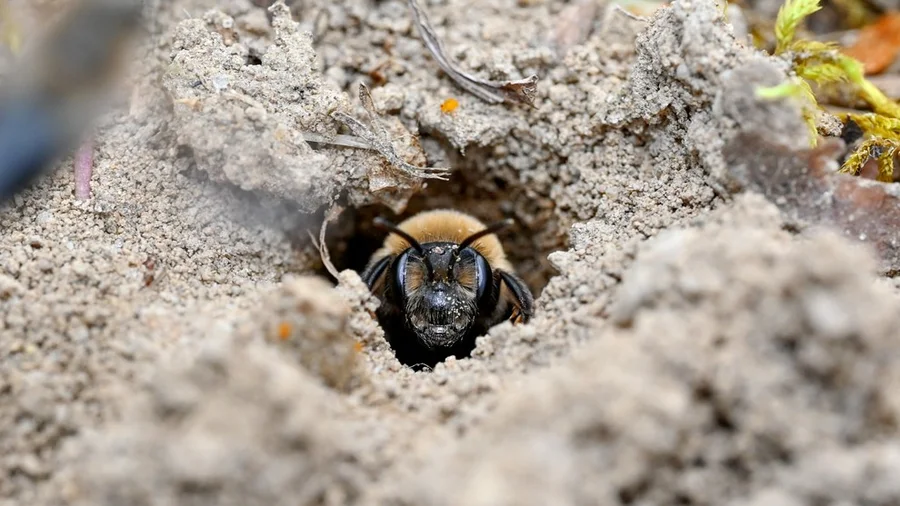 |
Bees digging burrows in the United States. Photo: SCIAM. |
Duc Trung (According to SCIAM, AFP, Reuters)