Data from the civilian flight tracking website FlightRadar24 showed a US E-3 Sentry early warning aircraft, tail number 79-0002, took off from southeast of Riydah in the early hours of 22/7. This occurred several hours after the US military launched its 12th consecutive night of strikes on Iran.
The aircraft flew a closed-loop pattern at an altitude of approximately 8,500 meters along Saudi Arabia's eastern coast. This is a common flight path for early warning aircraft conducting airspace surveillance and supporting allied forces.
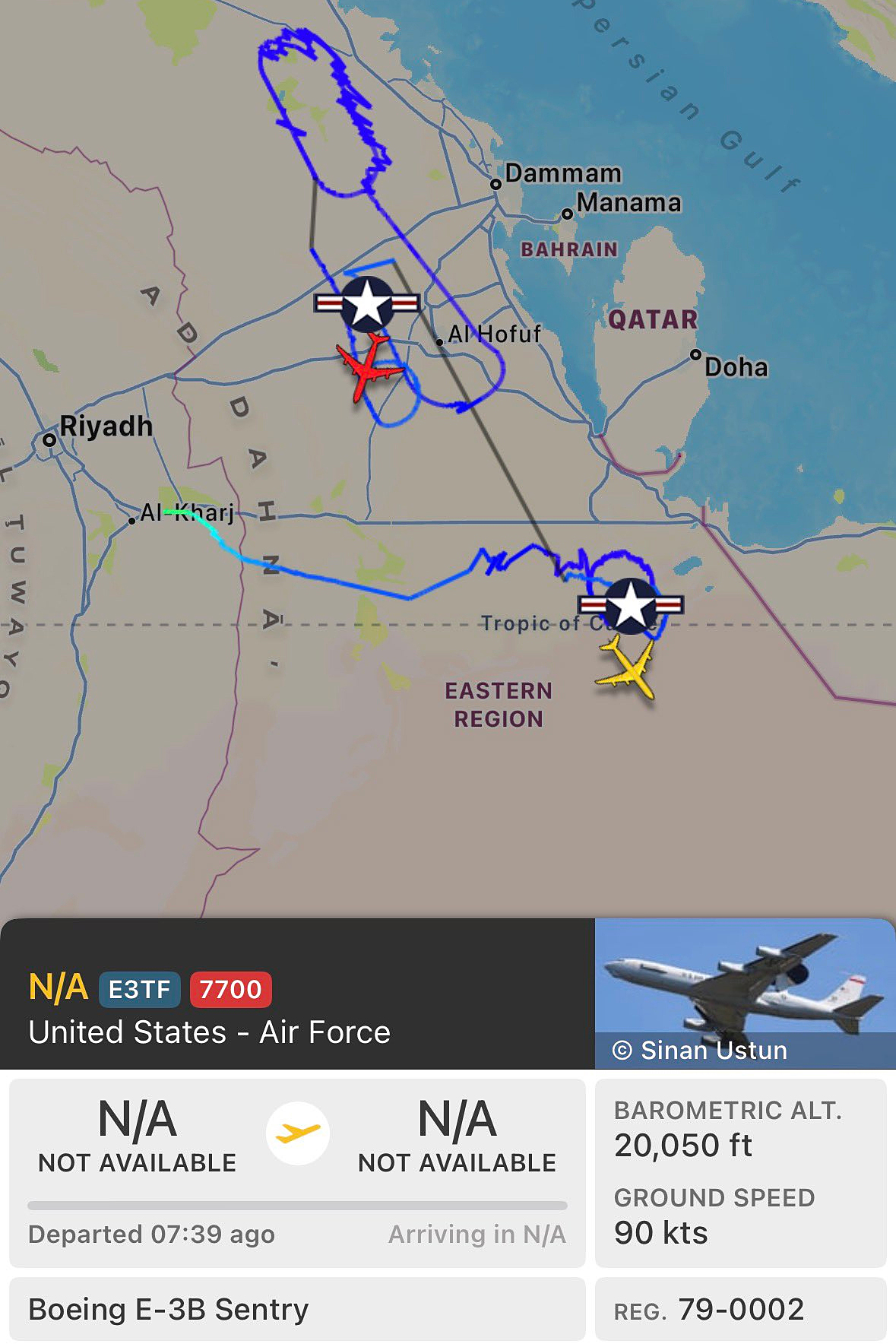 |
Flight path of E-3 Sentry, tail number 79-0002, on 22/7. *Graphic: FlightRadar24* |
Approximately 8 hours after takeoff, the US aircraft began its descent. During this process, the aircraft activated the "7700" transponder code and maintained an altitude of 6,000 meters for 23 minutes.
The "7700" code indicates an in-flight emergency, such as engine trouble, loss of cabin pressure, or a medical emergency requiring assistance. After activating this code, pilots must inform regional air traffic control about the nature of their problem.
The US aircraft continued to descend and turned off its transponder signal at an altitude of 1,200 meters, approximately 48 minutes after initiating the emergency signal.
FlightRadar24 stated that the E-3 Sentry was tracked using a multilateration (MLAT) system, which uses three or more receivers to determine an aircraft's position and speed.
"Errors that arise when tracking aircraft using MLAT are common in the region," the platform stated, seemingly referring to the aircraft's speed fluctuating between 75-1,835 km/h, which exceeds the normal operating parameters for an E-3 Sentry.
US Central Command (CENTCOM), the agency responsible for US military operations in the Middle East, has not commented on the information.
Ian Petchenik, a Boeing 767 captain, noted that activating the "7700" transponder code does not necessarily mean the aircraft is facing imminent danger. Instead, it could indicate the crew is exercising caution and wishes to report an unusual situation.
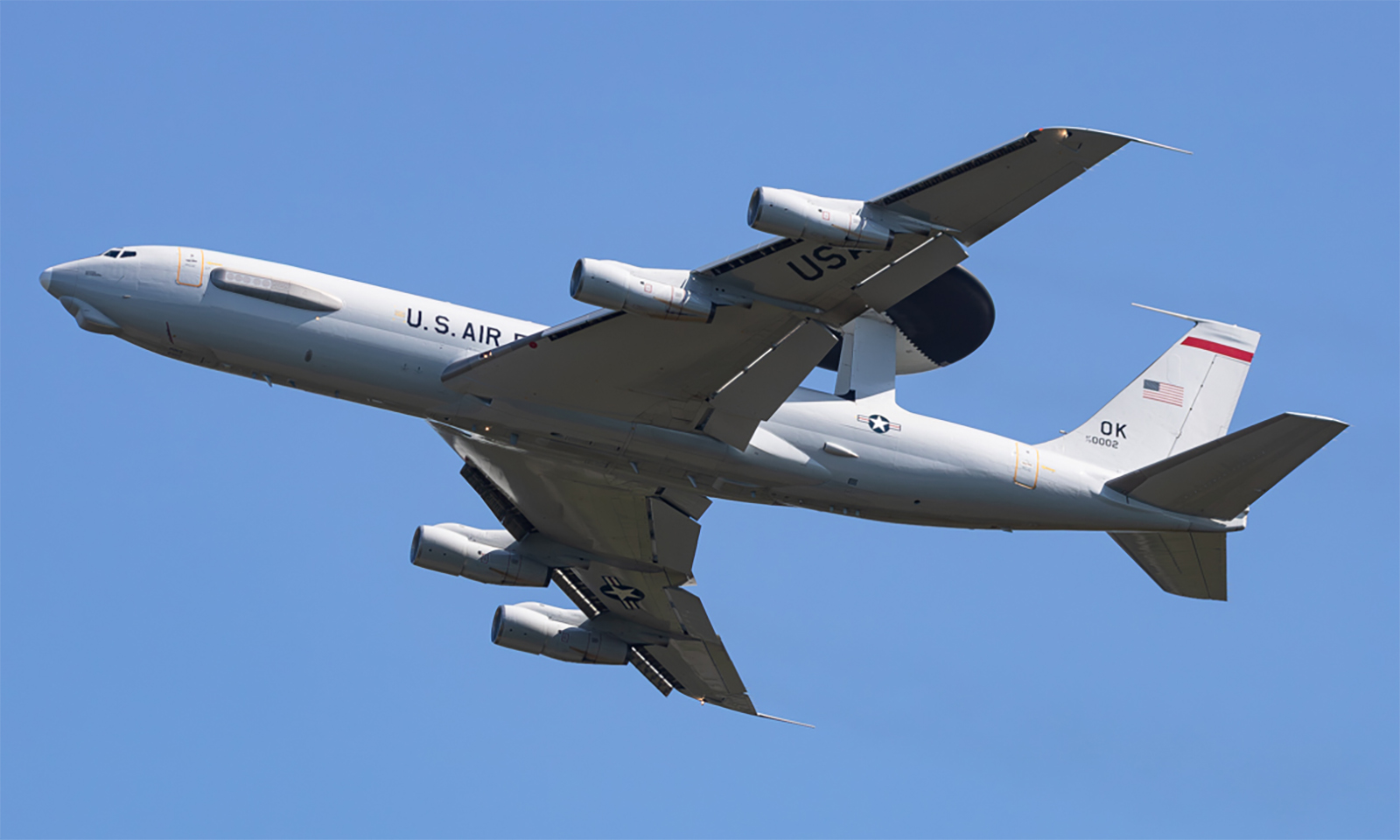 |
E-3B aircraft, tail number 79-0002, near Ramstein Air Base, Germany on 20/6. *Photo: Jet Photos* |
The E-3 Sentry is likened to an "eye in the sky" aircraft due to its ability to detect other aircraft from hundreds of kilometers away. This model, developed from the Boeing 707 passenger jet airframe, is recognizable by the large radar dome on its back.
The US Air Force once possessed a large number of E-3 aircraft, but only 16 remained in service before the conflict escalated, and not all of them could be deployed at any given time. The average mission readiness rate for the US E-3 fleet in fiscal year 2024 was 55,68%, meaning only about 8-9 aircraft were capable of takeoff when ordered.
Open-source imagery and flight tracking data indicate that the US deployed 6 E-3 aircraft, equivalent to 37,5% of the Sentry fleet in the Air Force inventory, to Saudi Arabia before the conflict intensified. At least one E-3G was completely destroyed, and another sustained an unknown degree of damage during an Iranian strike in March.
Nguyen Tien (According to AFP, AP, Reuters)