After years of relative calm, the conflict in Yemen recently escalated again, as Houthi forces intensified attacks against government troops on multiple fronts.
Last week, the Houthi launched a swift campaign, seizing the city of Mocha and gaining full control of the western coast and the nearby Bab el-Mandeb strait. The group is also pressuring Saudi-backed government factions in Marib and Taiz provinces.
These developments indicate that the Houthi are no longer an insurgent force operating primarily in northern Yemen's mountainous regions. Over two decades, the Houthi have progressively combined support from Iran with a cross-regional logistics network to build multi-terrain operational capabilities.
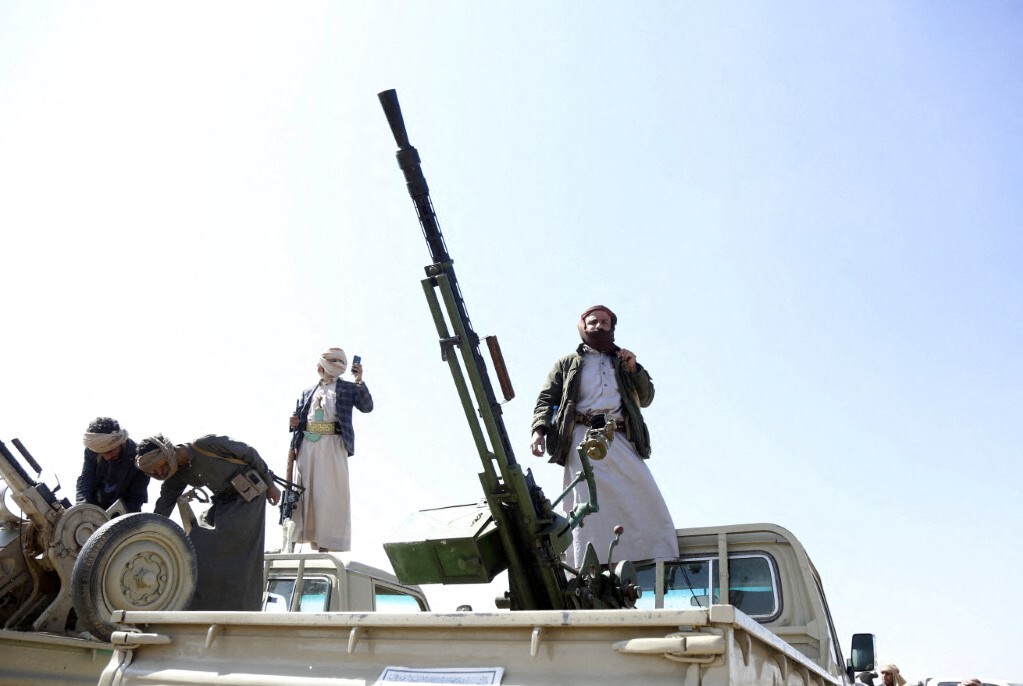 |
Houthi supporters in Sanaa, Yemen in November 2025. Photo: AFP
The Houthi movement, officially known as Ansar Allah (Supporters of Allah), was founded in 1994. It originated as a cultural revival movement of the Zaydi Islamic sect. As of 2022, approximately 35% of Yemen's population adhered to this sect.
Power struggles in Yemen erupted into civil war in 2014, when Houthi forces seized the capital Sanaa and overthrew the internationally recognized government of President Abd-Rabbu Mansour Hadi.
According to Telegraph, controlling Sanaa allowed the Houthi to take over numerous military facilities and arsenals from the Yemeni army, including ballistic missiles, rockets, and various other equipment. This was a critical resource, enabling the Houthi to rapidly expand their operational capabilities.
When the Saudi-led coalition intervened militarily in Yemen in 2015, the Houthi utilized much of the captured equipment to resist. Coalition ground forces landed in the port city of Aden and pushed the Houthi out of southern Yemen, but they could not dislodge the Houthi from Sanaa or the northern part of the country.
However, this arsenal was not an endless resource. The Houthi had to find ways to replenish both weapons and technical capabilities. The Houthi have long considered themselves a frontline force in the Axis of Resistance, built by Tehran since the 1980s, and declared their "destiny tied to Iran". This is when the relationship with Iran became crucial.
Yemeni officials suggest that Iran and the Hezbollah group in Lebanon have supported the Houthi in developing their military capabilities. Initially, Iran reportedly transported complete missile systems and unmanned aerial vehicles (UAVs) to Yemen by sea and land. However, this method had limitations, as it was easily detected and intercepted by adversaries.
The support model for the Houthi gradually shifted to providing components and expertise. This approach offered a benefit: the Houthi not only received weapons but also learned how to assemble, repair, and improve them.
"Components were brought into Yemen as regular goods, then assembled into weapons by the Houthi", a Yemeni source said.
This was a significant transformation, helping the Houthi evolve from an insurgent force into an organization capable of sustaining prolonged campaigns.
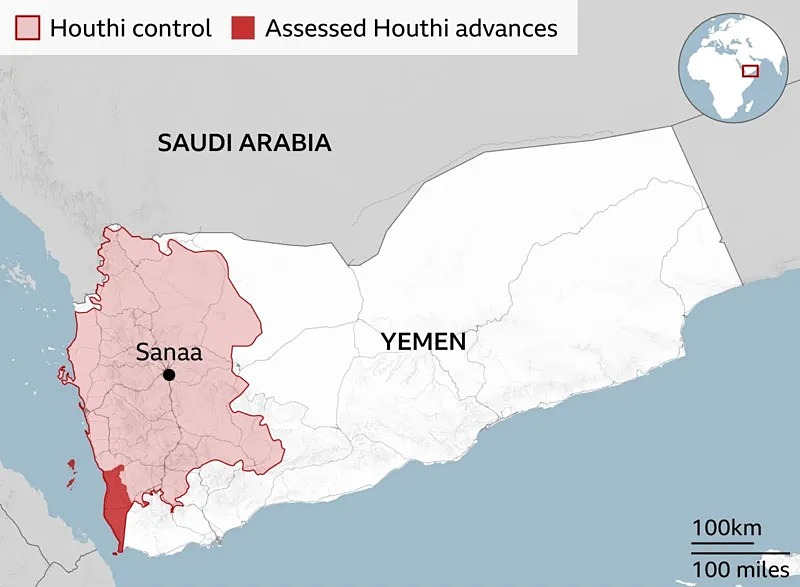 |
Houthi-controlled areas in Yemen, with dark red representing recently captured territories. Graphic: BBC
The Houthi are believed to possess around 100-200 long-range ballistic missiles and 1,000 UAVs. These include the Palestine-2 missile, with a range of up to 2,000 km, described by the Houthi as hypersonic and launched multiple times at Israel. The Hatem missile, developed based on Iran's Kheibar Shekan model, carries a warhead weighing about half a ton and has a range of over 1,450 km.
The Houthi possess the Al-Mandeb anti-ship cruise missile, capable of threatening maritime activity through the Red Sea at the Bab el-Mandeb strait. The Quds cruise missile flies at low altitudes to avoid radar systems. Samad and Qasef suicide UAVs have an operational range of up to approximately 2,400 km.
According to Yemeni sources, the Houthi have also manufactured explosive-laden uncrewed boats and are developing autonomous underwater vehicles and sea mines.
The ability to self-assemble or produce unmanned aerial vehicles and some types of equipment helps the Houthi maintain offensive capabilities even when external supply lines are disrupted. However, this does not mean the Houthi are entirely self-sufficient, making their logistics network a critical factor.
The Houthi have expanded their weapons network beyond Yemen, building relationships with armed groups in the Horn of Africa, notably al-Shabaab in Somalia. A Yemeni government source stated that al-Shabaab acts as an intermediary for transporting goods from Iran to the Houthi. This cooperation also provides the Houthi with additional assurance from the other side of the Red Sea, enabling the group to more easily blockade the Bab el-Mandeb strait.
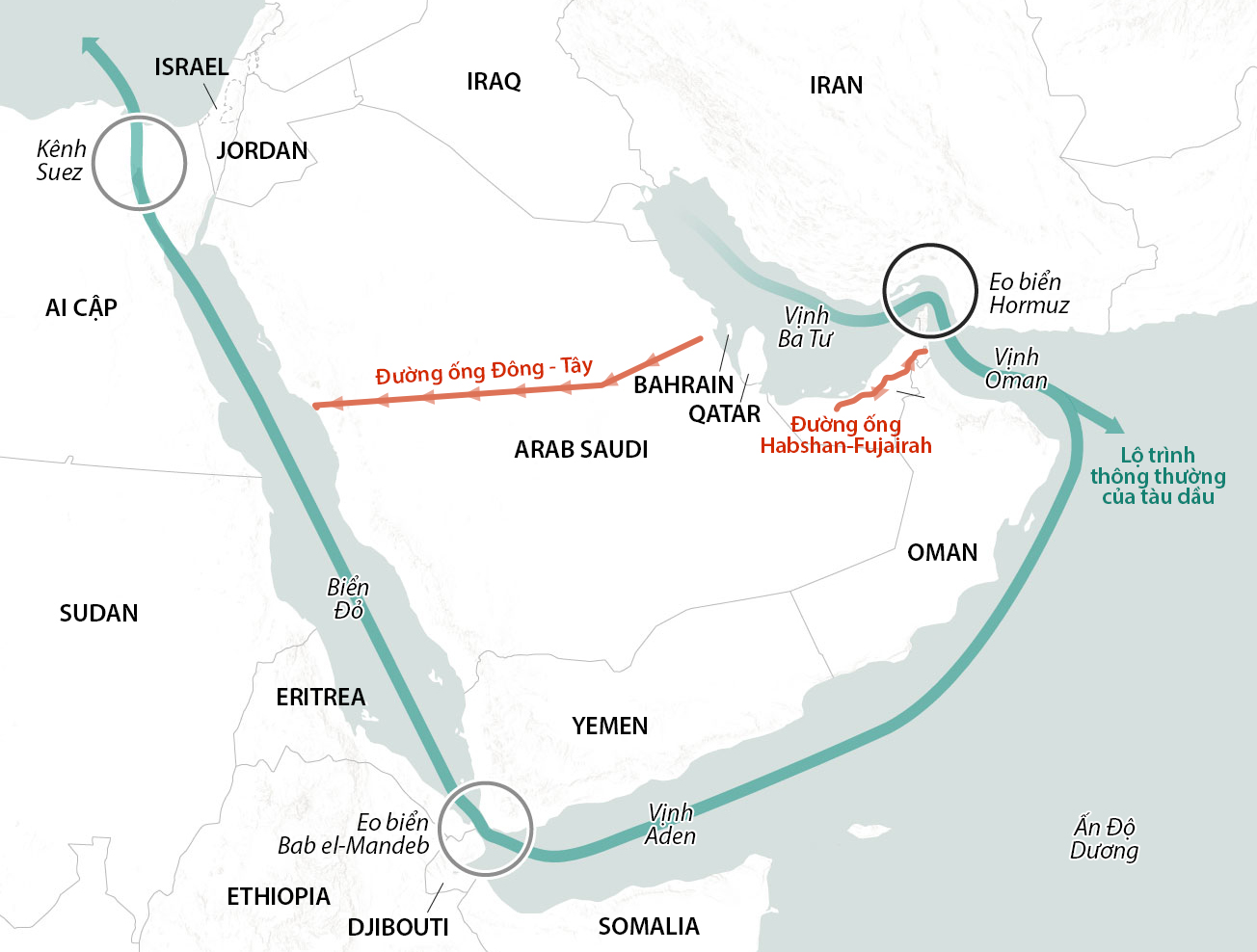 |
Location of the Bab el-Mandeb strait. Graphic: CNN
Farea al-Muslimi, a Yemen research fellow at Chatham House, believes Iran plays a significant role in the Houthi's military capacity building, particularly regarding technology and expertise. However, this does not mean all Houthi operations are directly directed by Tehran.
Former Yemeni diplomat Mahmoud Shehrah also suggests that Iran might want to use Houthi activities as a way to pressure the United States and Israel, but the group still has its own calculations regarding its position and interests in Yemen.
According to Shehrah, mere airstrikes are unlikely to compel the Houthi to cease operations. The armed group is more concerned about ground combat, particularly the risk of losing territory and financial resources.
Bader Mousa al-Saif, a history professor at Kuwait University, shares this perspective.
"To effect change, a ground presence is necessary, but no party is willing to deploy troops. Therefore, negotiations are needed", Mousa al-Saif said. "Negotiations will be difficult because the Houthi have a distinct approach. However, politics demands that parties find a way to compromise".
Nhu Tam (According to Telegraph, AFP, Reuters)