"Crews in Russia can observe real-time imagery transmitted from Geran suicide unmanned aerial vehicles (UAVs) and control them directly. This transforms them into a large, effective first-person view aircraft", Serhii Beskrestnov, an advisor to the President of Ukraine on defense technology development, stated on 24/8.
According to Beskrestnov, Russia has equipped all Geran UAVs with remote control systems, while more than 50% of these aircraft also feature automatic target recognition.
"Operators can guide them to an area a few kilometers from the target, after which the UAV will automatically search for and attack the target. In this scenario, Ukraine's electronic warfare measures are completely ineffective", Beskrestnov admitted.
Russian forces have also installed electronic warfare equipment on the Geran UAVs themselves. This equipment jams video signal transmissions on interceptor drones, one of the weapons Ukraine recently developed to counter enemy UAVs.
Beskrestnov explained: "When an interceptor drone approaches, the electronic warfare system on the Geran UAV will detect its signal and activate a jamming device on the same frequency. This causes both aircraft to emit similar signals, but the Russian UAV's transmission power, 5 times greater, completely suppresses the interceptor drone's video feed and control commands."
The Geran-2 is a suicide UAV domestically produced by Russia, based on Iran's Shahed-136 design. It has been operational in Ukraine since autumn 2022. Experts from the Institute for Science and International Security (ISIS) in the US noted that the initial production line only assembled UAVs from Iranian-made components, but Russia began domestic production of the aircraft in 5/2023.
According to estimates by US military specialized publication War Zone, Russia can produce thousands of Geran-2 units each month and is expected to exceed an annual production of 50,000 units this year.
Thomas Newdick, editor for War Zone, commented: "Initially playing a limited role, Geran UAVs have become a key asset in Russia's long-range strike operations against Ukraine. They were used on a relatively moderate scale during the 2022-2023 period, but Russia has since deployed hundreds of units at a time and is expected to be capable of launching over 1,000 units within 24 hours this year."
Russia also consistently applies new improvements to increase lethality and penetration capabilities against enemy air defense networks. These include installing large warheads tailored to specific target types, equipping satellite navigation antennas with high anti-jamming capabilities, and heat-seeking air-to-air missiles to shoot down Ukrainian manned aircraft.
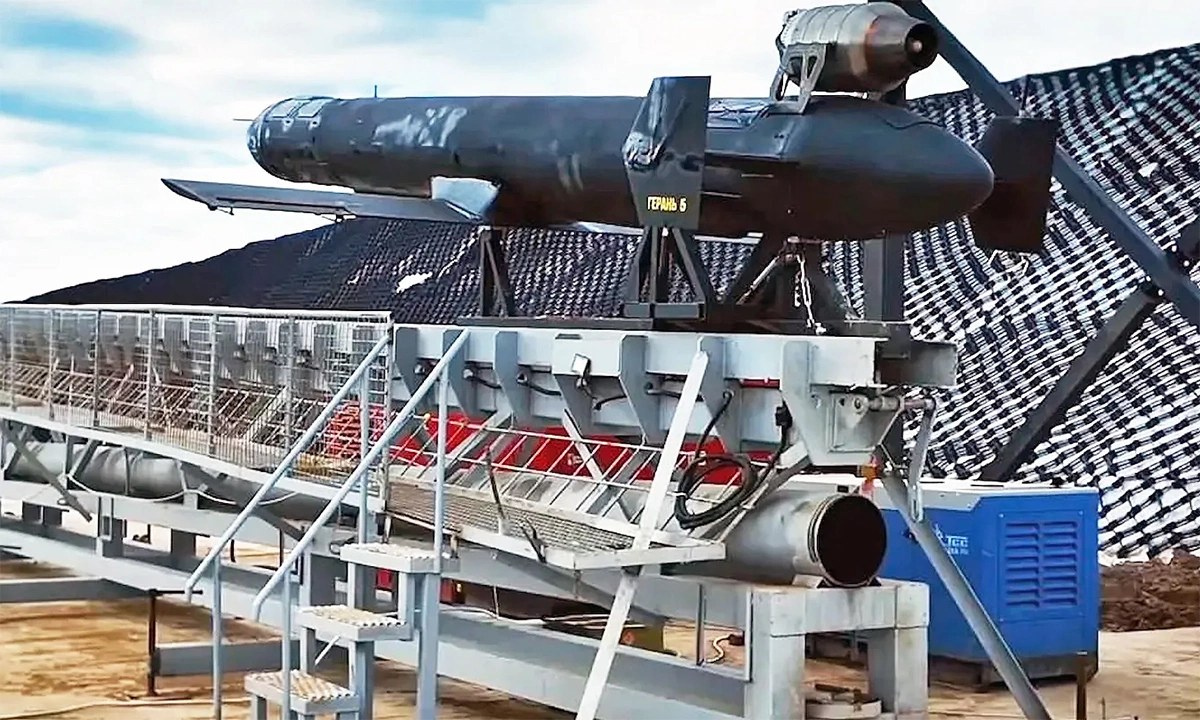 |
Geran-5 UAV on a launch pad in a photo posted on 21/6. *X/Oko Gora* |
Recently, Russian forces have also increased their use of Geran-4/5 UAVs, which employ jet turbine engines. These have significantly greater speed and altitude compared to the piston-engine Geran-2 model, putting them beyond the interception range of Ukraine's mobile air defense teams.
Ukraine previously recovered the wreckage of a Geran-4 Siker UAV containing a Raspberry Pi circuit computer, used for its automatic target recognition system. Ukrainian experts believe this measure helps overcome the disadvantage of Russia being unable to use Starlink satellite Internet services, as well as countering dense electronic warfare system networks around targets.
Nguyen Tien (According to Pravda, War Zone, AP)