Radio Taiso, a daily morning exercise program broadcast on Japanese radio, has become a cornerstone of public health and community building for nearly a century. This simple, accessible routine is credited with fostering physical and mental well-being, contributing to Japan's renowned longevity. Millions participate, from parks to homes, emphasizing both individual health and social connection.
Mieko Kobayashi, 88, is a familiar face at Kiba Park in eastern Tokyo, where a dedicated group gathers daily for Radio Taiso. "If it's cold or raining, I won't go", she said on 6/4. "But by moving my body, I feel healthier."
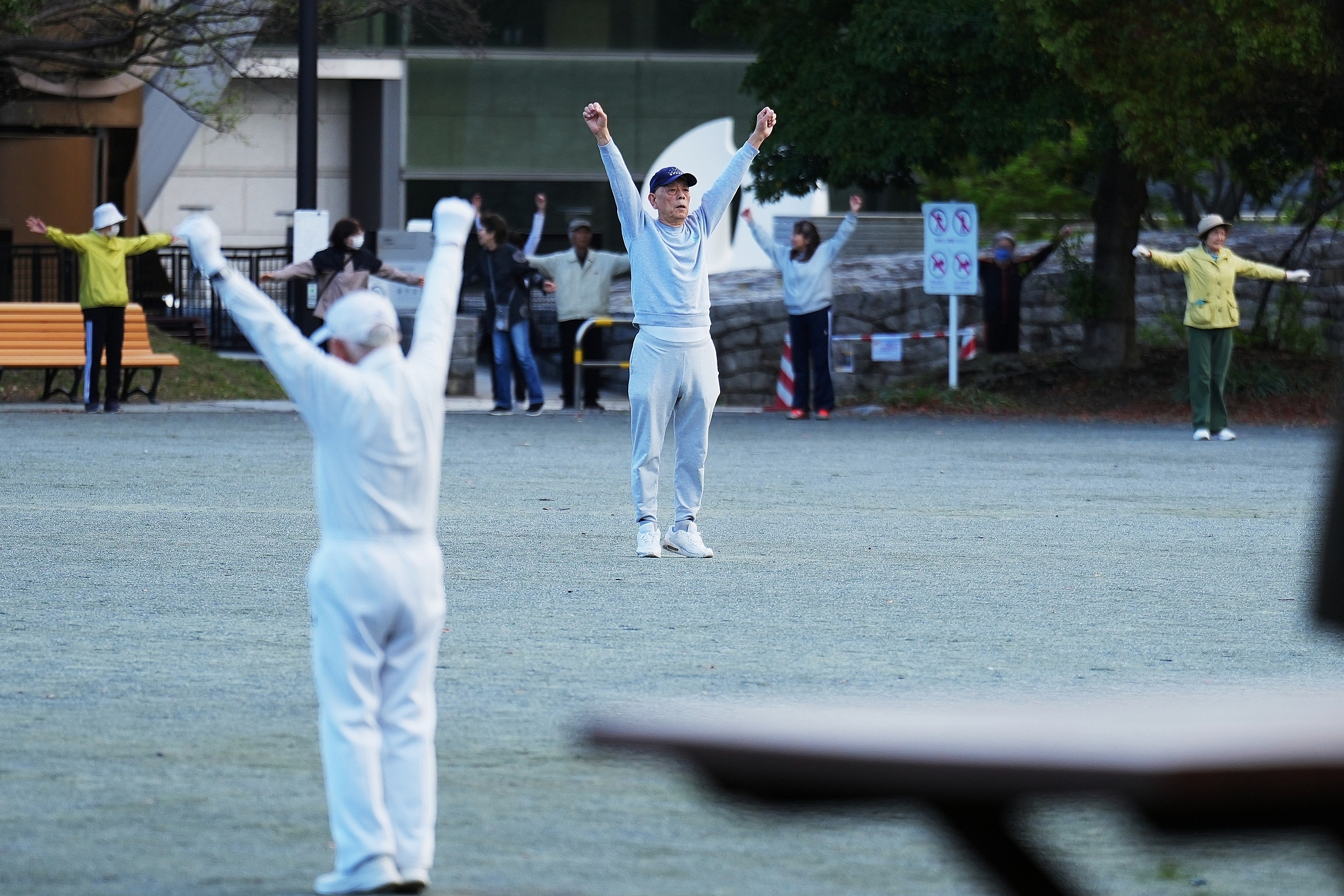 |
Nguoi Nhat tap the duc buoi sang theo chuong trinh Radio Taiso trong cong vien o Tokyo ngay 6/4. Anh: AP
Her friend, Yoshiko Nagao, 77, highlights the program's social importance: "Some in our group live alone, so this exercise appointment is a vital community activity." Nagao added, "Laughing and chatting while walking after exercise is also very good. We come here even on New Year's Day."
Another regular at Kiba Park for 20 years is Kenji Iguchi, 83, who appears much younger. "I wake up at 5 AM anyway", he shared. "I go to the park at 6 AM and walk around before Radio Taiso. Most faces here are familiar, and gathering with them is one of the things I look forward to."
Radio Taiso, which first aired in 1928, features music and instructions for exercises requiring no equipment. Its enduring popularity stems from its suitability for all ages and abilities, making it highly accessible. The program comprises three segments, each lasting three minutes, with increasing difficulty.
It includes about 10 basic movements performed standing or sitting, such as stretching, hip rotations, arm swings, shoulder relaxation, and marching in place. Each movement is repeated 4-8 times, accompanied by guidance on relaxation and breathing. The 10-minute program, set to soothing piano music, airs daily at 6:30 AM. While it starts early, many people also practice the routines at other times throughout the day.
Japan boasts one of the world's longest-living populations, a fact attributed to its diet, healthcare system, and a lifestyle that encourages physical activity among seniors. The average life expectancy in Japan is 85 years, slightly lower than Hong Kong but higher than the US's 79 years. Radio Taiso is widely recognized for promoting the health and spirit of the population.
At the end of last year, the Japanese government reported 99,763 people aged 100 or older, with 87,784 women (88%) and 11,979 men (12%). Japan holds the record for the highest number of centenarians relative to its population of approximately 122 million.
Chuong trinh tap the duc buoi sang qua dai phat thanh o Nhat Ban. Video: AP
The concept for Radio Taiso originated a century ago, inspired by a similar radio program in the US sponsored by Metropolitan Life Insurance. Officials from Japan's Post Ministry visited the US in the 1920s and brought the idea back. Within the first 10 years of its broadcast, the program attracted millions of participants. Postal workers played a central role in popularizing the exercises by distributing leaflets and organizing direct training sessions for the public.
The program was temporarily suspended during the US occupation of Japan after World War II, following 1945, but was restored in 1952. A 2023 survey by the Radio Taiso Federation indicated that over 20 million people in Japan perform Radio Taiso at least once a week. The program has also expanded internationally, notably in Brazil, home to the world's largest Japanese diaspora.