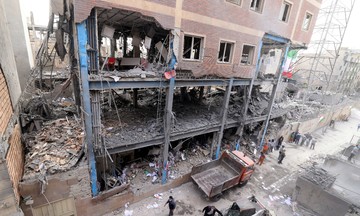
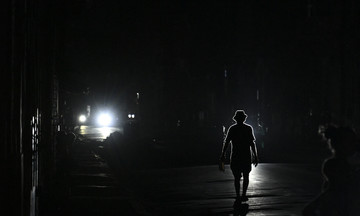
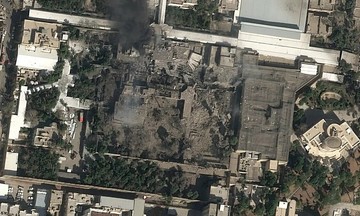
When Shira Oze heard the air raid sirens signaling Israel's attack on Iran, her reaction was almost automatic: She grabbed a few clothes into a bag and took her entire family by taxi to Jerusalem before Tehran launched retaliatory missiles.
Oze believed that if this time was like the last, they might be safe in Jerusalem, as the city is usually not a target. When Iran's missile launches decreased to just a few per day, it would then be safer to return home.
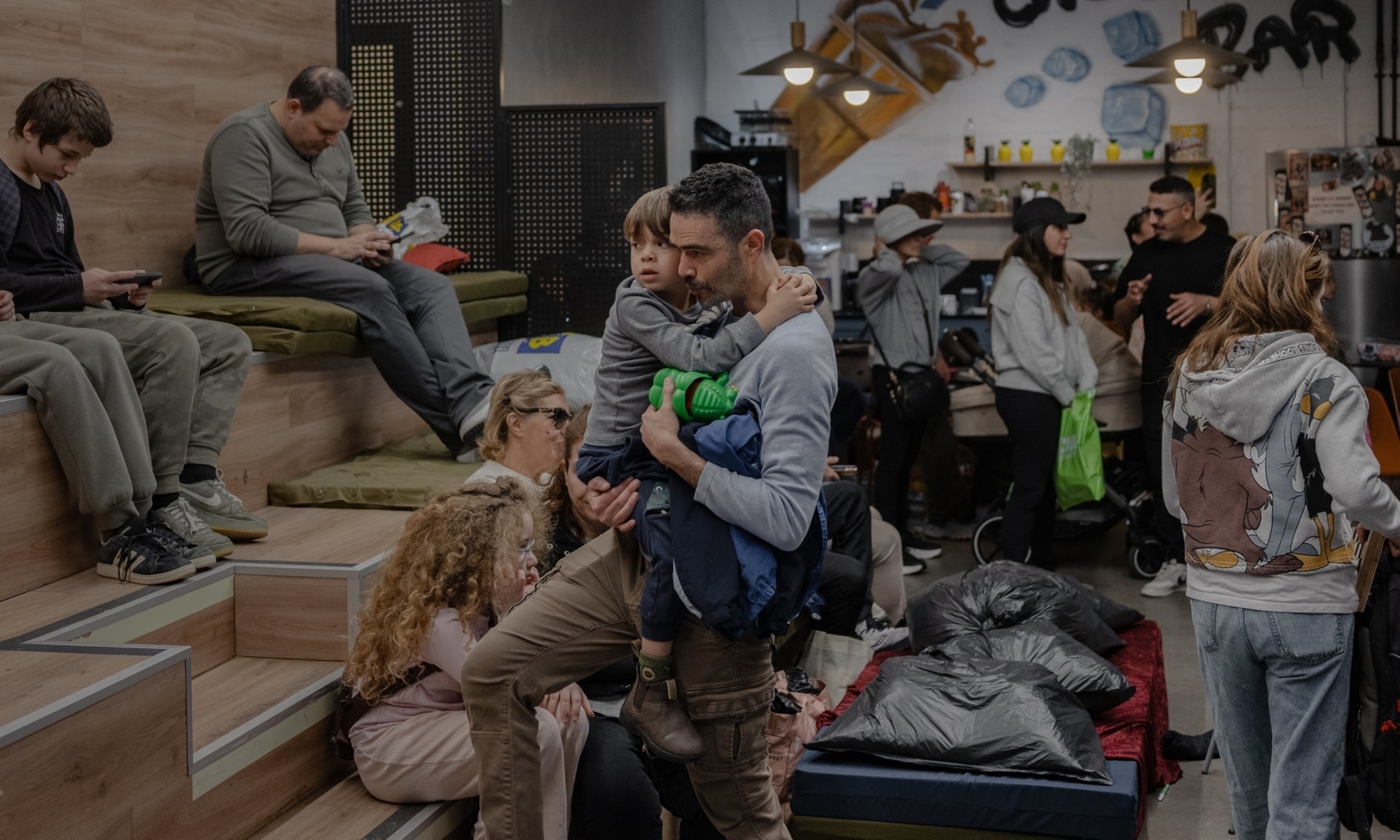 |
Families gather in a public bomb shelter in Ramat Gan, a suburb of Tel Aviv, Israel. Photo: WSJ |
Like many other Israelis, Oze, 43, could not pinpoint when this way of life became normal for her family. Following Hamas's raid into Israeli territory in 10/2023, Tel Aviv adopted a more aggressive military strategy than ever, attacking each opponent in turn.
Prime Minister Benjamin Netanyahu likened Israel to "the Sparta of the Middle East," an ancient Greek city-state renowned for its harsh military culture, where every citizen was trained to be an elite warrior.
This message was delivered as Israel continued to engage in a relentless war of attrition against armed groups Hamas, Hezbollah, Houthi, and ultimately their patron, Iran.
After over two years of conflict, Oze stated her family has gradually grown accustomed to, but also feels exhausted by, this "modern Sparta" lifestyle. They always keep emergency bags ready at the door and sleep in bomb shelters, hoping each engagement will be the last, while understanding it is unlikely.
"The conflicts are piling up, and there's always the lingering question of who we'll have to fight next," she said.
Israeli society is paying a heavy price for incessant conflict. Reservists, who form the majority of the Israeli military, are exhausted from being repeatedly called up whenever fighting erupts. Each time Israel attacks an opponent, the country's civilians brace themselves for new waves of retaliation.
In Tel Aviv, bearing the brunt of drone and missile fire from Iran, fatigue is evident on residents' faces as they are frequently woken up multiple times each night by air raid sirens. Some who do not have bomb shelters in their homes choose to camp permanently in public bomb shelters to avoid rushing to find safety whenever sirens sound.
Some shelters have transformed into small underground villages, with families living in tents and children's toys scattered everywhere.
Despite this, the majority of Israelis still support the current war against Iran, viewing it as an existential threat that needs to be addressed promptly, as Iran has repeatedly threatened to "wipe Israel off the map." A poll conducted by the Israel Democracy Institute showed that after 12 days of the operation, 81% of respondents still supported the government's decision.
"It's certainly exhausting," said Jenny Kohn, 38, who has lived in a public bomb shelter since the conflict erupted over two weeks ago. "But I also feel grateful that I live in a country with infrastructure that protects us."
Wartime rules are so ingrained in Israel that they have become a part of daily life. Almost anyone with a smartphone has installed the app released by the military's Ministry of Home Front Command. This app can override silent mode to issue early warnings of air strikes.
On the ground, Israeli cities still maintain a normal appearance. At Dizengoff Square in Tel Aviv, cafes are packed with customers. However, customers are always ready to put down their coffee cups at any moment to evacuate to the nearest bomb shelter if an alert sounds.
Just a 4-minute walk away, an underground parking lot converted into a bomb shelter now resembles a "city of tents." Residents lay out air mattresses to sleep, set up tables for eating and drinking, and enjoy coffee right next to children's play areas. They stock food at the Carrefour supermarket in the mall directly above.
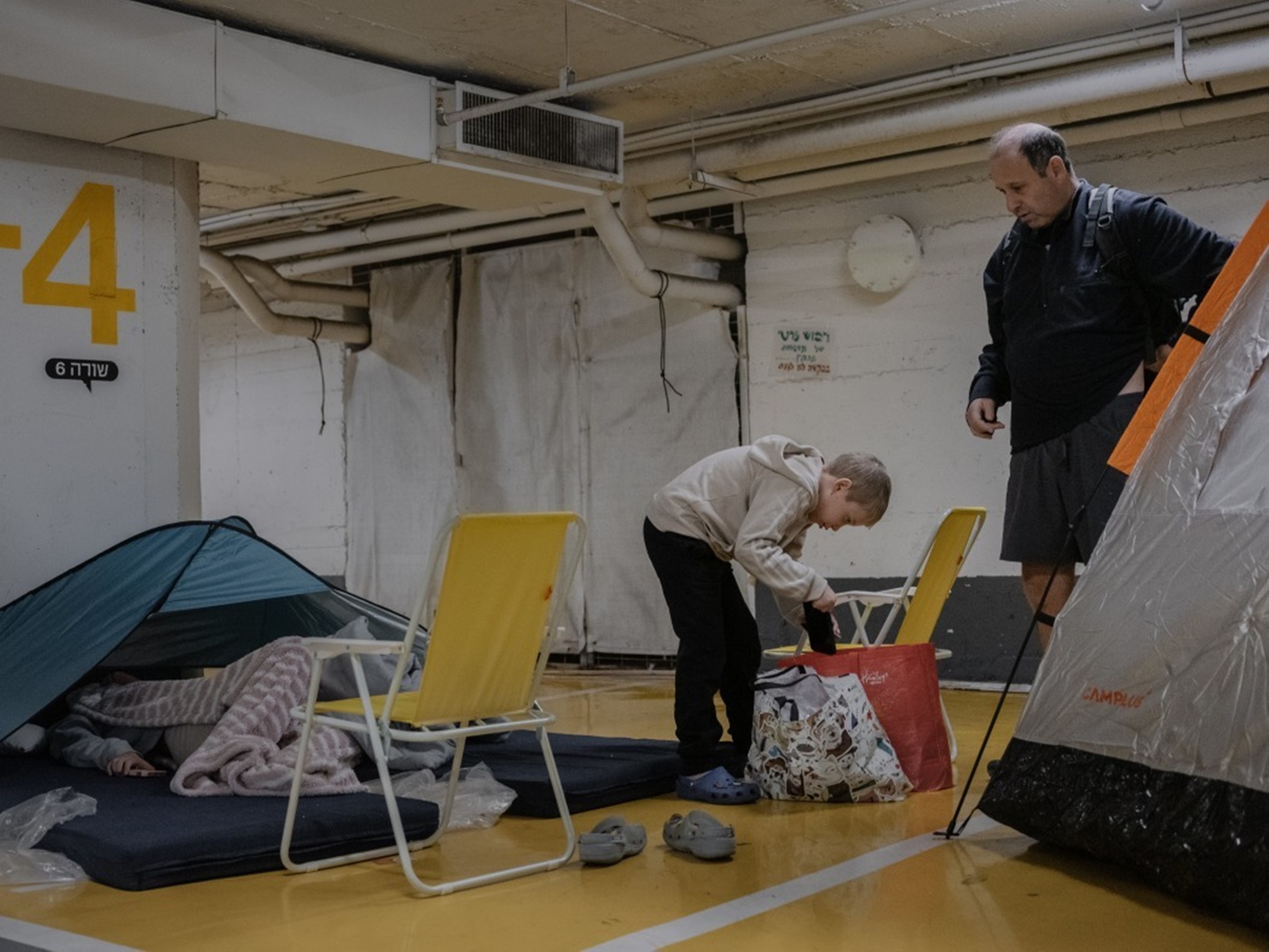 |
Jeffrey Lubotta and his son set up a tent in the Dizengoff underground parking lot. Photo: WSJ |
Jeffrey Lubotta, 52, has been holed up here with his wife and two children since the beginning of the conflict. He stated his family feels safer and more comfortable than in smaller public shelters near home. Moreover, sleeping underground also means they do not have to wake up and move if attacks occur during the night.
Some still try to find joy in ironic circumstances. A wedding took place in a bomb shelter right at the start of the Iran attack campaign. For many Israelis, such scenes have become commonplace, an inevitable feature of life, rather than an unforeseen incident.
"Honestly, it's not that inconvenient," said Mani Abitbol, a 37-year-old electrical engineer, who is in a tent with his girlfriend and dog. "For us, it's like going camping."
Others, often dual nationals who did not grow up in Israel, find this situation ridiculously absurd. Adeena Sussman, an American-Israeli chef living in Tel Aviv, calls her apartment a "war-time hostel" because she frequently hosts those who do not have shelters at home. A few nights ago, while sitting on her balcony, she found herself marveling at the sight of "a beautiful golden missile, like fireworks," streaking across the sky.
"What's happening is absolutely not normal," Sussman said. "Israelis are very good at adapting; everyone is just doing everything they can within their limits."
Beneath a shopping mall in Ramat Gan, a Tel Aviv suburb, on a recent afternoon, the air raid sirens were drowned out by the sound of a karaoke machine playing the K-pop hit "Gangnam Style" for a group of excited children.
Dana Mizrahi, 37, a single mother of five children, also sheltered here during the US and Israeli air strikes on Iran's nuclear facilities in 6/2025. This place has become a magnet for families with young children like Mizrahi's. Typically used as a community center, it already had furniture and toys. Despite the rather jarring noise, parents said they were willing to sacrifice privacy and quiet so their children would not feel afraid or lonely.
"Most children cry when they hear the sirens," Mizrahi said. "But our children here do not."
By Vu Hoang (Source: WSJ, AFP, Reuters)