The Russian Ministry of Defense announced today the start of a nuclear force exercise, simulating a scenario of a threatened attack. The activity is taking place from 19-21/5, involving the Strategic Missile Force, Northern Fleet, Pacific Fleet, Strategic Air Command, and units from the Leningrad and Central Military Districts.
The exercise aims to enhance the skills of command and staff, assess combat readiness, provide practical training for command bodies and operational units, and evaluate the participating forces' ability to carry out missions.
Russia launched Yars and Sineva intercontinental ballistic missiles during nuclear drills in October 2025. *Russian Ministry of Defense*.
The Russian Ministry of Defense stated that over 64,400 military personnel and 7,800 pieces of equipment will participate in the drills. This includes more than 200 missile launchers, 140 aircraft, 73 surface warships, and 13 submarines. The Russian military plans to launch ballistic and cruise missiles from its domestic training grounds.
The exercise also involves coordinated preparation and use of nuclear weapons deployed in Belarus. Last year, the Russian military deployed Oreshnik hypersonic missiles, capable of carrying nuclear warheads, to Belarus.
On 18/5, Belarus also announced it would hold joint field exercises with Russia on tactical nuclear weapons deployment, practicing the transport and preparation of warheads. Belarus stated that the activity "is not aimed at a third country and poses no regional security threat in the region".
The nuclear triad consists of land-based intercontinental ballistic missiles (ICBMs), submarine-launched ballistic missiles, and nuclear-capable aircraft. Maintaining these three nuclear pillars helps limit the risk of strategic forces being wiped out in a first strike, ensuring retaliatory strike capability and credible nuclear deterrence. Currently, four countries possess a nuclear triad: Russia, the United States, China, and India.
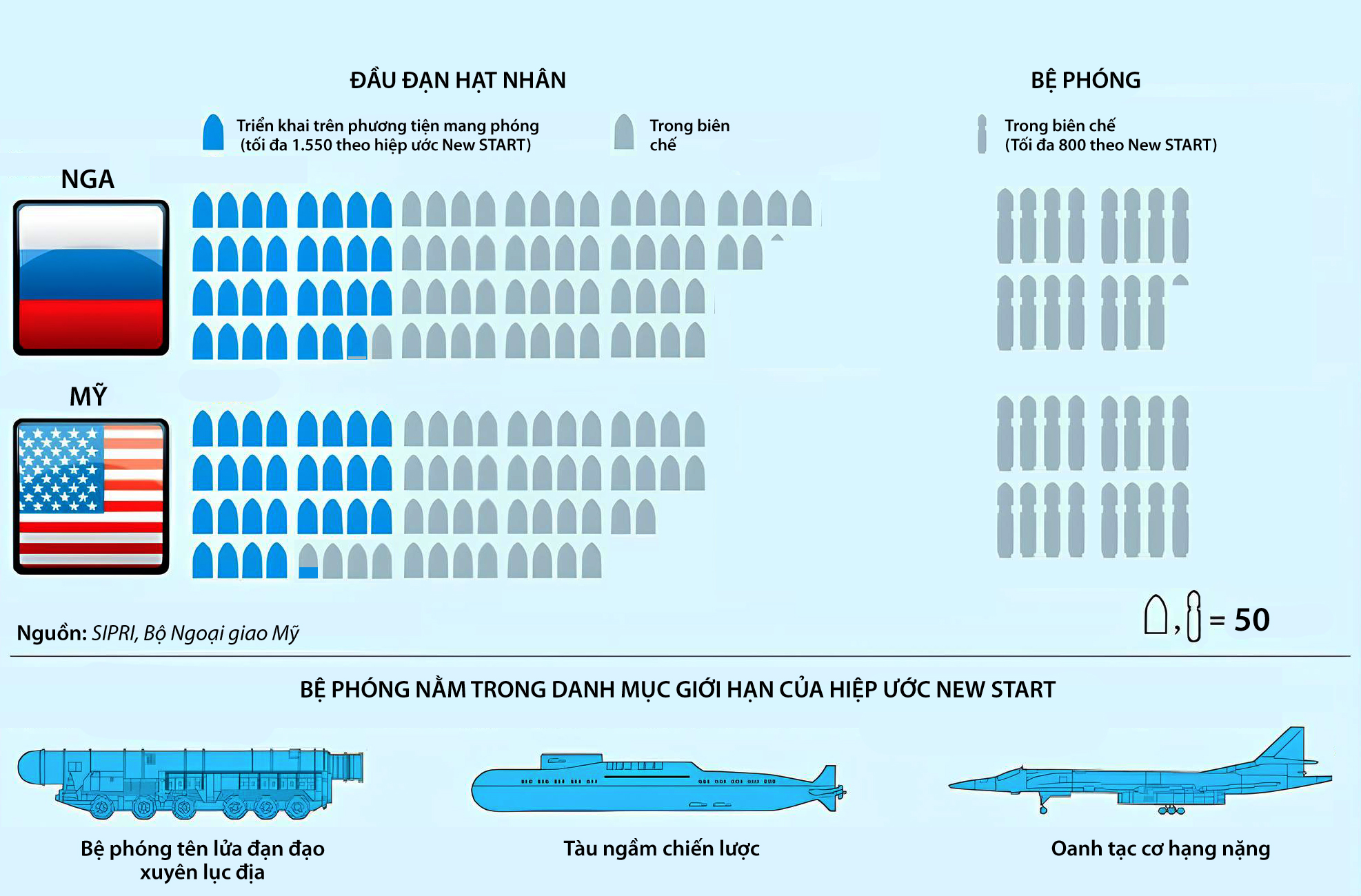 |
The nuclear arsenals of Russia and the United States, with over 8,000 warheads. *RIA Novosti*.
This marks the first exercise by Russia's nuclear triad since the country announced an end to all obligations under the New Strategic Arms Reduction Treaty (New START) in February. This treaty was the last nuclear arms control agreement between Russia and the United States.
New START, also known as START III, was signed by the United States and Russia in 2010 and became effective one year later. The treaty stipulated that each side could not deploy more than 700 intercontinental ballistic missiles (ICBMs), submarine-launched ballistic missiles (SLBMs), and nuclear-capable bombers, and the number of nuclear warheads on these platforms could not exceed 1,550.
Additionally, the number of "deployed or non-deployed" launchers for each country could not exceed 800. The treaty also restricted Russia's long-range nuclear weapons capable of reaching United States territory.
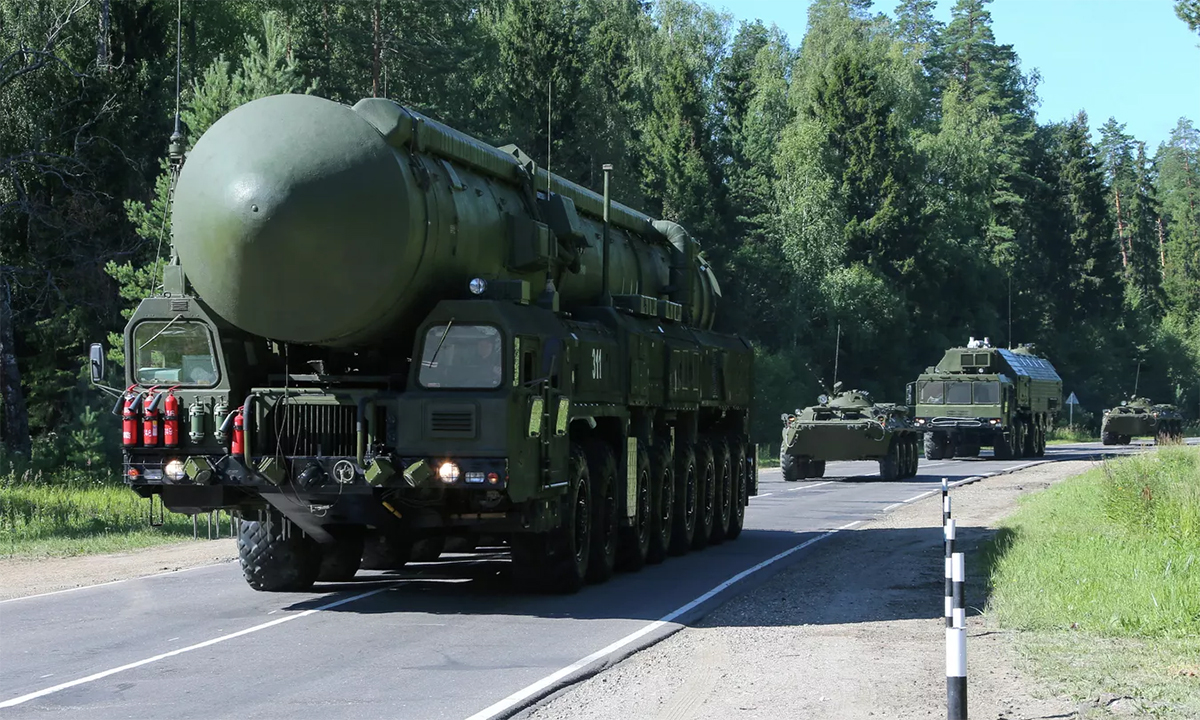 |
An RS-24 Yars intercontinental ballistic missile unit moving in an image released in July 2016. *RIA Novosti*.
Despite allowing Russia and the United States to possess hundreds of destructive nuclear weapons, New START helped prevent the two superpowers from continuing an arms race. While the treaty was in effect, both nations adhered to the agreed-upon restrictions and maintained nuclear warhead numbers at or below the stipulated levels.
Nguyen Tien (According to TASS, RIA Novosti, AFP)