The Swedish military announced on 11/4 that its JAS 39 Gripen fighter jets approached and monitored a Russian Kilo-class submarine in the Kattegat Strait on 10/4. "We, along with our allies, tracked this warship as it moved into the Baltic Sea," the statement said.
Photos released by the Swedish military showed a Gripen fighter jet flying behind the surfacing Russian submarine. A grey vessel, appearing to be a naval ship, was moving parallel to the Russian warship, though no details were provided.
The Kattegat Strait, situated between the Baltic Sea and the North Sea, falls within the territorial waters and exclusive economic zone (EEZ) of both Sweden and Denmark. Russian submarines transiting this area must adhere to the innocent passage rules outlined in the 1982 United Nations Convention on the Law of the Sea (UNCLOS), which mandate that such warships surface and display their national flag.
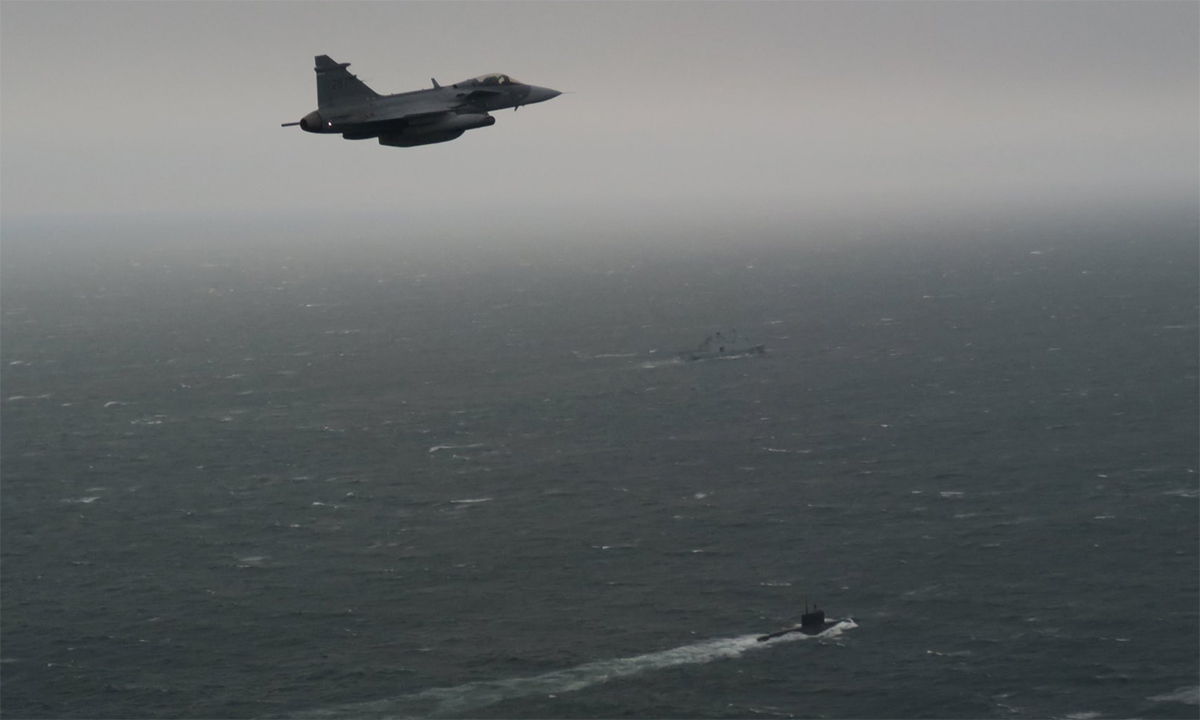 |
Swedish JAS 39 Gripen fighter jet monitoring a Russian submarine in the Kattegat Strait on 10/4. *Photo: Swedish Military*
Colonel Marko Petkovic, commander of Swedish naval operations, stated in 12/2025 that Russian submarine activity in the area has significantly increased in recent years. This surge is part of Russia's broader effort to enhance its military presence in the Baltic Sea. Petkovic added, "Russia is modernizing its navy, building one Kilo-class submarine each year. This is not a short-term activity; instead, it is part of a long-term, extensive, and purposeful program."
Sweden has established specialized teams to monitor Russian submarines in the region. These teams utilize various assets, primarily JAS 39 Gripen fighter jets for aerial surveillance and small Visby-class corvettes. The corvettes are capable of operating in shallow coastal waters and can reach a maximum speed of 65 km/h.
David Cenciotti, editor of the military news site Aviationist, described Sweden's surveillance formation as "particularly interesting". He noted that Sweden deployed Visby-class warships and Gripen fighter jets for anti-submarine duties, rather than using specialized aircraft such as the P-8.
"This approach could be effective in the restricted environment of the Baltic Sea," Cenciotti commented, "but it is still significantly different from the anti-submarine warfare model using specialized aircraft."
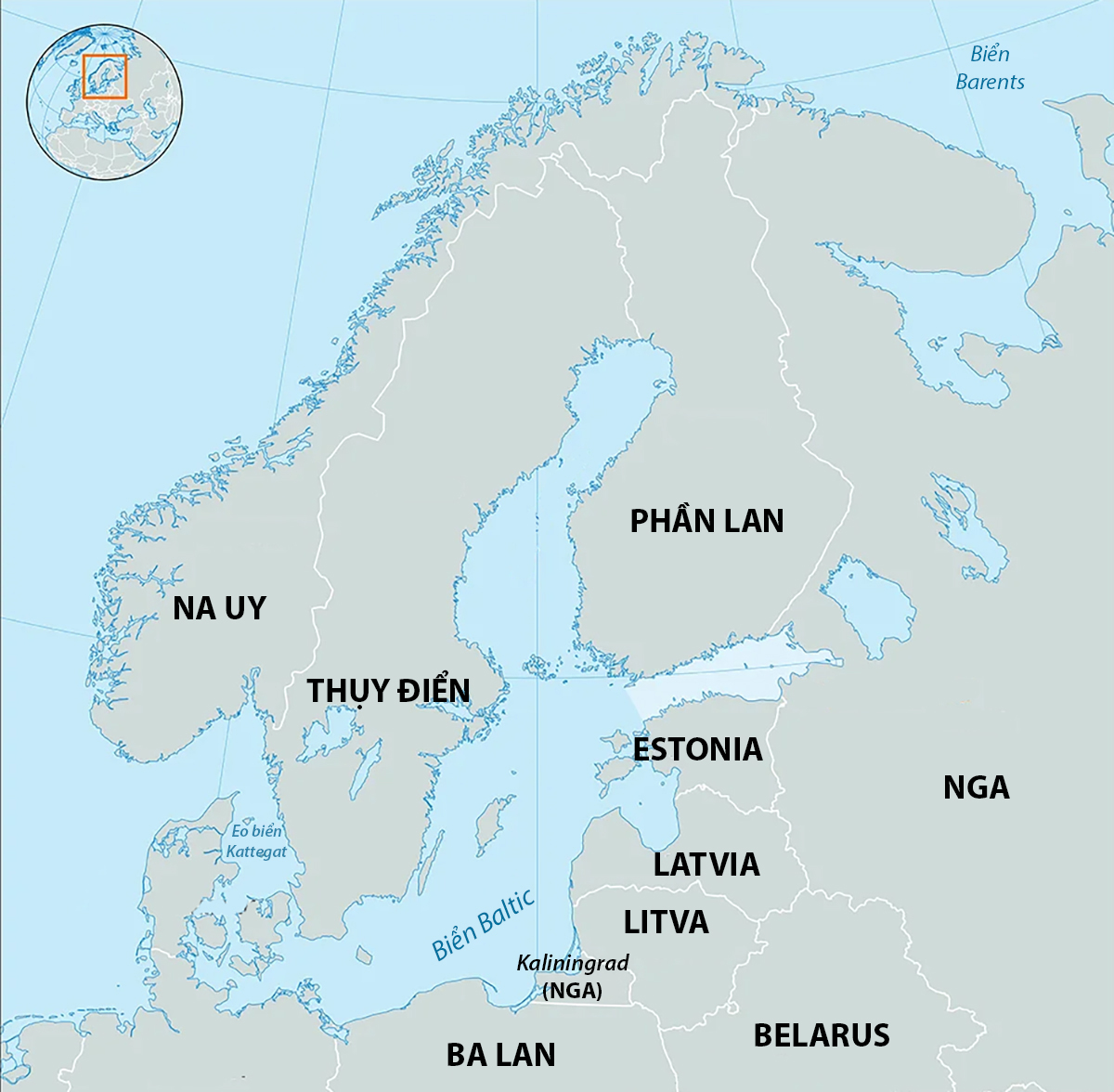 |
Location of the Kattegat Strait and the Baltic Sea. *Graphic: Britannica*
The Kilo is the NATO designation for Project 877 and 636 diesel-electric submarines, originally built by the Soviet Union and now by Russia. Currently, the Russian Navy operates five Project 877 submarines and 12 Project 636.3 submarines.
Project 636.3 submarines measure nearly 74 meters in length and have a submerged displacement of nearly 4,000 tons. This makes them slightly larger than Project 877 warships, which are approximately 73 meters long with a submerged displacement of over 3,000 tons. These submarines can achieve a maximum speed of 31 km/h when surfaced and 37 km/h when submerged, with an operational endurance of 45 days.
These warships are equipped with six 533 mm torpedo tubes, capable of carrying 18 torpedoes, 24 mines, and four Kalibr cruise missiles. Additionally, the submarines feature eight 9K34 Strela-3 or 9K310 Igla-1 anti-aircraft missiles, although export variants may not include these specific weapons.
By Nguyen Tien (AFP, AP, Aviationist)