The Thai military on 24/12 confirmed using M-46 cluster munitions in cross-border clashes with Cambodia. This admission followed accusations by Cambodian Mine Action Center (CMAC) Director General Heng Ratana on 23/12, stating that Thai forces fired 155 mm artillery with M-46 cluster munitions on 22-23/12, endangering border communities in Cambodia. The Thai military maintained they only fired when necessary at military targets to increase their destructive capability.
Ly Thuch, Vice Chairman of the Cambodian Mine Action and Victim Assistance Authority, highlighted the extreme sensitivity of M-46 submunitions, stating that a light touch could cause them to detonate, leading to fatalities. He warned these weapons could scatter across farmland, forests, and residential areas, posing a long-term threat.
A Thai military statement described M-46 as "multi-purpose artillery rounds," designed for submunitions to detonate immediately upon impact. These submunitions, they claimed, are not like anti-personnel mines and do not pose a long-term threat to civilians. Thai army spokesperson Winthai Suvaree accused Cambodian officials of "distorting the truth" to undermine Thailand's reputation. He emphasized that Thai operations strictly adhere to international humanitarian law and the principle of proportionality. Winthai also noted that neither Thailand nor Cambodia are members of the Convention on Cluster Munitions (CCM), and thus are not bound by its international legal obligations.
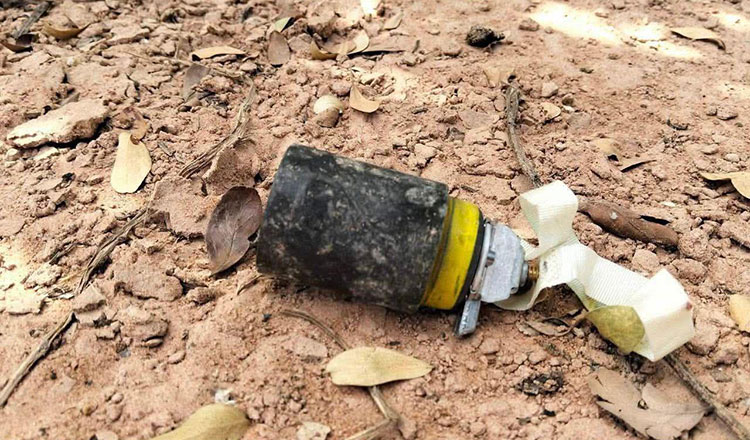 |
Submunition casing from an M-46 cluster munition, reportedly fired by the Thai military into Cambodian territory on 23/12. Photo: Khmer Times
This is not the first time Cambodia has accused Thailand of using cluster munitions. In a July border conflict, Cambodia made similar claims, though the Thai military then only stated they "would consider using this weapon if necessary to target military objectives to increase destructive effectiveness." During the 2011 border conflict over Preah Vihear temple, both nations accused each other of using these weapons. The Cluster Munition Coalition (CCM) condemned the 2011 use as "disappointing" and "unconscionable."
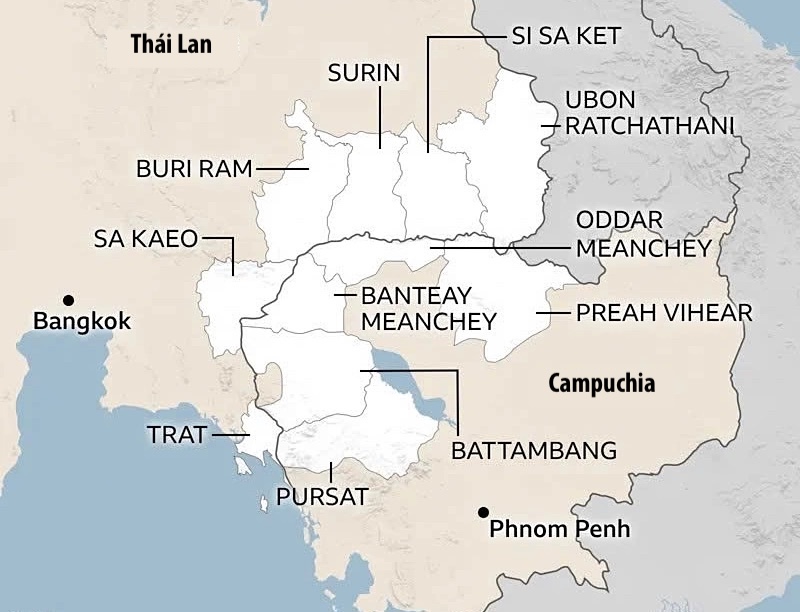 |
Location of border provinces between Thailand and Cambodia. Graphic: BBC
Cluster munitions typically disperse dozens of submunitions over a target area, increasing their destructive reach compared to conventional high-explosive shells. However, submunitions have a dud rate, meaning some fail to detonate upon impact, scattering across wide areas without marking. These unexploded submunitions can remain live and detonate when touched, even years after hostilities end. Reuters estimates that 60% of cluster munition casualties occur during daily civilian activities, with one-third of all victims being children who often mistake them for toys.
Recognizing their danger, over 120 countries have signed the CCM, which prohibits their production, stockpiling, use, and transfer. Since the CCM came into effect in 2008, approximately 99% of the world's cluster munition stockpiles have been destroyed.
Tensions between Cambodia and Thailand recently re-escalated, erupting into clashes on 7/12 when soldiers from the two countries exchanged fire along the border. Both sides subsequently used heavy weaponry, including F-16 fighter jets and multiple rocket launchers, to strike targets in the neighboring country's territory. The fighting resulted in at least 23 deaths in Thailand and 21 in Cambodia, displacing over 900,000 people. The two nations initiated new ceasefire negotiations on 24/12, expected to continue until 27/12.
Thanh Danh (According to APK, Nation, Thai Enquirer)