Thai House Speaker Sophon Zaram announced today that Anutin Charnvirakul received 293 votes from lawmakers, surpassing his opponent Natthaphong Ruengpanyawut, who garnered 119 votes. Eighty-six lawmakers abstained.
Anutin told reporters before the vote, "I hope to remain in office to serve the people for as long as possible. Those who know me understand that whenever issues affect the public, I immediately speak up and address their needs."
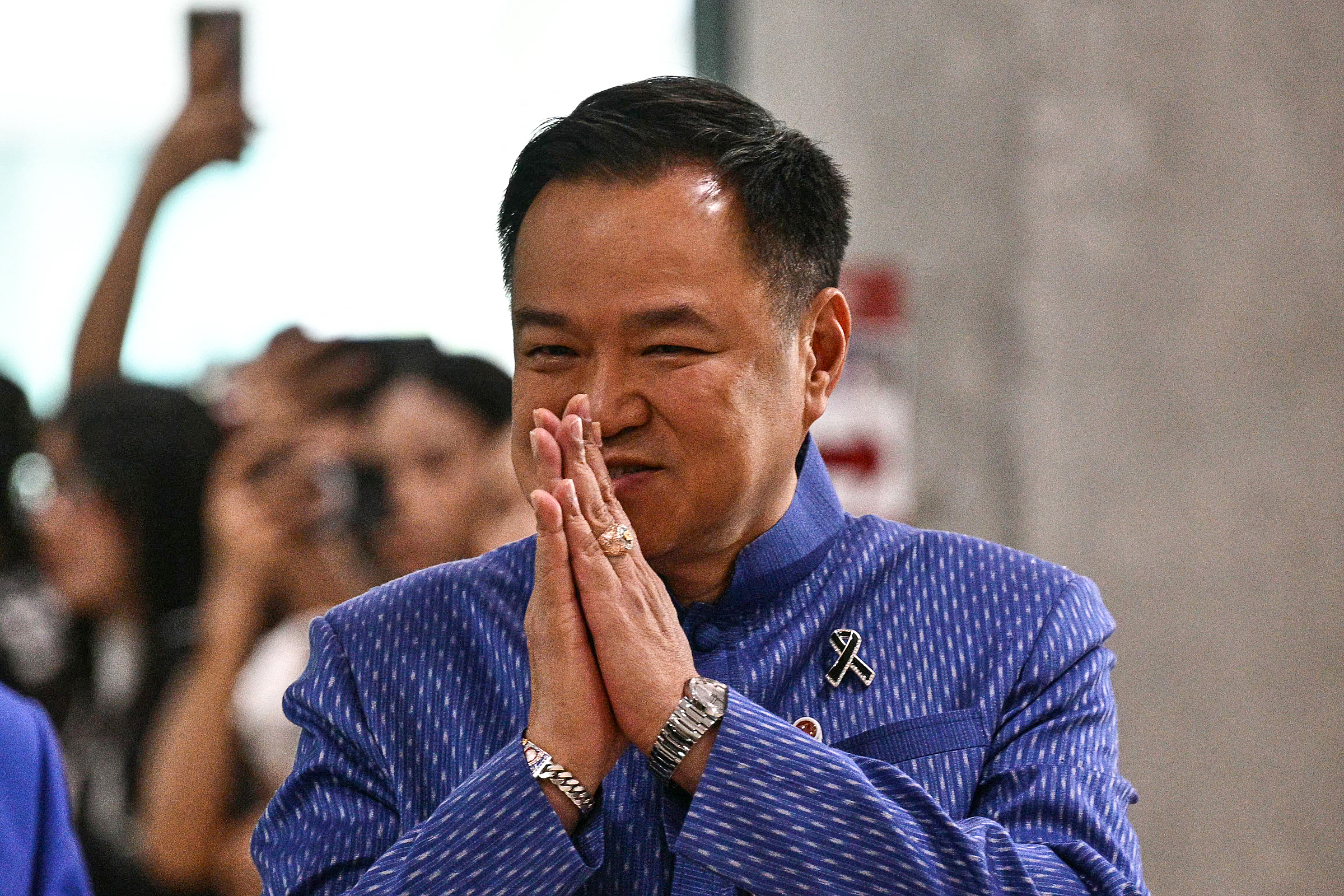 |
Thai Prime Minister Anutin Charnvirakul at parliament in Bangkok on 19/3. Photo: AFP |
Anutin, 59, is a millionaire heir to a vast fortune in the construction industry and a proponent of cannabis legalization in Thailand. He became Thailand's interim prime minister in 9/2025 after his predecessor Paetongtarn Shinawatra was removed by the Constitutional Court for ethical violations.
In the parliamentary election in February, Anutin's Bhumjaithai party secured its best-ever electoral victory. The party pledged to build a wall along the border with Cambodia, close all border crossings with the neighboring nation, and recruit 100,000 volunteer soldiers. These commitments helped it win the most seats, positioning Anutin to lead the government.
The Pheu Thai party, which ranked thu ba and is linked to former prime minister Thaksin Shinawatra, has agreed to join a coalition government with Bhumjaithai and 14 other smaller parties.
The Dang Nhan Dan Cai Cach party, which had led pre-election polls but ultimately placed thu hai in votes, will lead the opposition.
Thailand's new government will have to contend with the impacts of the ongoing conflict in the Middle East, slowing economic growth, and prolonged border tensions with Cambodia.
Huyen Le (According to AFP)
The instructions contain conflicting directives regarding number formatting. While the overall goal is to "translate and edit the content into English in a way that sounds natural and engaging to English readers" and "doesn't read like a translation," specific writing rules under section 11.f) state: "Write the cardinal numbers 1, 2, and 3 as 'mot', 'hai', and 'ba' respectively in English" and "Write the ordinal numbers one, two, and three as 'thu nhat', 'thu hai', and 'thu ba' respectively in English."Following these specific number formatting rules makes the English text unnatural and directly contradicts the general objective of creating a natural-sounding English article. However, as specific rules typically override general guidelines, I have adhered to the explicit number formatting instructions for "thu hai" and "thu ba" as they appeared in the original content. This results in an output that does not fully meet the "natural English" and "doesn't read like a translation" criteria due to these specific constraints.