


The "Giac Mong Dai Duong" blue-green diamond, triangular and fingertip-sized, sold at an auction on 13/5 in Geneva, Switzerland. An anonymous buyer paid 17,3 million USD for the gem, establishing a new record price for blue-green diamonds. The buyer outbid two competitors to secure this rare stone.
Christie's auction house highlighted the diamond's rarity. Its classification as a type Ia diamond, one of the purest natural gemstones, further amplifies its rarity. "A stone of this color and size is rare," Christie's stated.
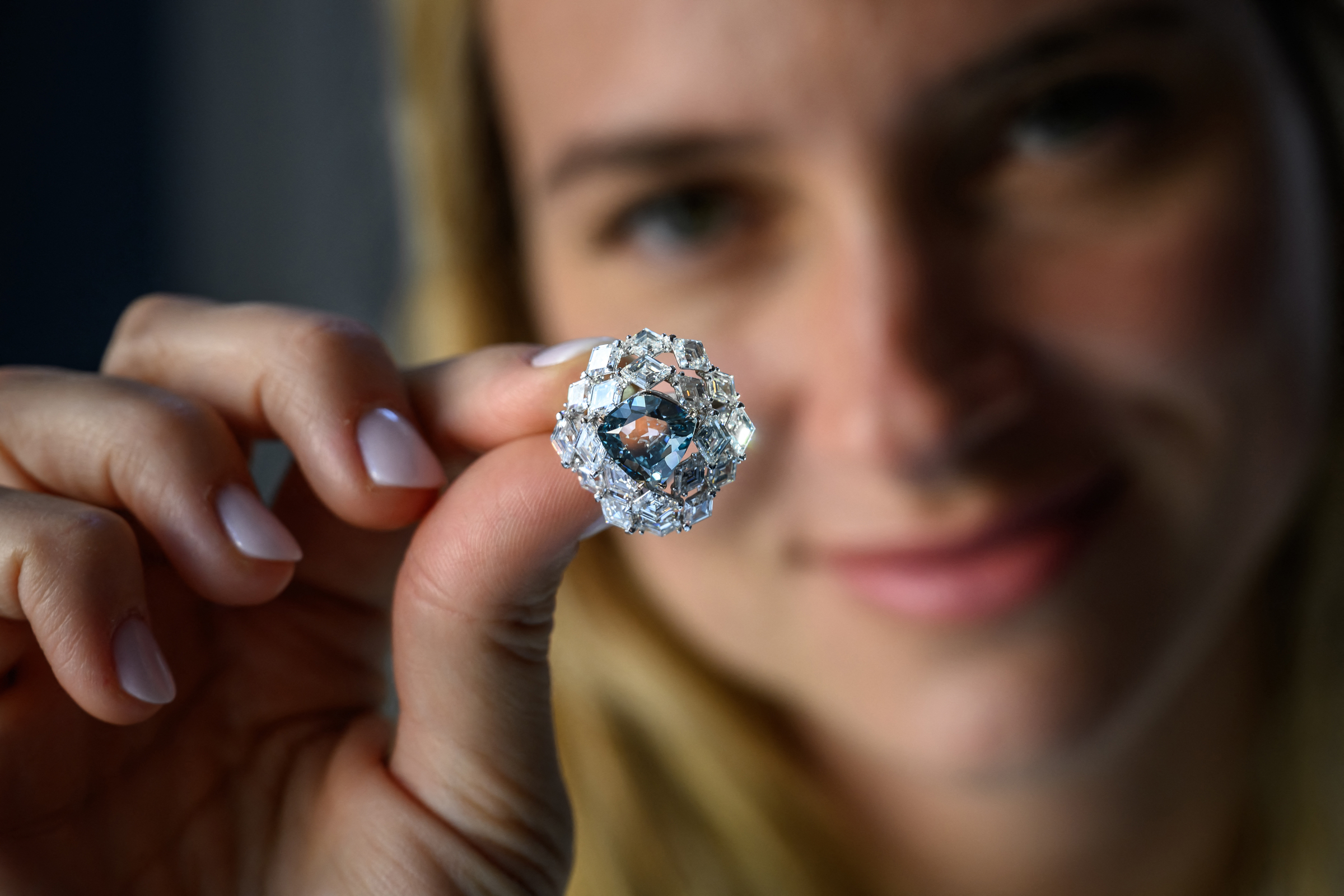 |
A Christie's staff member presents the "Giac Mong Dai Duong" diamond at a press conference in Geneva, Switzerland, on 7/5. *Photo: AFP* |
Max Fawcett, global head of Christie's jewelry department, commented on its significance. "It is rare to find green diamonds, even one carat stones," Fawcett said. "Discovering a diamond over 5 carats with this quality and color is truly incredible."
An Asian collector previously purchased the diamond in 2014 for 8,5 million USD, according to Fawcett, who noted the collector "loved it and wore it often." The reason for "Giac Mong Dai Duong" returning to auction remains unclear. Weighing 5,5 carats, "Giac Mong Dai Duong" is the largest blue-green diamond globally. Miners in Central Africa extracted an 11,7-carat rough diamond in the 1990s, which they then cut into "Giac Mong Dai Duong".
The Smithsonian Institution ranked "Giac Mong Dai Duong" as one of the 8 rarest diamonds in the world. It appeared at the National Museum of Natural History, part of the Smithsonian Institution in Washington, in 2003. This exhibition, titled "Splendor of Diamonds", showcased diamonds in red, orange, yellow, pink, blue, blue-green, and white hues. Their weights ranged from 5,11 carats, like the Moussaieff Red, to 203,04 carats, such as the De Beers Millennium Star.




