Abdul Muhari, spokesperson for Indonesia's National Disaster Mitigation Agency (BNPB), announced on 10/7 that a fire at the Jatiwaringin landfill, located in Jakarta's Tangerang district, erupted on 30/6. The blaze spread across approximately 15 hectares before firefighters contained it on the evening of 9/7.
Images and videos from the scene depicted plumes of smoke rising from the "trash mountain", which stands 20-30 meters high, equivalent to a 7-story building.
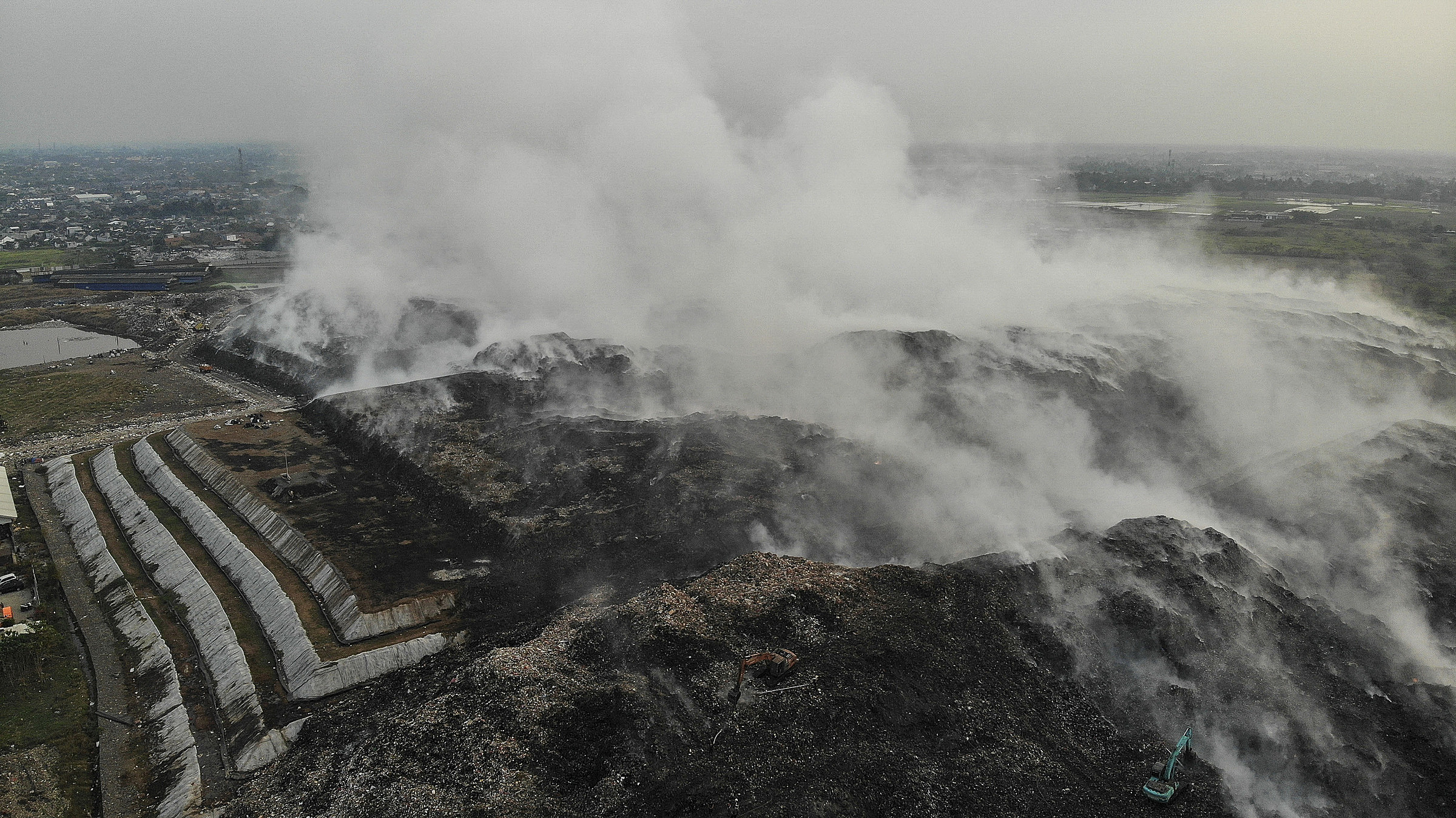 |
Smoke rises from the fire at Jatiwaringin landfill, Tangerang district, Jakarta, on 3/7. *Photo: AFP* |
BNPB reported that over 230 people were evacuated from the area surrounding the landfill. Local authorities declared a two-week state of emergency after more than 300 cases of acute respiratory syndrome were recorded in the area due to inhaling smoke.
Firefighters are continuing to spray water to fully extinguish hotspots, according to Abdul Muhari. "We maintain a state of vigilance, ready to increase water spraying in areas that have burned", he said.
Scene images showed firefighting helicopters dropping buckets of water onto the landfill, while firefighters accessed suspected hotspots below to spray water.
Those evacuated due to smoke have returned home. Rizal Irawan, an official from Indonesia's Ministry of Environment, stated that authorities are investigating the fire's cause.
Local residents expressed no surprise at the incident, as methane gas accumulated under millions of tons of trash easily ignites during prolonged heatwaves.
Wahyu Eka Styawan, an activist for the Indonesian Environmental Forum (Walhi), a non-governmental organization, described the situation as a "ticking time bomb". He attributed it to long-standing issues in waste management that authorities neglected for many years.
"Just a spark or a rise in temperature, and the methane gas accumulated under the trash mountain will ignite immediately", Wahyu explained.
Meanwhile, Indonesia's Agency for Meteorology, Climatology, and Geophysics (BMKG) warned that this year's dry season in the country could be longer and harsher than average, partly due to the effects of the El Nino phenomenon.
By Huyen Le (AFP, Independent)