The US Central Command (CENTCOM) conducted extensive airstrikes across several Iranian provinces on the night of 11/7 and early morning of 12/7. This marks the third US airstrike this week targeting Iran, coming after the Islamic Revolutionary Guard Corps (IRGC) attacked the Cyprus-flagged cargo ship GFS Galaxy in the Strait of Hormuz.
US Defense Secretary Pete Hegseth addressed the situation on X on 12/7, stating, "Iran made a bad choice. Now they will pay the price", citing CENTCOM's announcement of the strikes. Journalist Barak Ravid of Axios quoted a US official who detailed the targets, which included air defense surveillance radars, missile and drone storage facilities, missile and drone launchers, and Iranian naval radars.
Dozens of explosions were reported across the targeted locations. Iran's state television (IRIB) confirmed multiple blasts in the country's southern regions, with six explosions in the port cities of Bandar Abbas and Sirik, 10 in Jask in Hormozgan province, two in Chabahar, and at least 12 within Bushehr province. Iranian officials confirmed military and economic facilities were hit, including the Deyr base in Bushehr province. Iran's student television reported a military barracks in Risheh district, Bushehr province, was also struck. However, Bushehr Deputy Governor Ehsan Jahanian stated that no casualties had been recorded following the attacks, and the province's nuclear power plant appeared undamaged. Mehr news agency also reported the activation of air defense systems in the port city of Bandar-e Mahshahr, Khuzestan province.
 |
US Defense Secretary Pete Hegseth speaks at an event in Brussels, Belgium on 18/6. *Photo: AP* |
CENTCOM clarified that these airstrikes were a direct response to the IRGC's attack on the GFS Galaxy. The cargo ship, transiting the strategic Strait of Hormuz, was hit by a missile, causing its engine room to catch fire and rendering it unable to continue its journey. One crew member was reported missing.
Just prior to the attack on the GFS Galaxy, the IRGC Navy had announced a temporary closure of the Strait of Hormuz. Tehran stated that this closure would remain "until the US ceases interference in the region". Furthermore, Tehran declared that all civilian and military vessels would be prohibited from passing through the strait, accusing some ships of "ignoring warnings" and failing to switch to routes approved by Tehran, which, according to Iran, compelled the IRGC to open fire.
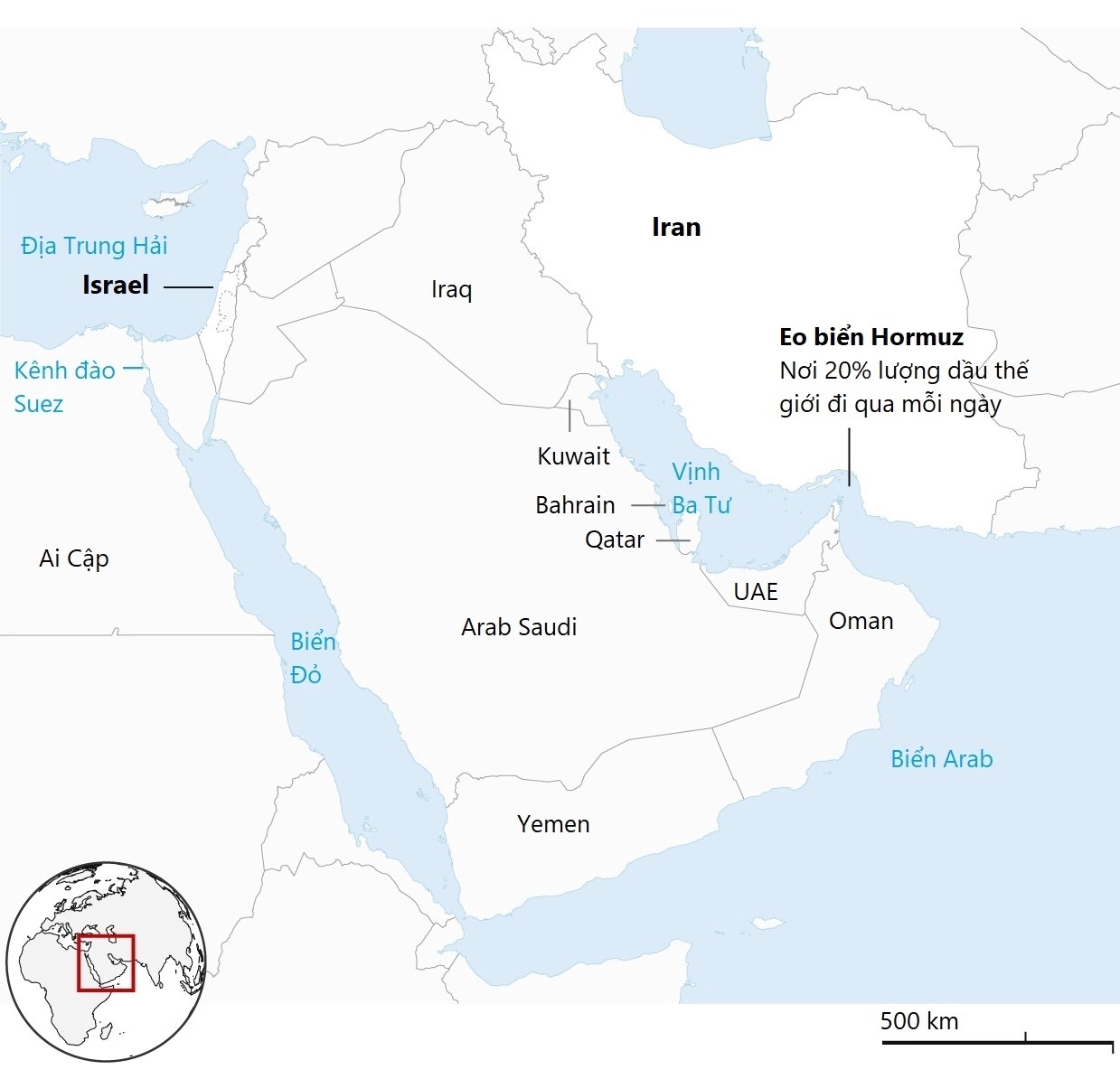 |
Location of Iran, Bahrain, and Kuwait. *Graphic: Guardian* |
Tensions surrounding the Strait of Hormuz continue to escalate following a series of attacks on commercial shipping, leading to tit-for-tat strikes between the US and Iran. Both Washington and Tehran remain at odds over control of maritime traffic in this vital waterway, which is crucial for global oil shipments.
By Thanh Danh (According to Al Jazeera, AFP)