Top US intelligence leaders, including Director of National Intelligence Tulsi Gabbard, Director of the Central Intelligence Agency (CIA) John Ratcliffe, and Director of the Federal Bureau of Investigation (FBI) Kash Patel, testified publicly on March 18 before the Senate Intelligence Committee.
The hearing's purpose was for senators to receive assessments from the intelligence community on major threats to US national security. However, the discussions primarily focused on Iran, as the conflict with the Middle Eastern nation entered its third week with no signs of an early resolution.
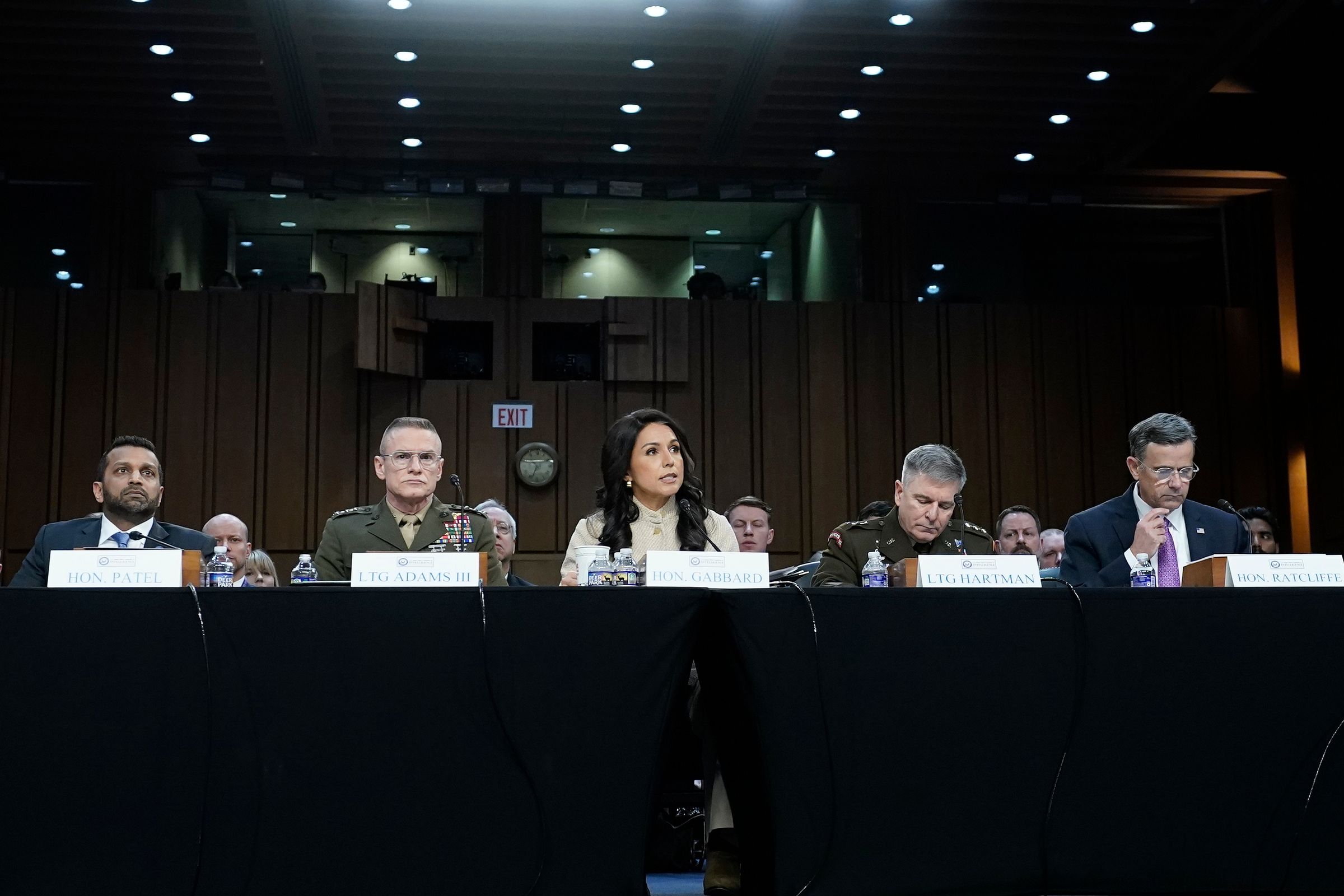 |
From left: Director of the Federal Bureau of Investigation Kash Patel, Director of the Defense Intelligence Agency James Adam, Director of National Intelligence Tulsi Gabbard, acting commander of US Cyber Command William Hartman, and Director of the Central Intelligence Agency John Ratcliffe at the Senate hearing on March 18. Photo: AP
The most frequent line of questioning centered on whether Iran constituted an "imminent threat" to the US, a justification cited by the Trump administration for launching its offensive.
This issue gained prominence after Joe Kent, director of the National Counterterrorism Center and a senior aide to Ms. Gabbard, resigned on March 17. Kent objected to the war with Iran, asserting that Tehran did not pose an "imminent threat" and that Washington was drawn into the conflict due to pressure from Israel.
In her opening statement, Ms. Gabbard noted that the Iranian government might face growing challenges due to its weakening economy. Nevertheless, she stated that Iran and its proxy forces "continue to attack US and allied interests in the Middle East", despite suffering losses before and after the conflict erupted.
Significantly, Ms. Gabbard deviated from her prepared written statement submitted to the committee before the hearing. She mentioned that following US military bombings of Iranian nuclear facilities in summer 2025, Tehran was "trying to fix severe damage" caused by the campaign.
Her prior written statement indicated that Iran "made no effort to restore uranium enrichment capabilities after US airstrikes". This assessment somewhat contradicted President Trump's view that Iran was "pursuing nuclear ambitions and developing missiles capable of reaching the US, creating an imminent threat that compelled Washington to act".
When Senator Mark Warner, the leading Democrat on the committee, questioned the reason for this change, Ms. Gabbard explained she omitted certain sections due to "time constraints". Senator Warner accused Ms. Gabbard of "deliberately omitting parts that contradict the President".
Senator Jon Ossoff, a Democrat, then asked if the written document still accurately reflected the intelligence community's assessment. Ms. Gabbard affirmed that it did. He further pressed whether the intelligence community had assessed Iran's nuclear program as "destroyed", as President Trump stated in June, only for it to become an "imminent threat" in recent weeks.
Ms. Gabbard did not respond directly to the question, appearing evasive. "Yes or no?", Senator Ossoff emphasized.
"The intelligence community is not responsible for deciding if something is an imminent threat", Ms. Gabbard responded. "The President is the only one who can decide what threat is considered imminent, not the intelligence community".
Senator Ossoff countered, asserting that assessing national security threats is a core duty of US intelligence agencies.
Meanwhile, Mr. Ratcliffe offered a different perspective. He stated that Iran has long been a threat to the US and is currently a "direct threat", deliberately avoiding the phrase "imminent". The CIA director added that Iran is a destabilizing force in the Middle East, "tolerated and empowered by previous US administrations, making them the threat they are today".
During his State of the Union address in late February, President Trump declared that Iran was developing intercontinental ballistic missiles (ICBMs) that "will soon reach the US". However, the US intelligence community seemingly did not share this view.
In her written statement to the committee, Ms. Gabbard reiterated a previous assessment that Iran "could use existing technologies to begin developing a military-grade ICBM before 2035, if Tehran truly intends to". Ms. Gabbard indicated that the intelligence community would update this assessment during the current conflict.
When Senator Tom Cotton, the Republican chairman of the Senate Intelligence Committee, cited other analyses estimating Iran could possess ICBMs "threatening the US in six months", Mr. Ratcliffe declined to provide a specific timeframe. Instead, the CIA director merely agreed that Senator Cotton's concern was valid.
Several other Democratic senators on the committee attempted to compel Ms. Gabbard to clarify the information she provided to the President before the conflict with Iran erupted, including assessments of Iran's capability to attack maritime shipping in the Strait of Hormuz, but they were unsuccessful.
"I will not comment on whether or not the President asked me about any issues", Ms. Gabbard affirmed.
Conversely, Mr. Ratcliffe confirmed that US agencies were prepared for Iran's response, but he did not elaborate on specific intelligence assessments.
Republican senators questioned Mr. Ratcliffe about the possibility of the war with Iran diminishing the US military's readiness to confront threats from Russia and China.
Mr. Ratcliffe responded that the intelligence provided before the attack on Iran was "perfect". He argued that while attacks targeting US personnel and interests in the Middle East "will come at a cost", the US military and intelligence community are capable of "doing both at the same time".
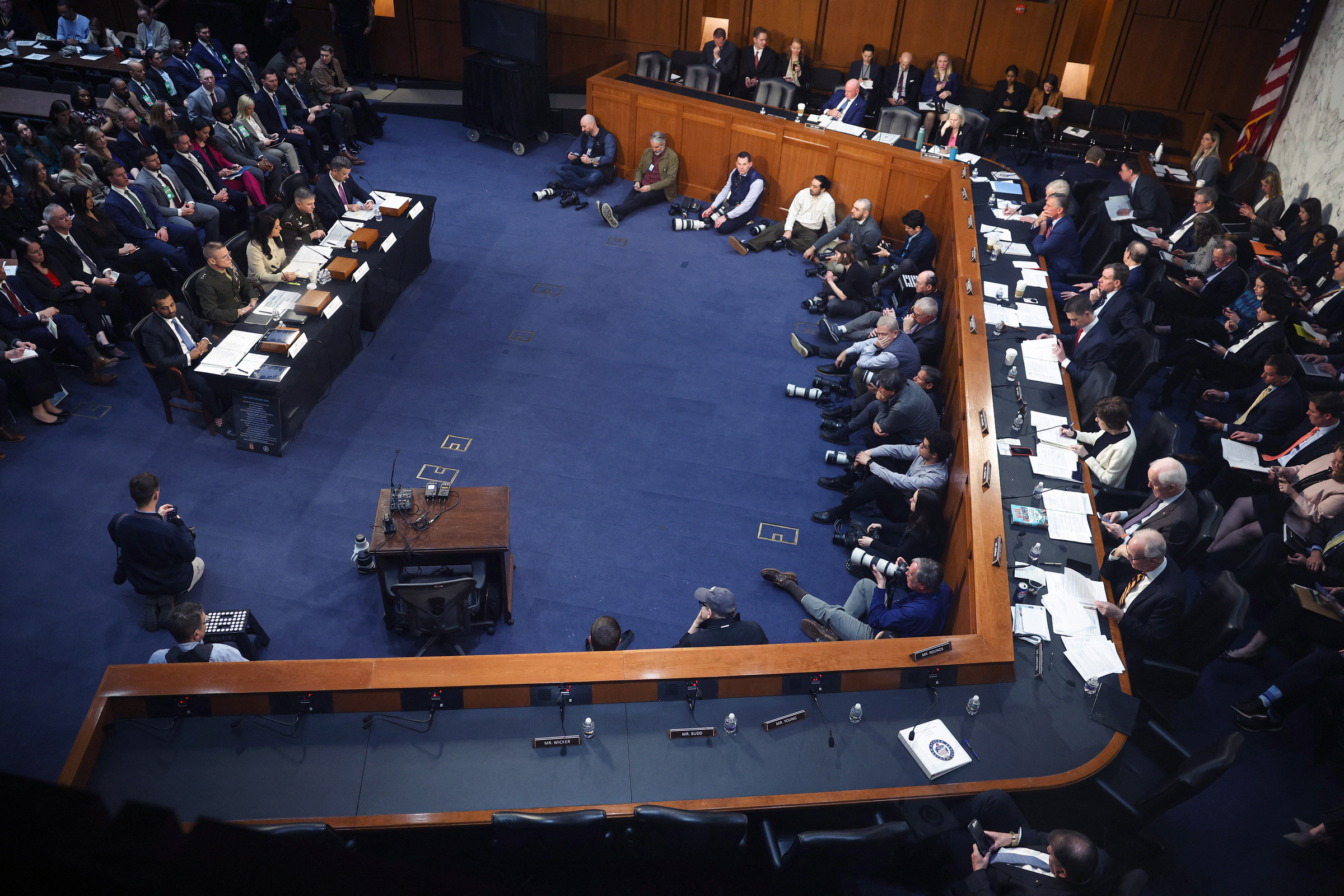 |
The scene at the Senate Intelligence Committee hearing on March 18. Photo: AFP
During the hearing, US intelligence officials also presented other assessments from the US intelligence community, such as Russia gaining an advantage in the conflict in Ukraine, and that the US does not face a risk of foreign interference in the midterm elections in November.
Ms. Gabbard stated that Russia, China, North Korea, Iran, and Pakistan are researching and developing missile systems capable of reaching the US.
After two and a half hours of intense questioning in the Senate, Ms. Gabbard and other US intelligence leaders were scheduled to continue their testimony before the House Intelligence Committee on March 19.
Nhu Tam (According to CNN, Washington Post, Politico)