Chinese President Xi Jinping and North Korean leader Kim Jong-un on 8/6 praised the "unbreakable" relationship between their two countries during Xi's visit to Pyongyang.
The two-day trip marked Xi's first overseas visit this year and the first by a Chinese leader to Pyongyang in seven years. The visit occurred as North Korea continues to expand its international influence, having become a key partner for Russia in the conflict in Ukraine.
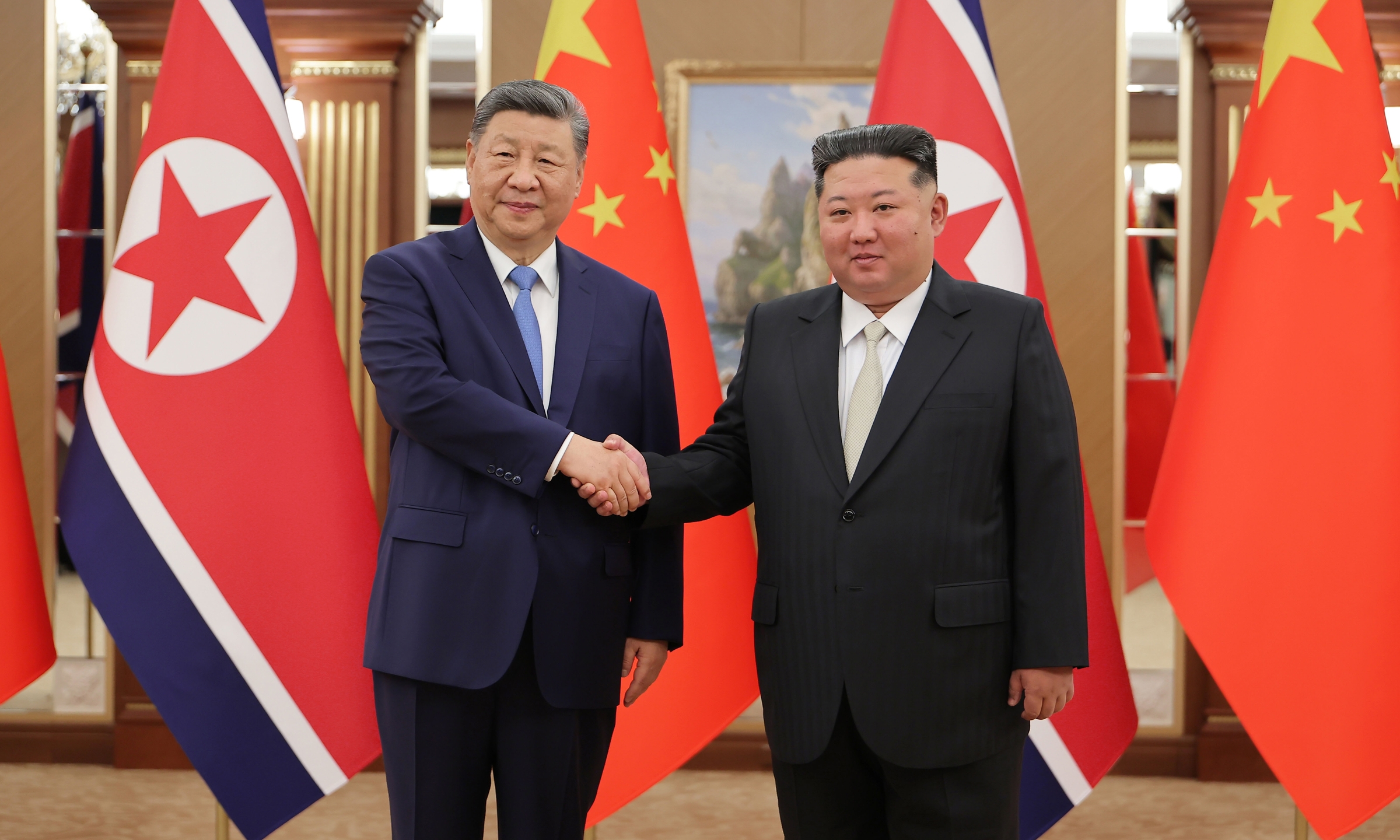 |
North Korean leader Kim Jong-un (right) and Chinese President Xi Jinping shake hands before their talks at the Kumsusan State Guest House in Pyongyang on 8/6. Photo: AP
According to a communique on the talks between the two leaders, released by China's Xinhua news agency, President Xi called for both sides to engage in "close strategic coordination" and enhance exchanges "at all levels, across all sectors."
Xi expressed his readiness to deepen ties with the North Korean leader in a "new era," a phrase the Chinese president has previously used to allude to the increasing power and influence of the United States on the international stage. Xinhua also detailed proposals ranging from high-level exchanges to trade, agriculture, and the restoration of transport routes between the two nations.
Hong Min, a senior researcher at the Korea Institute for National Unification (KINU), suggested that Xi's emphasis on economic and trade exchanges during the visit indicates China's focus on creating leverage with North Korea, especially as Pyongyang increasingly solidifies its relationship with Moscow.
Since Russia launched its operation in Ukraine in 2022, Pyongyang has expanded military cooperation with Moscow, sending troops to Russia's Kursk province to counter Ukraine's offensive, culminating in a mutual defense treaty signed during Putin's visit to North Korea in 2024.
"China wants to ensure that its interests with North Korea are protected as Moscow and Pyongyang rapidly grow closer," noted Ankit Panda, a nuclear policy expert at the Carnegie Endowment for International Peace.
Chu Feng, Dean of the Institute of International Studies at Nanjing University, China, stated that Beijing's deep concern is being drawn into a Russia-China-North Korea alliance to openly confront the West. Such a Cold War-era alliance could be highly detrimental to China's efforts to cooperate and trade with the United States and Europe.
"The issue is that Russia and North Korea hope to form such a trilateral military alliance," Chu said. "This is a Cold War-era structure that China absolutely cannot accept."
The welcoming ceremony for President Xi Jinping in Pyongyang, North Korea, on 8/6. Video:CCTV, Xinhua
However, if China does not take steps to strengthen its relationship with North Korea, it risks Moscow becoming the overwhelmingly influential party with Pyongyang, significantly reducing Beijing's leverage, expert Panda pointed out.
China has responded by attempting to re-establish its relationship with North Korea. Last year, Xi invited Kim to a military parade in Beijing, placing him prominently alongside himself and Putin.
This marked their first summit in six years. Xi praised the two countries as "good neighbors, good friends, and good comrades bound by a common destiny," calling for closer coordination.
Xi's current visit is part of this objective. The Chinese president had not visited Pyongyang since 2019 and has consistently reduced his foreign trips in recent years.
"We need to remember that Xi actually does not travel abroad much," said William Yang, a senior analyst for Northeast Asia at the International Crisis Group. "President Xi's decision to personally visit Pyongyang shows how much China values this trip."
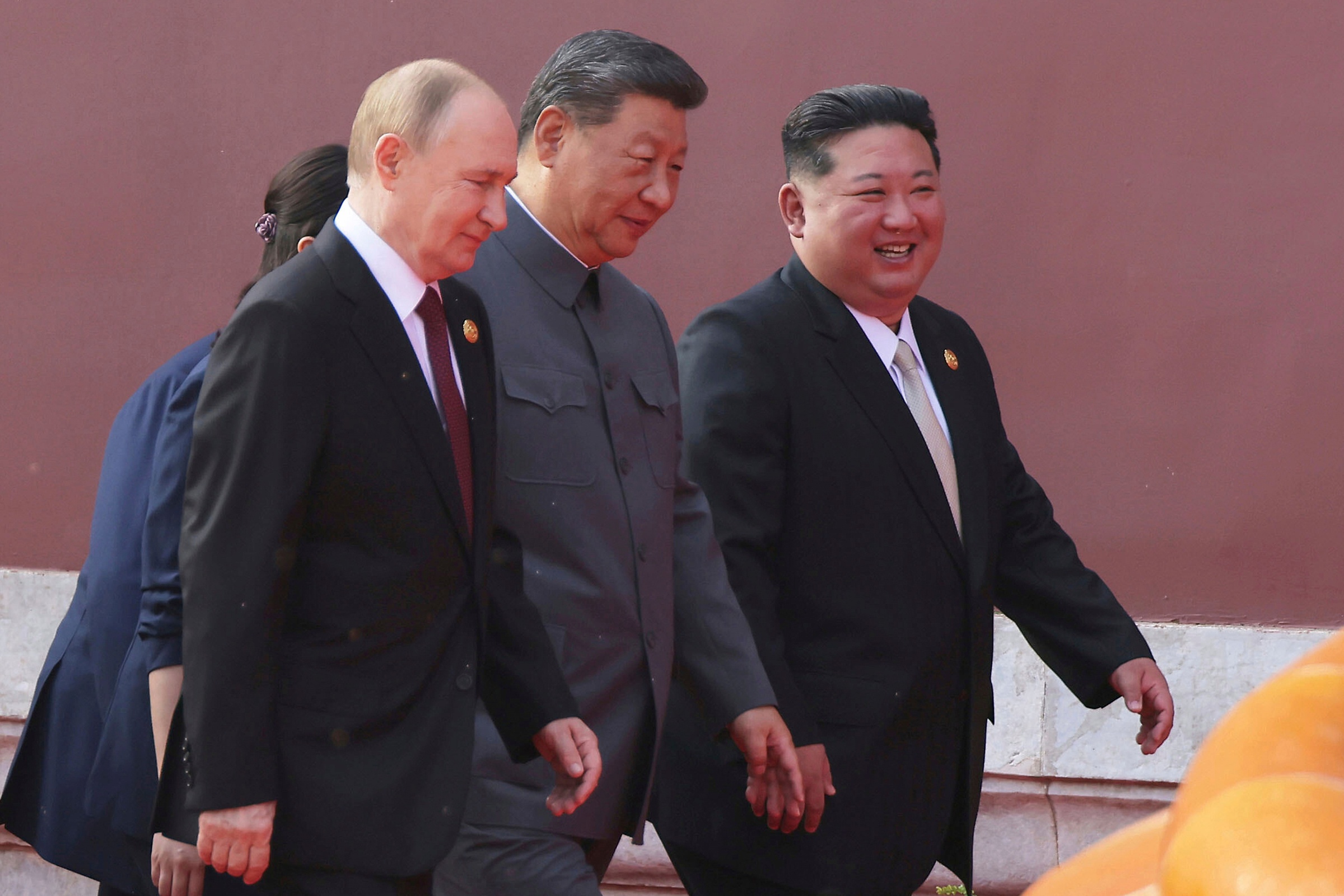 |
From left, Russian President Vladimir Putin, Chinese President Xi Jinping, and North Korean leader Kim Jong-un attend a military parade commemorating the 80th anniversary of the end of World War II in Tiananmen Square, Beijing, in 9/2025. Photo: AP
According to Rachel Minyoung Lee, a senior associate with the Korea Program at the Stimson Center, based in Washington, Beijing could also increase economic support to Pyongyang to limit Russia's influence over North Korea.
China's exports to North Korea soared to about 2.3 billion USD last year, the highest level in six years. Passenger train services between Beijing and Pyongyang also resumed early this year after a six-year hiatus.
Xi stated on 8/6 that the recent resumption of passenger train and flight services between Beijing and Pyongyang would help expand exchanges. The two neighbors also pledged to enhance cooperation in tourism.
In a thank-you message after the visit, Xi stated that he and Kim Jong-un had reached "important consensus" after extensive discussions and agreed to jointly safeguard regional and global peace. Details of the agreements reached by the two sides were not disclosed.
However, Professor Lim Eul-chul, an expert at Kyungnam University in South Korea, pointed out that while Xi focused on the economic and trade relationship between the two countries and global order initiatives, North Korea appeared to have different concerns.
In its official communique on the visit's outcomes, North Korea's official Korean Central News Agency (KCNA) omitted information that might suggest the country was "subordinate" to China or dependent on it. Instead, Pyongyang emphasized national dignity and a "special relationship" with its neighbor, creating the impression of two equal partners.
KCNA reported that during this summit, Kim and Xi agreed to expand cooperation in political, economic, and cultural fields, emphasizing that the Pyongyang summit had "opened a new chapter in bilateral relations."
"The North Korean communique highlighted solidarity, expressed through messages countering the United States or concerning Taiwan, to demonstrate equality," expert Hong Min commented.
Neither the Chinese nor the North Korean communique mentioned Pyongyang's nuclear program. Unlike the visit seven years prior, Xi no longer mentioned China's support for "denuclearization of the Korean peninsula," which is seen as a victory for Kim, who considers nuclear weapons possession an inherent right for Pyongyang.
Experts indicated that for Kim, balancing relations with China is also a practical choice. If the conflict in Ukraine ends, Russia's need for support from North Korea could decrease.
"China recognizes the risks of exerting excessive pressure on North Korea," said expert Leif-Eric Easley, a professor at Ewha Womans University in Seoul, South Korea. Meanwhile, a more confident Pyongyang seeks greater equality in its relationship with Beijing.
"China expects North Korea to respect its interests and avoid destabilizing policies," Professor Easley noted. "While not unconditional support, Xi's visit is a strategic move to forge closer ties with Kim."
Vu Hoang (According to CGTN, Washington Post, KCNA)