A collision between an Air Canada Express plane carrying 76 people and a fire truck on the night of march 22 at LaGuardia airport resulted in the deaths of the captain and first officer, and injured over 40 others. The Bombardier CRJ-900 aircraft's nose was completely destroyed after the impact, which occurred during the final stages of landing while the plane was moving at approximately 48 km/h.
Experts attribute the severe damage to the fundamental design philosophy of aircraft. Unlike automobiles, planes are not engineered for ground impacts. Michael McCormick, an associate professor of air traffic management at Embry Riddle Aeronautical University, explained that the primary criterion in aircraft design is ensuring safe flight capability. This focus includes resisting turbulence, avoiding mid-air collisions with birds and other aircraft, and surviving emergency landings, even on water. Aircraft are built to endure repeated takeoffs and landings via the landing gear, and to withstand impact forces on the underside if landing without deployed gear, essentially "sliding along the runway."
John Hansman, a professor of aeronautics and astronautics at the Massachusetts Institute of Technology (MIT), highlighted that while cockpits can withstand bird strikes and engines are designed to detach during water landings, aircraft are not built to resist impacts with other objects. He noted that every component on a plane balances weight and flight performance. "Anything reinforced to make the aircraft stronger adds weight. The plane would have to carry this mass throughout the flight, leading to inefficiency," Hansman stated. This design compromise means features common in cars, such as airbags, bumpers, or rigid cockpits designed to absorb frontal impact energy, are absent in aircraft.
A specific vulnerability lies in the aircraft's nose cone. While the fuselage is largely aluminum, the nose, which houses crucial radar equipment, is made of composite plastic. Professor McCormick clarified that a metal nose would interfere with radar function. This material choice, while necessary for radar, makes the nose exceptionally susceptible to destruction in the rare event of a ground collision.
Pilots also face significant limitations in avoiding ground obstacles. Unlike cars, aircraft cannot quickly steer to avoid sudden obstructions. Hansman explained that once an aircraft reaches a certain speed during landing or takeoff, a pilot's options are severely limited. "Even if a vehicle appears ahead, you don't have enough runway to lift the plane. At that point, the only option is to brake as hard as possible," he said. "Especially if a car suddenly pulls out right in front of the nose, the pilot has almost no way to react."
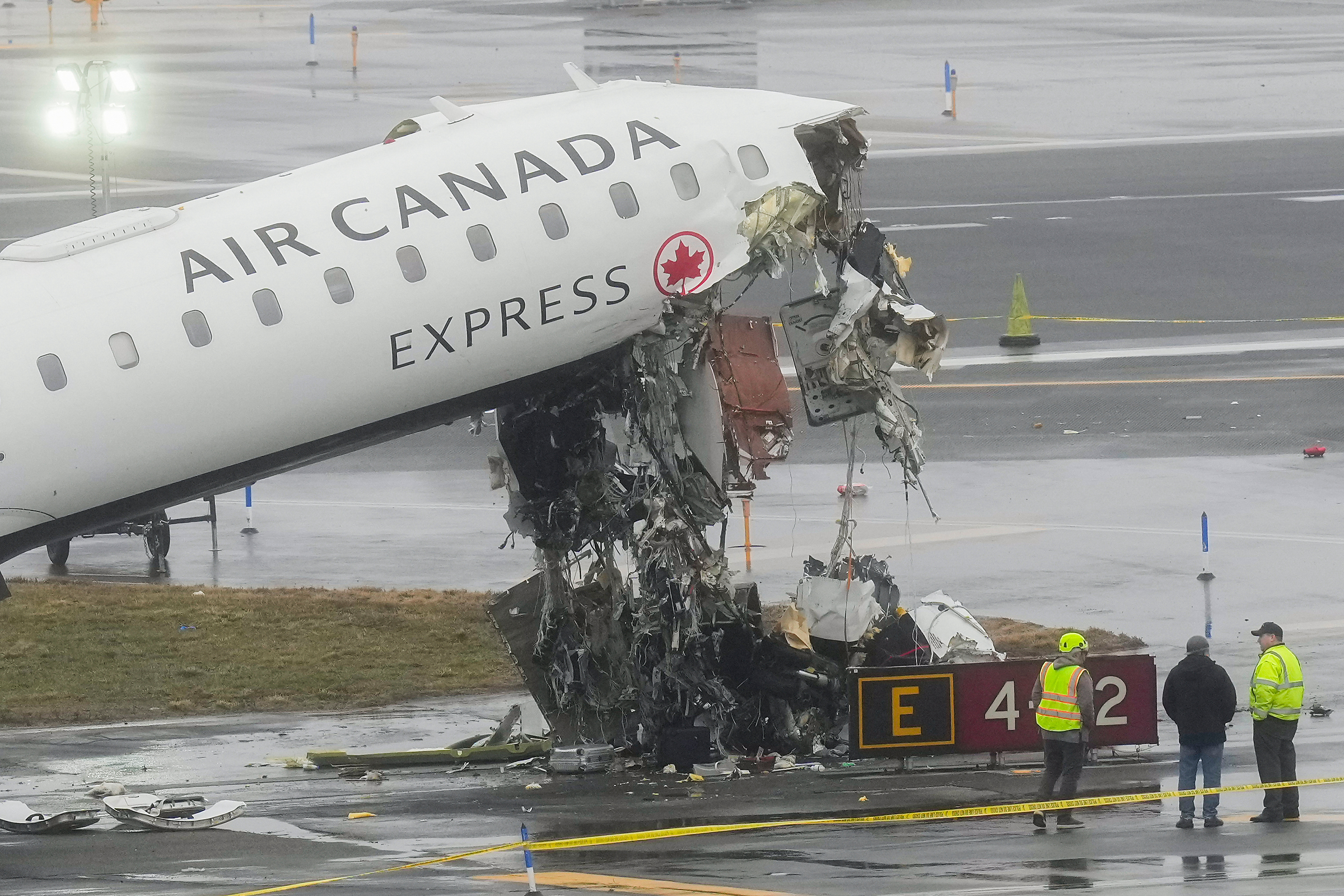 |
The aircraft's nose was destroyed after colliding with a fire truck, at LaGuardia airport, on march 23. Photo: AP |
Professor McCormick also mentioned that LaGuardia airport has short runways. These runways were not originally designed for commercial jet aircraft and required an extension in the 1960s. However, the National Transportation Safety Board (NTSB) and the Federal Aviation Administration (FAA) have not yet determined if runway length was a contributing factor to the incident on the night of march 22, as the cause of the accident remains under investigation.
Duc Trung (According to Scientific American, Washington Post, AP)
LaGuardia airport |