According to the China Association of Automobile Manufacturers (CAAM), the country's car exports continued their strong growth in July, after surpassing one million vehicles for the first time in June. Prior to this, monthly exports had exceeded 900,000 vehicles in both April and May.
Specifically for new energy vehicles (NEVs), China exported 553,000 units in July, marking a 145.5% increase year-on-year. These vehicles accounted for more than one-half of the total car exports for the month.
This export surge comes as the Chinese car market shows signs of slowing. Carmakers are increasingly relying on foreign demand to sustain growth, as domestic car purchase incentive policies gradually diminish and local purchasing power weakens.
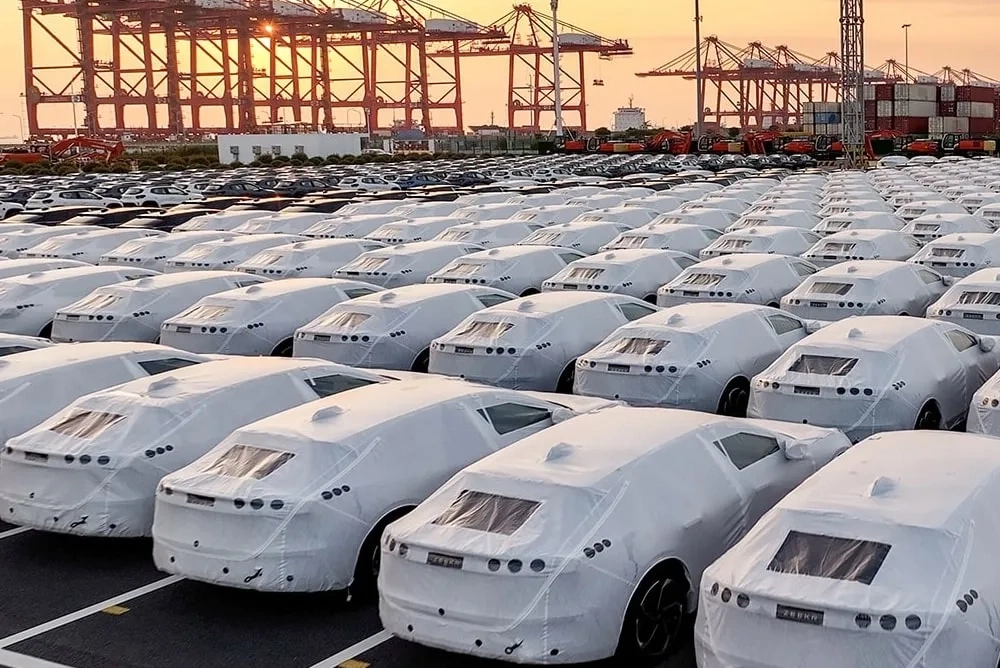 |
Chinese cars at the port, awaiting export. Photo: Zeekr |
CAAM stated that China's automotive industry benefits from a complete production chain, encompassing lithium mining and processing, battery manufacturing, motors, control systems, and vehicle assembly. This large-scale production allows companies to maintain competitive advantages in capacity and cost.
Beyond competitive pricing, Chinese manufacturers are also enhancing their competitiveness through technological advancements. Advanced driver-assistance systems and cockpits integrated with artificial intelligence are helping Chinese vehicles attract more customers in overseas markets.
In July, the total volume of NEVs sold by Chinese brands, including both domestic and export markets, reached approximately 1.56 million units, a 23.7% increase year-on-year. Of this, battery electric vehicles accounted for about 1.07 million units, up 32%, while plug-in hybrid vehicles reached approximately 489,000 units, a rise of 8.4%.
Chen Shihua, Deputy Secretary General of CAAM, noted that exports are becoming a significant growth driver for China's automotive industry. This overseas expansion comes as Chinese brands increasingly establish their presence in various markets. BYD, Geely, Chery, and many other electric vehicle manufacturers are boosting exports while also building overseas production facilities to shorten supply chains and access local consumers.
Ho Tan (according to Electrive)