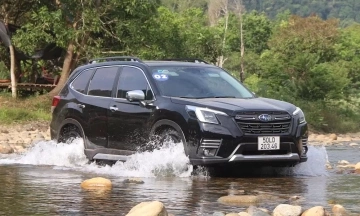
A total of 10,064 Jaecoo J7 units were sold in March, surpassing 9,193 Ford Puma vehicles, 8,718 Nissan Qashqai vehicles, and 7,310 Kia Sportage vehicles, according to the Society of Motor Manufacturers and Traders (SMMT). This marks the first time a Chinese model has led the list of best-selling cars in the UK market for a month.
| No. | Model | March Sales (Units) |
| 1 | Jaecoo J7 | 10.064 |
| 2 | Ford Puma | 9.193 |
| 3 | Nissan Qashqai | 8.718 |
| 4 | Kia Sportage | 7.310 |
| 5 | Vauxhall Corsa | 6.315 |
| 6 | Volvo XC40 | 6.311 |
| 7 | MG HS | 6.135 |
| 8 | Volkswagen Golf | 5.890 |
| 9 | Tesla Model Y | 5.177 |
| 10 | BMW Series 1 | 4.936 |
March also proved to be the busiest sales period for the UK automotive industry, with electric vehicles (EVs) and hybrid electric vehicles (HEVs) achieving record sales figures.
Since its launch in the UK market in September 2025, the Jaecoo J7 has consistently appeared on the monthly best-selling car list. Year-to-date 2026, the J7 has sold 15,569 units, ranking second after the Puma with 16,128 units. The Sportage holds third place with 14,190 units, and the Qashqai is in fourth position with 12,853 units.
The J7 plug-in hybrid electric vehicle (PHEV) variant quickly became a "star" of the product line, accounting for 85% of sales in March, the Chinese automaker stated.
In the UK, the J7 has a starting price of 38,600 USD for the petrol version, and goes up to 46,600 USD for the top-tier PHEV model. Even at its highest trim, the J7 is priced lower than similarly sized plug-in hybrid competitors, offering a clear competitive advantage in terms of cost.
The new car market in the UK accelerated in March, reporting a 6,6% increase to 380,627 new registrations. This made it the best sales month since 2019. Private customers led the growth at 10,1%, while fleet sales increased by 3,5% and business registrations by 18,8%.
Electrified vehicles experienced a record month, led by a 46,9% surge in PHEV sales. HEVs ranked second with a 7,3% increase, while EV sales rose by 24,2%.
In terms of market share, PHEVs accounted for 13%, HEVs for 15,8%, and EVs for 22,6% of UK sales in March. However, these figures remain significantly lower than the 33% zero-emission vehicle target set by the government for 2026.
| No. | Model | Cumulative 2026 (Units) |
| 1 | Ford Puma | 16.128 |
| 2 | Jaecoo J7 | 15.569 |
| 3 | Kia Sportage | 14.190 |
| 4 | Nissan Qashqai | 12.853 |
| 5 | Vauxhall Corsa | 10.552 |
| 6 | Volvo XC40 | 9.288 |
| 7 | Volkswagen Golf | 9.176 |
| 8 | MG HS | 9.147 |
| 9 | Nissan Juke | 8.512 |
| 10 | Mini Cooper | 8.109 |
SMMT reported that automakers are relying heavily on discounts to maintain growth momentum. Concurrently, battery costs are approximately 30% higher than anticipated, while public charging prices have increased by 140% over the past five years. This combination makes profit margins increasingly uncertain.
The situation is further complicated by the ongoing Iran crisis. The conflict has sharply driven up fuel prices, encouraging consumers to consider electric vehicles. However, it also risks eroding consumer confidence due to broadly rising living costs.
By Minh Vu (Source: Carscoops, AutoCar)