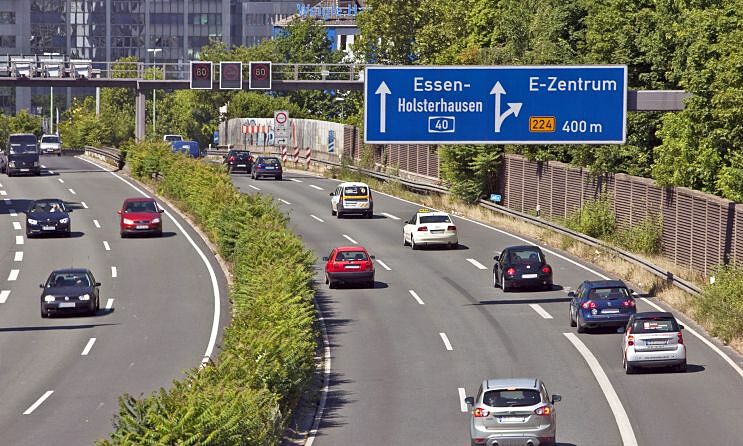
In recent days, the Traffic Police Department proposed two suggestions related to overtaking: designating the left lane on highways for overtaking and prohibiting the use of oncoming lanes for overtaking. This, combined with earlier highway lane division efforts, indicates authorities are working to align Vietnam's traffic standards with global norms. Frankly, Vietnam is one of the few countries with very impulsive traffic.
Why do I make such a statement? I am the author of "The joy of driving on Western highways". However, one doesn't need to travel to the West; simply crossing the border into Laos reveals a distinct traffic culture. On Laotian roads, there is no honking, and vehicles adhere to regulations, patiently queuing. No one ventures into the oncoming lane just because a vehicle ahead paused briefly to allow an elderly person to cross.
By now, perhaps opponents of these proposals will no longer resort to the "our infrastructure is underdeveloped" argument as an excuse. Laos, for instance, also has only two-lane highways. Observe their lane division: one lane for overtaking and one for cruising. (Naturally, an emergency lane is essential; roads in Vietnam lacking an emergency lane, in my view, do not qualify as highways and are thus excluded from this comparison).
We should strive to adopt regulations that align with global standards to foster civility. The ultimate goal is to drive without needing to overtake, where everyone proceeds in sequence without complaint or haste. So, why is overtaking so prevalent in Vietnam? In my opinion, there are two main reasons:
Weak Driving Skills
Most Vietnamese families have only recently acquired oto, with vehicle ownership often just transitioning to a second generation within households. Only affluent families might see a third generation of oto ownership. This relatively short period of oto use, following many years of motorcycle reliance, means driving skills are often underdeveloped. Many drivers on highways only feel comfortable traveling at 60-70 km/h, fearing a loss of control at higher speeds.
Weak driving skills often result in poor judgment. These slower drivers mistakenly believe that staying in the left lane ensures safety, rationalizing that "driving this way means not having to avoid anyone." This perspective is both selfish and erroneous.
I frequently find myself having to overtake on highways because I consistently drive at the maximum permitted speed. However, I often encounter "snail-paced" vehicles ahead that refuse to yield when signaled, leading to prolonged periods of disruptive maneuvering.
Lack of Queuing Awareness
In one scenario, drivers overtake because others fail to yield. Conversely, many drivers overtake due to a complete lack of queuing awareness. While you are entitled to overtake slower vehicles on a highway, there is no justification for constantly honking and flashing lights to pass on a blind curve while trailing a line of cars on a mountain pass. Such behavior demonstrates a disregard for traffic laws.
I can still empathize somewhat with drivers in the first category, but there is no room for sympathy for those in the second. They deserve severe penalties.
Hopefully, the Traffic Police Department's proposals will soon become law, gradually guiding us toward driving civility. This civility is achieved when everyone on the road merges into the busy traffic flow, consistently maintaining speed and distance. After all, no one would need to overtake if they could maintain 100 km/h on a highway without braking for an entire hour.
By Ba Phong, Reader