On 27/7, a proposal by the Traffic Police Department suggesting that the lane adjacent to the median divider on expressways should be exclusively for passing, prohibiting continuous driving, sparked extensive debate. A VnExpress poll conducted over 24 hours recorded over 15,000 votes, with opinions closely split: 53% of readers supported the proposal, while 47% disagreed.
Many readers believe this regulation would help resolve issues caused by slow vehicles hogging the left lane, which leads to congestion and forces following vehicles to make multiple lane changes to pass. "This is a traffic management method adopted by many countries globally to increase traffic flow and reduce conflicts between different vehicle streams," one widely supported comment stated.
Conversely, some expressed concerns that implementing this rule would be challenging given the specific characteristics of current Vietnamese expressways, especially sections with only two lanes per direction and high vehicle density. Many drivers argued that continuously having to return to the right lane after each pass would increase lane-changing maneuvers, potentially creating additional collision risks.
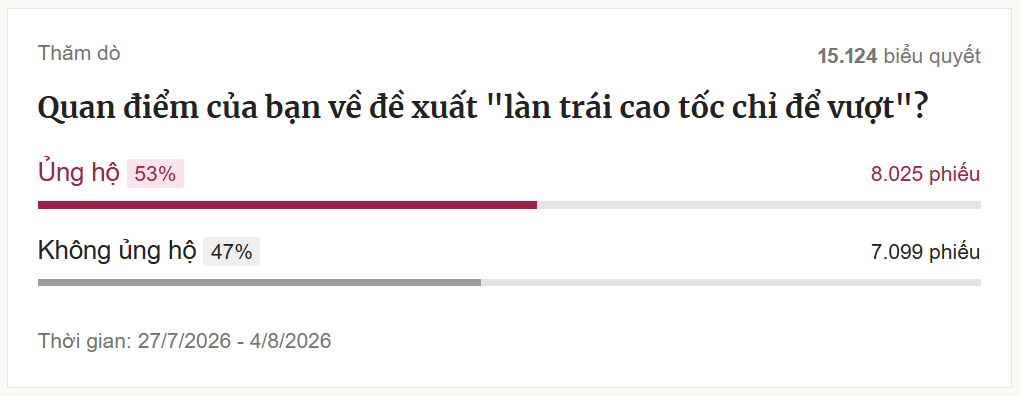 |
Results of the VnExpress reader poll from 13h57 on 27/7 to 13h30 on 28/7. *Screenshot*
Even in developed countries, this regulation generates debate. On automotive forums in the US, Canada, and Australia, some drivers contend that the rule requiring a return to the right lane after passing forces them to change lanes more frequently.
However, most proponents agree that the long-term benefits outweigh short-term inconveniences. A consistently clear left lane helps reduce slow vehicles occupying the passing lane, curbing unsafe practices like passing on the right or weaving between lanes, which are significant contributors to collision risks on expressways.
Regarding this issue, safe driving experts at Car Awards noted that while this law is new to Vietnam, it is not new globally. However, because it has not yet been implemented in practice and Vietnamese drivers often do not maintain consistent speeds on expressways, many remain hesitant.
Judge Trinh Tung, who has driven in the US, Europe, and many Southeast Asian countries, emphasized that whether an expressway has two or more lanes per direction, drivers primarily use the right lane, only moving to the left lane when passing and then quickly returning to their original lane.
According to Trinh Tung, on any road, some vehicles travel below the maximum speed limit for various reasons. If these vehicles continuously occupy the lane next to the median divider, traffic behind will be obstructed, leading to long queues or forcing drivers to pass under unsafe conditions. Reserving the left lane for passing ensures a clear path for faster vehicles, thereby increasing overall traffic capacity.
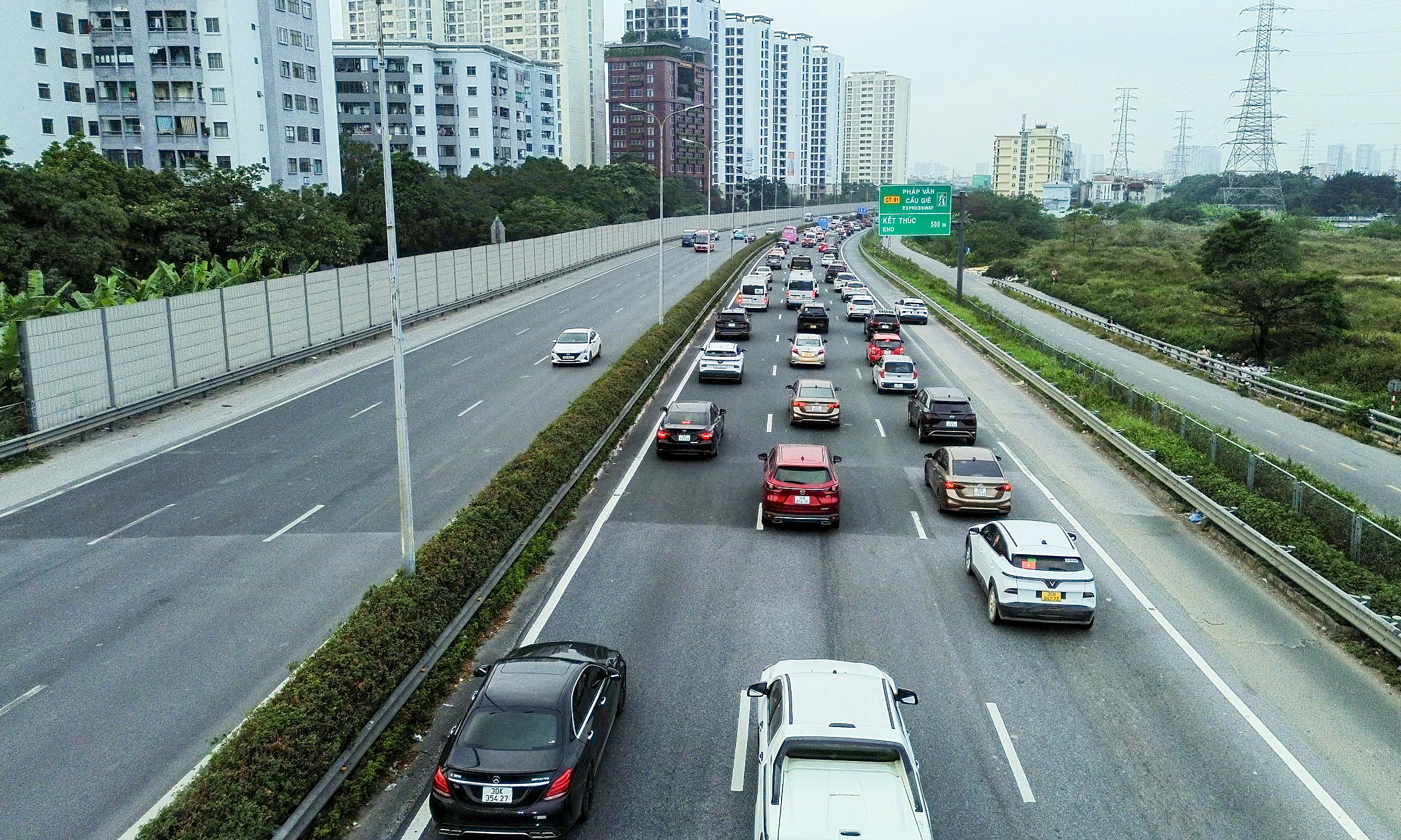 |
Vehicles moving on the Phap Van - Cau Gie expressway section entering Hanoi, 1/2026. *Pham Chieu*
"Even in the US, there are expressways hundreds of kilometers long with only two lanes per direction, and vehicles consistently adhere to the principle of passing on the left and staying on the right," Trinh Tung stated.
In practice, experts suggest that for the left-lane passing law to be effective and smooth, drivers must not only understand and remember the rule but also possess the awareness and skill to maintain vehicle speed consistent with traffic flow.
Typically, in the right lane of expressways in developed countries, drivers do not feel the need to pass too often because vehicles in the right lane maintain relatively high speeds. For example, on a road with a maximum limit of 75 mph, vehicles generally travel steadily at 65-70 km/h, maintaining safe distances.
To instill this habit in all drivers, experts recommend integrating it into driver's license training, ensuring students gain practical experience through legally compliant lesson plans from training centers.
Pham Hai