Slowest cars at the bottom of a race scoreboard rarely garner audience attention. However, in recent years, underdogs at the Nurburgring 24h race have captivated social media and live audiences. Their novelty and simplicity stand out amidst a field dominated by expensive GT3s and professional drivers.
Before the Dacia Logan’s debut in 2021, the 1988 Opel Manta, recognizable by its fox tail antenna, held legendary status at the Nurburgring 24h, racing since 1994. After 29 years, the Manta transitioned to the less demanding ADAC 24-Classic, a three-hour support race.
The Manta's departure cleared the way for the Dacia Logan, a compact, affordable, front-wheel-drive sedan. Olli’s Garage Racing, a small team based in Munster, Germany, founded by Oliver Kriese, first brought the Logan to the race in 2021.
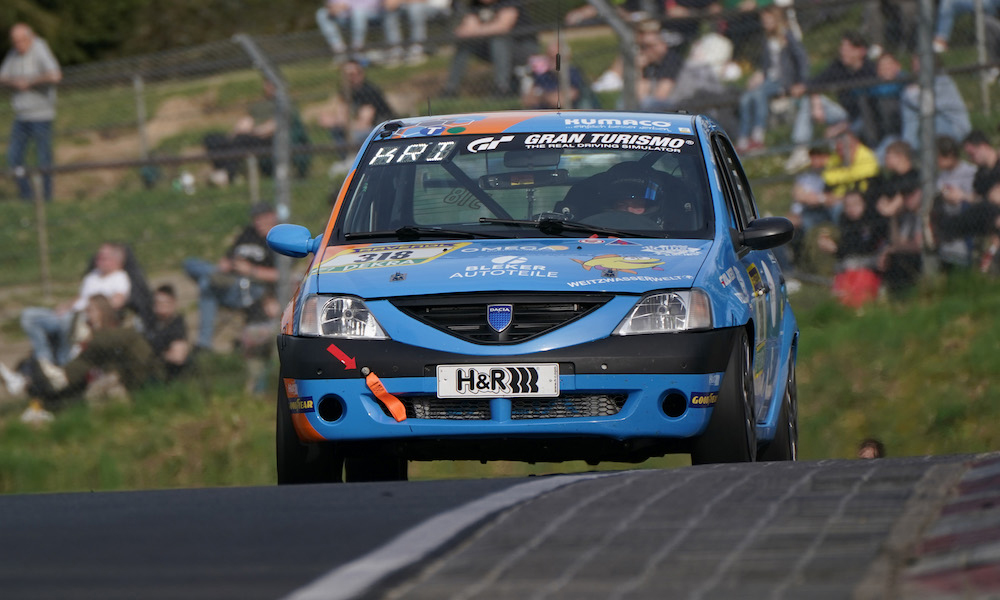 |
Second-generation Dacia Logan on the track. *Gruppe C Photography*
The first Dacia Logan utilized a 2-liter naturally aspirated 4-cylinder engine from a Renault Clio RS, producing 165-200 horsepower depending on seasonal adjustments. Its chassis featured an FIA-standard roll cage, racing suspension, large front disc brakes, and a rear wing. The car completed a 25,378 km Nordschleife lap in approximately 11 minutes 40 seconds, nearly four minutes slower than the leading GT3s.
In its debut year, the Logan finished 98th out of 121 cars, improving to 88th out of 135 in 2022. However, in 2023, a nighttime collision with a Dinamic GT Porsche 911 GT3 R completely destroyed the Logan. The team donated the irreparable chassis and body to the local fire department for training exercises and auctioned off intact parts to fans.
The accident seemed to end the slowest race car's journey, but the Logan’s underdog spirit resonated deeply with the car community. Fans worldwide united to raise 10,000 euro, enabling the team to acquire a newer Dacia Logan and build a second-generation race car. As a gesture of gratitude, the team sold small sections on the car's body for fans to display their names or signatures.
The new Dacia Logan boasts 280 horsepower, 80 hp more than its predecessor, thanks to a 2-liter turbocharged engine from a Renault Megane RS. Olli’s Garage initially wanted to continue using the old naturally aspirated engine but could not find suitable replacements or compatible parts.
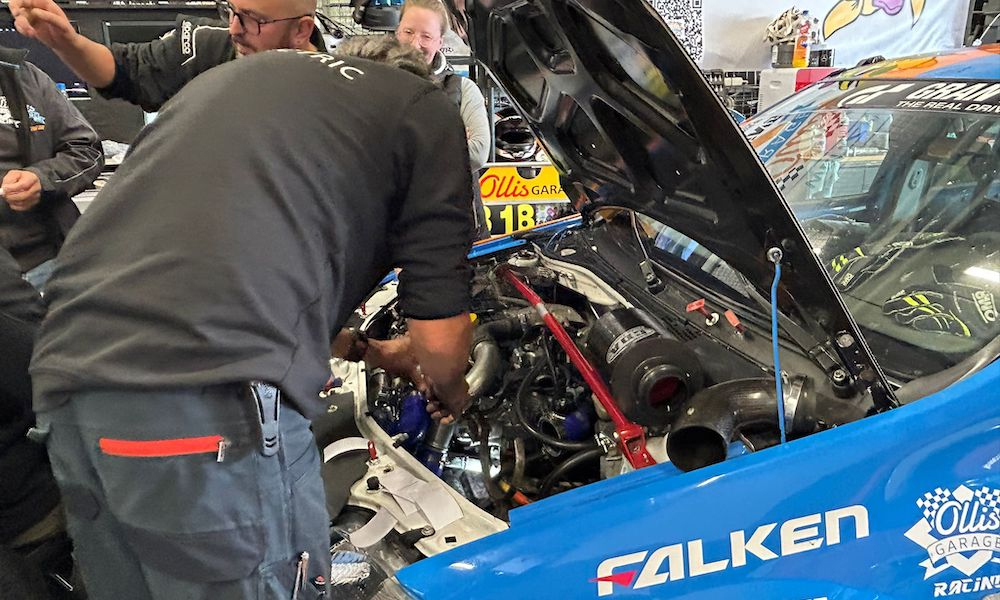 |
Mechanics from Olli’s Garage Racing and Car Electric inspecting the Dacia Logan's engine bay. *Racecar Engineering*
The Nurburgring 24h organizers questioned whether the Logan chassis had a commercial turbocharged variant, as regulations require a commercial vehicle platform. After research, the team discovered similar turbocharged engines were produced for some non-European markets. This finding justified their use of the 2-liter Megane RS engine.
The turbocharger, with an adjustable pressure range of 0,8-1,65 bar from the cockpit, shifted the Logan from class SP 3 to SP 3T. Both classes accommodate 1,750-2,000 cc cars, but SP 3 is for naturally aspirated engines, while SP 3T allows turbocharging technology.
Increased horsepower introduced new technical challenges. The original suspension from the Clio RS could not withstand the higher torque, causing excessive stress on the system. A team member stated: "all parts were not strong enough. We conducted tests and damaged many components."
This prompted the team to install more robust front suspension and a non-abs braking system from the Megane RS. However, this setup occupied more space than the Clio RS components, reducing the camber angle to one degree from two degrees, which affected cornering grip. The rear suspension retained Clio RS parts.
The six-speed manual gearbox also came from the Clio RS. The car employed a mechanical limited-slip differential, added after the team struggled to achieve stable traction with Goodyear 206/620R17 racing tires, even with traction control engaged.
The gearbox limited the Logan's top speed to 215 km/h, despite its theoretical potential for faster speeds on long straights. However, with a modest budget compared to rivals, utilizing existing components was a pragmatic choice.
Car Electric, a German company, installed an engine control unit (ECU) to minimize wheelspin during acceleration. Technicians also reused several functioning safety devices, wiring, and small sensors from the previous car to save costs for the second-generation Logan. Many interior details retained Dacia's design, and the rear wing even originated from a Dacia Logan Cup car.
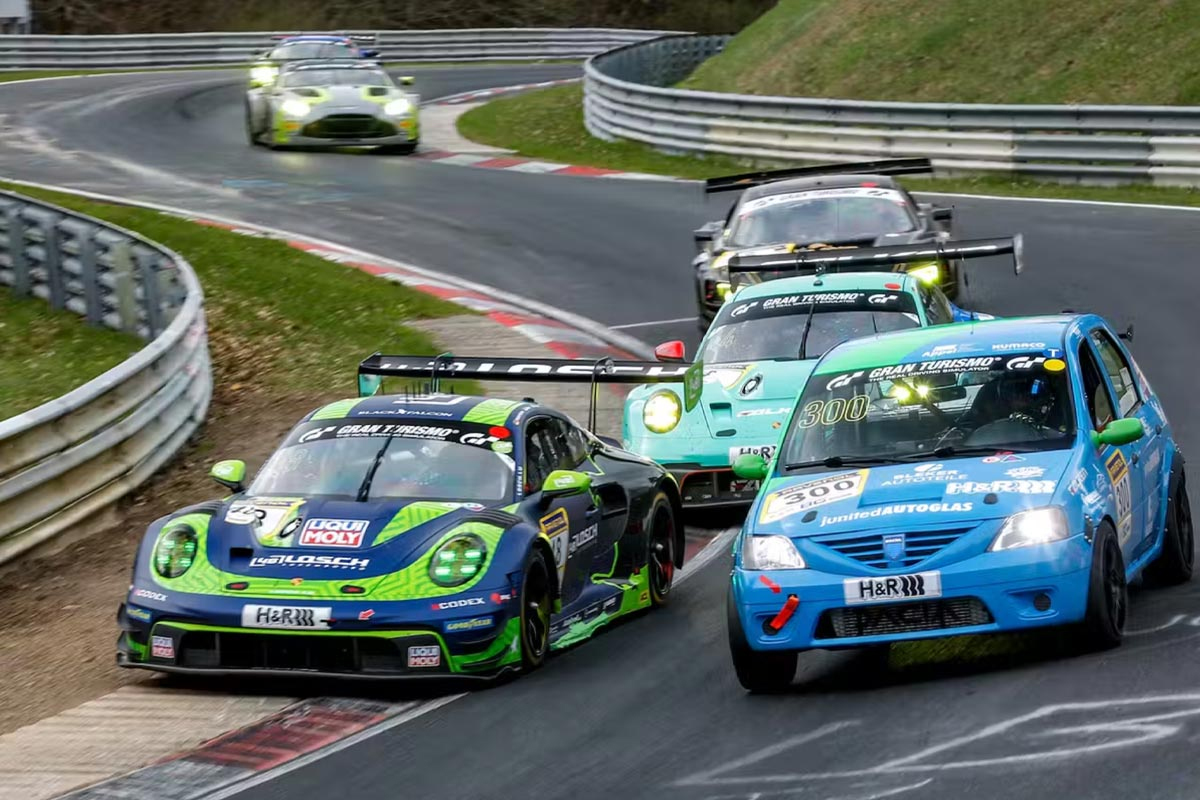 |
Dacia Logan (right) and Porsches at a corner. *ItalPassion*
At the 2026 Nurburgring 24h, Dacia Logan, car number 300, competed against six rivals in the SP 3T class, including the Volkswagen Golf GTI Clubsport 24h, Audi TT RS, and RS3 LMS TCR. During the race, the car quickly drew attention for its encounters with the Mercedes GT3 Evo, driven by four-time Formula 1 champion Max Verstappen, and for maintaining stability through oil slicks while trailing GT3s lost control. The car even veered off track a few times, spinning in the Carousel corner, surprising some GT competitors.
Olli’s Garage's technical team constantly battled to keep the engine running. While other teams fine-tuned aerodynamics and monitored remote data, the Logan frequently experienced misfires above 4,500 rpm, requiring cam sensor replacements at every pit stop.
In the final laps, with about three hours remaining, the Logan crashed into a barrier, losing its front left wheel and requiring towing to the pit. Despite damaged front suspension and the missing wheel, the technical team diligently repaired and replaced parts to return the car to the track. The Romanian car finished 6th in the SP 3T class and 107th overall out of 159 entries.
After an extraordinary journey, despite financial and technological gaps or the media attention on driver Max Verstappen, the effort of a fan-funded private team to revive and finish the Dacia race car truly defined the spirit of the Nurburgring 24h.
Minh Quan (*Racecar-Engineering, Drive*)