At the CATL Tech Day event on 21/4 in Beijing, the major Chinese battery manufacturer unveiled an integrated supercharging and battery swap network. CATL announced that all its Chocolate (for automobiles) and Qiji (for heavy-duty trucks) battery swap stations will now come standard with Shenxing supercharging piles.
Starting from the second half of this year, users of the Chocolate battery swap service will be able to swap fully charged battery packs at swap stations during peak electricity pricing hours. The stations will pay vehicle owners the price difference, with daily earnings potentially reaching 40 Chinese yuan (6 USD). This income could cover battery rental costs. CATL describes this innovation: "Previously, both charging and battery swapping cost money; now, you can earn money from battery swap stations."
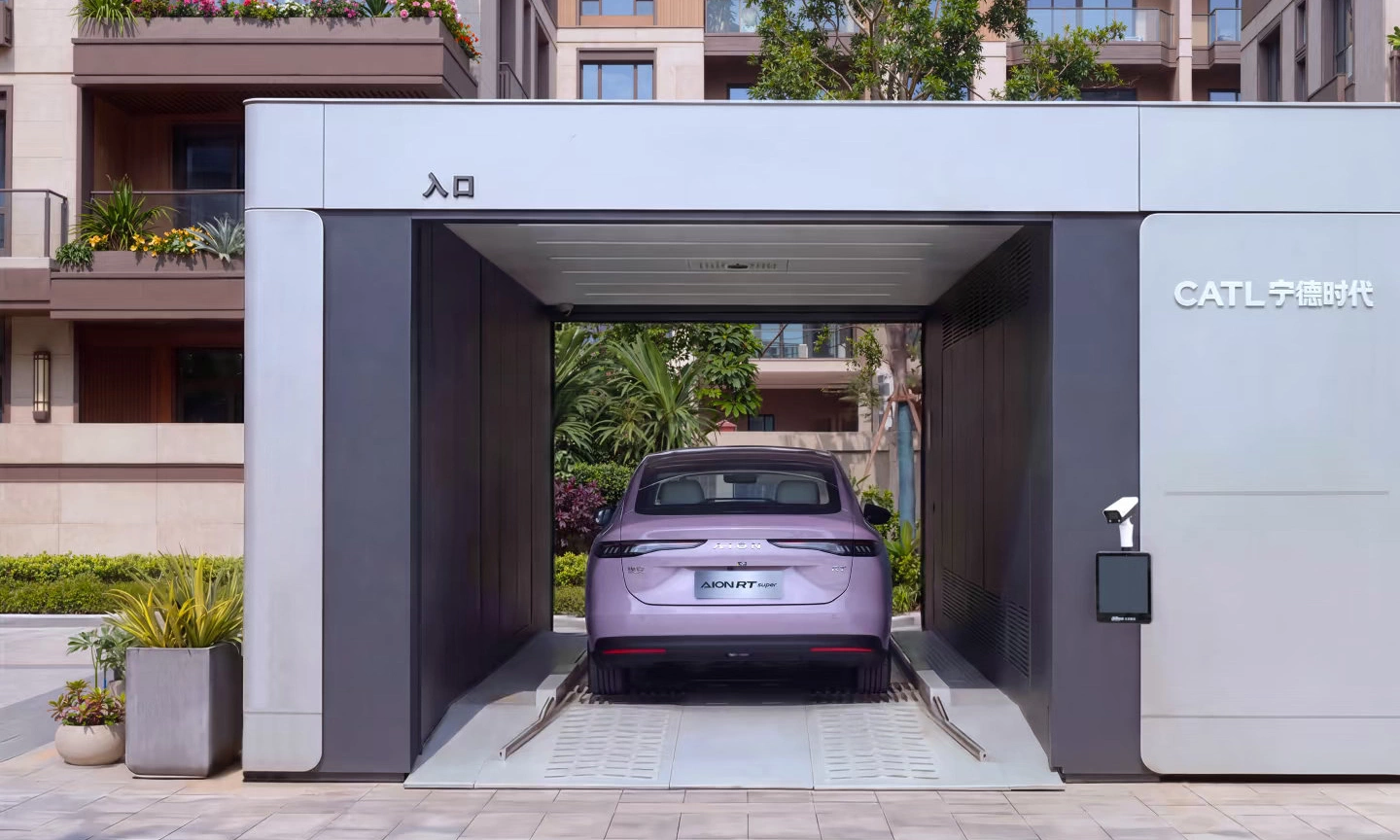 |
An Aion (GAC) electric vehicle at a CATL battery swap station. *Photo: EGT* |
Specifically, a vehicle owner arrives at a swap station during peak hours with a fully charged battery pack. Within approximately 100 seconds, a robotic arm replaces the user's fully charged battery with a partially charged one. The station then pays the owner the price difference between the higher-value electricity they just supplied and the lower cost of the energy they received.
To date, CATL has built 1,470 Chocolate battery swap stations across 99 cities. The company highlights two core advantages of this integrated solution: energy conversion efficiency and grid compatibility.
Regarding energy conversion efficiency, battery swapping requires only one energy conversion process — from the grid to the swap battery and then to the vehicle — resulting in a single instance of power loss. In contrast, existing charging solutions equipped with storage systems on the market require energy to undergo two intermediate stages: from the grid to the storage battery, then discharged into the vehicle battery, leading to two instances of power loss.
This integrated solution reduces power loss by more than 13 percentage points compared to super-fast charging solutions with integrated storage systems, thanks to the shared use of transformers and charging modules. CATL states that for every 100 kWh of electricity drawn from the grid, the integrated solution can provide an additional 13 kWh to vehicles compared to storage-based solutions. Depending on vehicle energy consumption, this translates to an extended driving range of 65-120 km.
To support this integrated solution, CATL launched the Chocolate 26# swappable battery, built on an 800 V high-voltage architecture. The initial version available is a 75 kWh battery, with larger capacity versions expected to launch in the future, suitable for both B-segment and C-segment vehicles.
The core philosophy behind Chocolate battery swapping is demand-based energy allocation: users can use a smaller battery for daily driving and swap for a larger battery for long-distance trips. This avoids the lifetime cost burden of carrying a large battery for infrequent long journeys. Rental users receive a lifetime warranty and lifetime upgrades, eliminating concerns about battery degradation and the depreciation of used vehicles.
CATL plans to offer two types of stations: standard integrated charging and battery swap stations, and 4S dealership experience stations. These are designed to flexibly adapt to urban centers, highway corridors, and test drive scenarios. The company plans to build a total of 4,000 integrated charging and battery swap stations by the end of 2026, covering 190 cities nationwide and the highway network, achieving seamless urban and inter-provincial charging coverage.
Initial partners include Changan, Chery, GAC, Seres, SAIC-GM-Wuling, and BAIC. By 2028, CATL aims to establish over 100,000 shared charging infrastructures. To date, the company has formed battery swap partnerships with 11 automakers.
*My Anh (according to CarNewsChina)*