Facing pressure from electrification and the rise of Chinese automakers, Japanese manufacturers are considering large-scale component standardization. This move aims to boost competitiveness, cut production costs, and allocate resources to new technologies.
Automakers have long shared components to save costs, not only across models within the same brand but also among multiple brands and segments. In the 2010s, Volkswagen's MQB platform became a model for this trend. Following this, many companies also consolidated their vehicle platforms to make production more affordable and consistent.
However, this approach has drawbacks. Volkswagen has faced criticism for years due to its models being too similar. Component sharing among brands can also lead to accusations that companies are merely cutting costs or rebranding existing products.
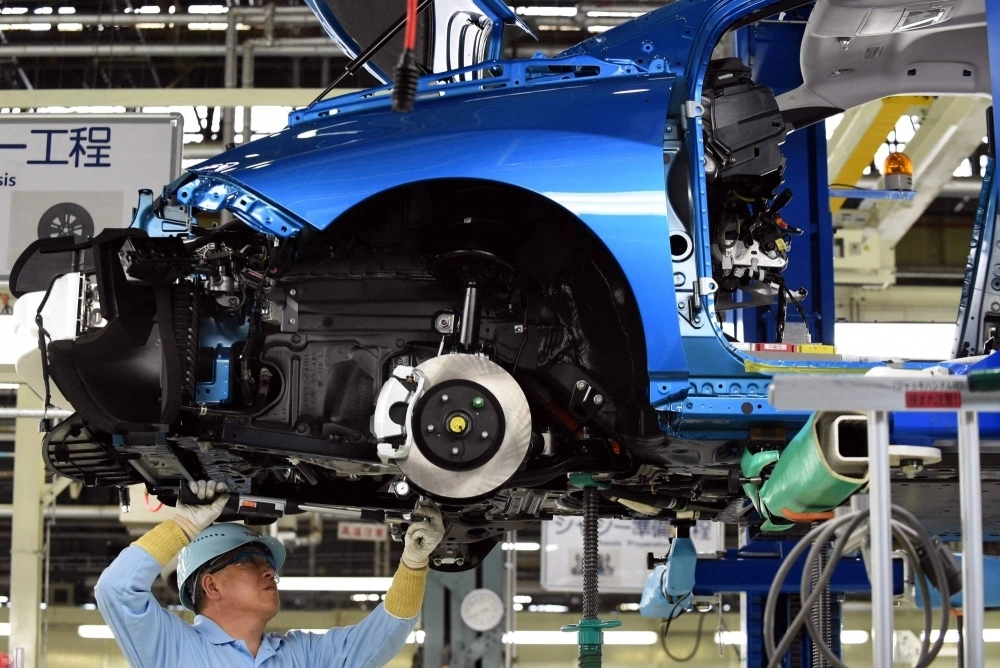 |
Workers at a Toyota factory in Toyota city, Aichi province. Photo: AFP |
According to Automotive News, the Japanese automotive industry now seeks to implement standardization on a larger scale, extending beyond brands within the same group to include various manufacturers.
The automotive industry has previously seen collaborative projects between companies. BMW and Toyota jointly developed the Z4 and Supra, while Mazda and Fiat partnered to produce the Fiat 124 Spider based on the Mazda MX-5. However, the plan Japanese automakers are considering is far more ambitious. Koji Sato, Toyota's chief executive officer and chairman of the Japan Automobile Manufacturers Association (JAMA), is spearheading this initiative. JAMA includes Toyota, Honda, Nissan, Mazda, Subaru, Mitsubishi, and Suzuki. In addition to his roles at JAMA and Toyota, Sato also serves as Toyota's chief officer for the industrial sector, responsible for promoting policies beneficial to the automotive industry.
"We recognize that the Japanese automotive industry is facing a significant transformation. This is the time for the entire industry to continue innovating and implementing necessary reforms," Sato said.
Sato, along with Nissan chief executive officer Ivan Espinosa, believes component standardization will allow companies to dedicate more resources to technologies that genuinely interest customers, such as new software interfaces, advanced driver assistance systems, and electric vehicles with faster charging speeds.
"We are discussing what we can do together because we observe that many industries in other countries are better organized. There will be more cooperation among Japanese automakers in the near future," Espinosa stated.
This collaboration will commence with components that users rarely see, mirroring the internal practices of these companies. These could include wiring harnesses, fluid lines, and other technical details, rather than visible parts like body panels or chassis. Sato did not mention the possibility of companies sharing vehicle platforms or body structures.
In fact, the automotive industry has previously featured shared development platforms within alliances or following mergers. For instance, Chrysler's LX platform was engineered to be compatible with many Mercedes components and Daimler's Sprinter van line, despite originating from Chrysler's LH platform.
Component standardization presents both advantages and disadvantages. Ford and General Motors once collaborated on developing a 10-speed automatic transmission, but each company refined it in its own way, creating distinct customer experiences.
For car enthusiasts, increasingly similar car models are not appealing. Standardization helps reduce costs and simplify production but can also diminish a vehicle's individuality. Conversely, many companies using common components will make it easier for users and garages to find replacement parts when vehicles need repairs. Overall, the benefits and limitations of this trend remain a subject of debate. For financial experts, this could be a more effective cost-cutting solution for automakers.
Ho Tan (according to The Drive)