Drivers are often advised to maintain a safe distance when driving, especially on highways. But what exactly constitutes a safe distance, and how can drivers quickly and accurately estimate it while on the highway?
In China, the 69 marking on highways refers to dashed white lines. Each white segment is 6 m long, with a 9 m gap between segments, hence the name "69 marking". The total length of each pair of lane marking segments and the gap between them is 15 m, and the distance spanning 10 white segments is 150 m.
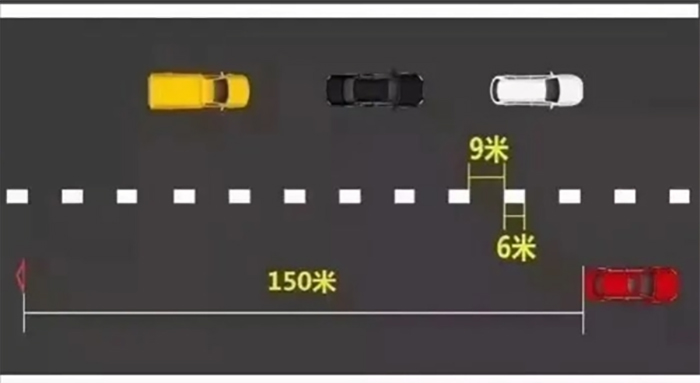 |
Each white segment is 6 m long, the gap between two segments is 9 m, and the distance across 10 white segments is 150 m. *Photo: Sohu*.
A representative from the Traffic Accident Prevention and Handling Guidance Office, under China's Ministry of Public Security Traffic Management Bureau, stated that if driving over 100 km/h on a highway, drivers should maintain a safe distance of more than 100 m from the vehicle ahead.
In this scenario, they can count how many 69 road markings are between their vehicle and the one in front. If fewer than 6 markings are present, drivers should reduce their speed to increase the distance. If traveling under 100 km/h, the distance can be shortened accordingly, but must not be less than 50 m. This means maintaining a distance of at least three road markings between your vehicle and the one ahead.
Additionally, when driving on a highway, in the event of an accident or vehicle breakdown, regulations require drivers to place a warning sign 150 m behind the vehicle. The 69 marking provides an easy way for drivers to determine this distance. "Just count 10 markings, and you get 150 m", the representative said.
My Anh (according to Sohu)