The cleaned surface area (sweep pattern) of a car's windshield wipers is determined by the arrangement of the wiper arms and the drive mechanism. Parallel wipers are the most common design.
Parallel wipers are found on most passenger cars today. This configuration features two wiper arms moving in the same direction, pivoting around fixed axes at the base of the windshield. This creates a large cleaned area directly in front of the driver. However, it often leaves an uncleared triangular region in the passenger-side corner.
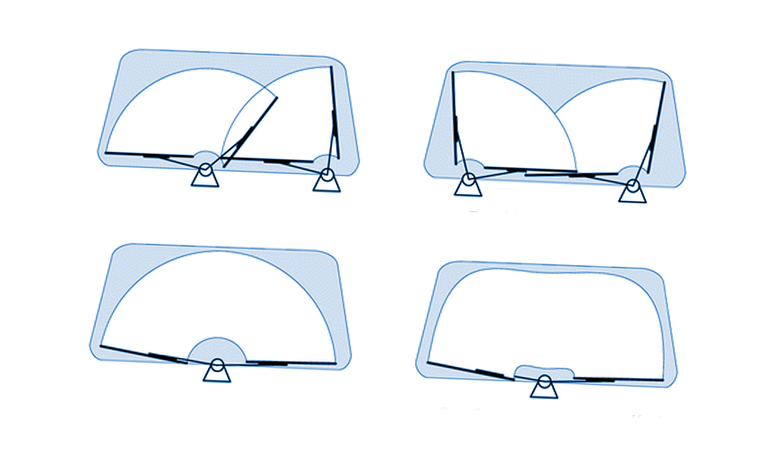 |
Types of windshield wipe patterns for automobiles. *Photo: Applied Mechanisms*
Opposing wipers typically appear on vehicles with wide windshields, luxury cars, or buses. Two wiper arms move in opposite directions, either from the center outwards or from the sides inwards.
This method maximizes the cleaned area across the entire windshield surface, eliminating the central triangular gap often left by parallel systems. This design requires a complex control mechanism to prevent the two wiper arms from colliding.
Single wipers are used on some small car models, such as older Fiat Panda vehicles, or special sports cars, like previous generation Mercedes models. This system uses only one large wiper arm positioned in the center of the windshield.
This design offers simplicity for small vehicles. Some premium versions, such as those by Mercedes, incorporate an extension mechanism to push the wiper blade further into the corners of the glass, increasing the cleaned area to up to 95% of the surface.
Mercedes' "dancing" single wiper type. *Video: Josh Brinson*
Pantograph wipers are often used for very flat and tall windshields found on passenger coaches and large trucks. The wiper arm structure consists of two parallel bars connected to each other, ensuring the blade remains vertical, or perpendicular to the glass edge, throughout its movement. This allows for cleaning a rectangular area instead of a fan shape, which is optimal for the large windshields of commercial vehicles.
Rear wipers, in contrast, are typically a single central type with a sweep trajectory of approximately 180 degrees. This ensures minimal visibility through the rearview mirror inside the vehicle.
My Anh