A modest manufacturing facility in southern Cleveland is becoming the starting point for the automotive industry's next supply chain shift: replacing hardware components sourced from China.
This plant belongs to Eagle Wireless, an electronics component manufacturer established in late 2025. The company was founded primarily to meet US government regulations prohibiting certain Chinese connected software and hardware in cars from now until the end of the decade.
"This is a massive opportunity for us," said TJ Dembinski, President of Eagle Wireless. He shared that Eagle was created to address China's dominance in connected module manufacturing, which he knew would be a significant challenge for US automakers once the new regulations took effect.
The industry is in a sprint to scale up module production - tiny microchips that enable vehicles to connect wirelessly to the outside world. Starting with about 140 employees, Eagle aims to grow to 1,000 people in the next three years. The company's revenue forecast for this year is also expected to increase by nearly 100%, approaching 100 million USD.
"Everything is happening at lightning speed," Dembinski stated.
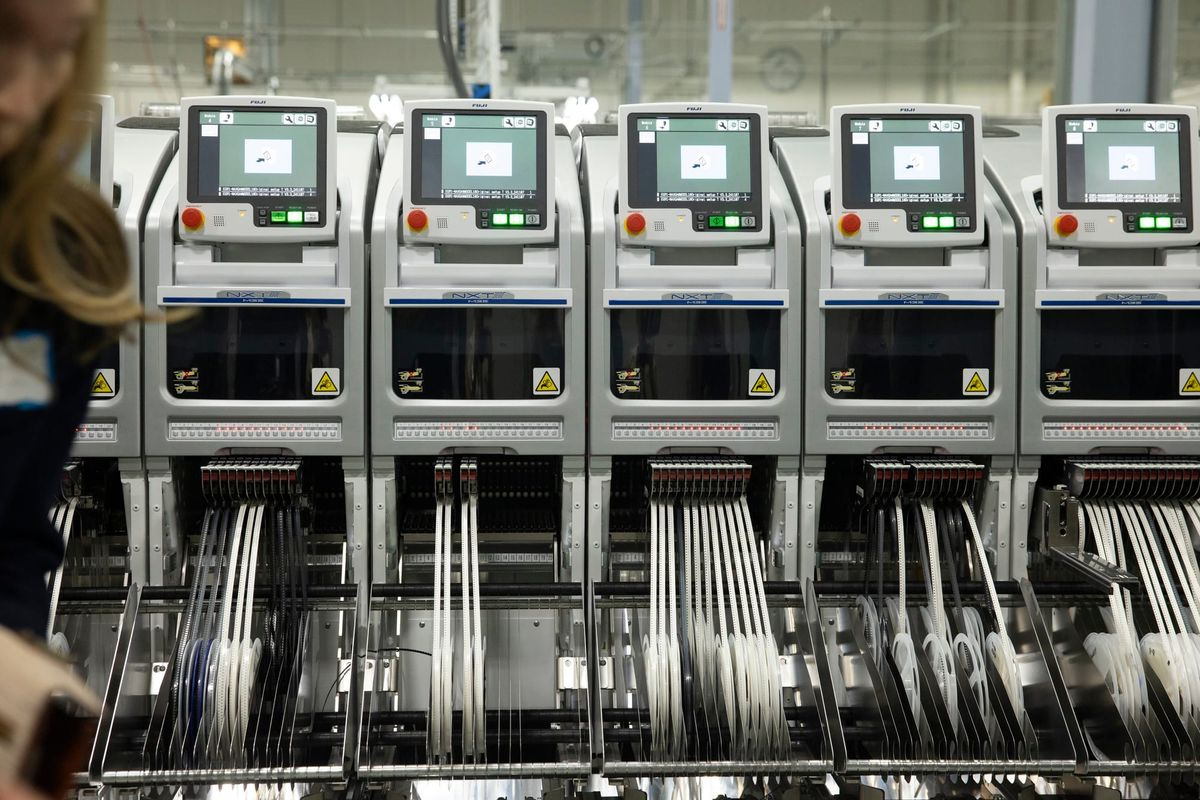 |
A row of machines loads reels of module components, which are then assembled onto circuit boards at the Eagle Wireless facility in Solon, Ohio. Photo: Eagle Wireless |
Connected vehicle regulations, passed in January 2025 under former President Joe Biden due to national security and data privacy concerns, continue under the Donald Trump administration. These regulations prohibit the use of Chinese connected software from the 2027 model year and hardware from the 2030 model year. While these deadlines may seem distant, automakers typically plan new vehicle lines years in advance, meaning they must finalize compliant suppliers now.
Amid rising geopolitical and trade tensions, automotive companies are in the midst of a disruptive decoupling from China, affecting everything from low-cost components, like Eagle's modules, to battery materials and essential rare earth minerals.
Industry concerns intensified after Polestar, an electric vehicle brand majority-owned by Geely, was prohibited from selling new vehicles in the US in June under this regulation.
High costs
The components most affected by the hardware regulations include satellite communication systems, external antennas, and microcontrollers that support external vehicle communication, according to Matt Wyckhouse, CEO of cybersecurity firm Finite State and an advisor to Eagle Wireless.
Shifting component supply chains away from China often leads to significantly increased costs. A former Detroit executive expressed shock when comparing the cost of an autonomous driving system without Chinese technology to one that included Chinese technology (including LiDAR sensors).
"I was genuinely shocked when I saw the price increase," the former executive shared. Most advanced driver-assistance systems (ADAS) components are not currently within the scope of connected vehicle regulations, though the government has warned it may address this segment separately in the future.
Eagle stated it is working to achieve competitive pricing with Chinese rivals, but a 5%-15% price difference for its module products still exists.
 |
Polestar electric vehicles have been prohibited from sale in the US. Photo: Polestar |
The shift away from Chinese suppliers also presents logistical challenges. Component company executives indicated that automakers are demanding deeper transparency into supply chains to ensure no Chinese components violate US regulations.
This regulation "requires deep supply chain scrutiny and presents a very tight compliance timeline," stated Hilary Cain, Senior Vice President of Policy for the Alliance for Automotive Innovation (AAI), which represents most major automakers.
Electric vehicle startups like Rivian say they are better positioned for compliance than traditional automakers due to their flexibility in changing suppliers or self-sourcing components. Wassym Bensaid, Rivian's Chief Software Officer, told Reuters that he is cautious when selecting suppliers and always prepares contingency plans for geopolitical fluctuations.
Some companies are seeking exceptions. Ford has applied for permission to continue importing certain vehicle lines manufactured in China. Volvo (owned by Geely) was among the first automakers to receive approval.
Module production line
At Eagle's plant in Solon, Ohio, machines are busy producing modules for various industries, with plans to expand into automotive applications at a nearby facility. The company expects to reach a production capacity of about 2 million modules per year by the end of QIII, and the new plant will have an even higher capacity, Dembinski noted.
A "modern vending machine," as Chief Technology Officer Joel Young calls it, sorts capacitors, diodes, and other components. These are then mounted onto circuit boards, which are conveyed through an oven at temperatures over 260 degrees Celsius. The modules are then engraved with serial numbers, quality checked, and picked up by robotic arms for packaging.
According to market research firm Counterpoint Research, connected module production is currently concentrated among a few large manufacturers. Chinese suppliers account for nearly half of the global cellular IoT module supply for the automotive industry. In North America, Eagle competes with leading manufacturers such as Rolling Wireless and LG.
While positioning itself as a US-compliant solution for automakers, Eagle still has work to do to fully adhere to the regulations. Eagle began by licensing module designs from Quectel Wireless Solutions, a Chinese company that leads the global industry.
Eagle will need to replace this design with self-developed technology before the 2030 model year deadline, as the regulation prohibits any connected hardware designed, developed, manufactured, or supplied by China.
Young said he is racing against time to create products that can replace Quectel's current modules without disrupting automakers. "I have to hire a lot more engineers," he said, adding, "We will use every tool we can."
Licensing technology from China is a strategy the US auto industry has employed before. For example, Ford is licensing battery technology from CATL (China) to produce batteries in the US.
"This reality could lead to a situation where we become even more dependent on China through these partnerships," commented Ilaria Mazzocco, Deputy Director and Senior Fellow at the Center for Strategic and International Studies (CSIS). However, she also suggested that this collaboration might be the only way for the US to accumulate expertise in an increasingly competitive ecosystem.
"And who knows, perhaps thanks to those partnerships, we will ultimately reduce our dependence," Mazzocco stated.
My Anh