Hemant, an electric vehicle owner, recently shared a video on Instagram showcasing a practical benefit of his Tata Harrier EV: powering his home air conditioner during a power outage. His family experienced an unexpected blackout in the middle of the night, leading him to utilize his car's battery.
To address the situation, Hemant transformed his Harrier EV into a makeshift power generator. He explained that he had proactively equipped his vehicle with a vehicle-to-load (V2L) converter shortly after purchasing it. This essential device facilitates the conversion of direct current (DC) from the car's battery into alternating current (AC), suitable for running household appliances. The video also shows him activating the power discharge mode within the car's system.
Hemant calculated that running the air conditioner for one hour consumed only about 1% of the car's battery capacity. This minimal power usage meant that operating the AC overnight would not significantly deplete the vehicle's energy. He views this as a valuable added feature, enhancing the overall convenience of owning an EV, rather than merely promoting a car priced at 3 million rupees (approximately 32,000 USD) as a backup power unit.
Furthermore, Hemant demonstrated his home's new electrical panel, which features two distinct connections: one linked to the electric car and another to a rooftop solar power system. This dual infrastructure ensures that his home air conditioner continues to function normally whenever the main power grid experiences disruptions.
The Tata Harrier EV, a flagship high-ground clearance electric SUV from the Indian brand, is priced between 2,17-3,04 rupees (approximately 22,700-32,000 USD). It offers two battery pack options: a 65 kWh pack providing a range of 538 km, and a 75 kWh pack extending the range up to 622 km on a full charge.
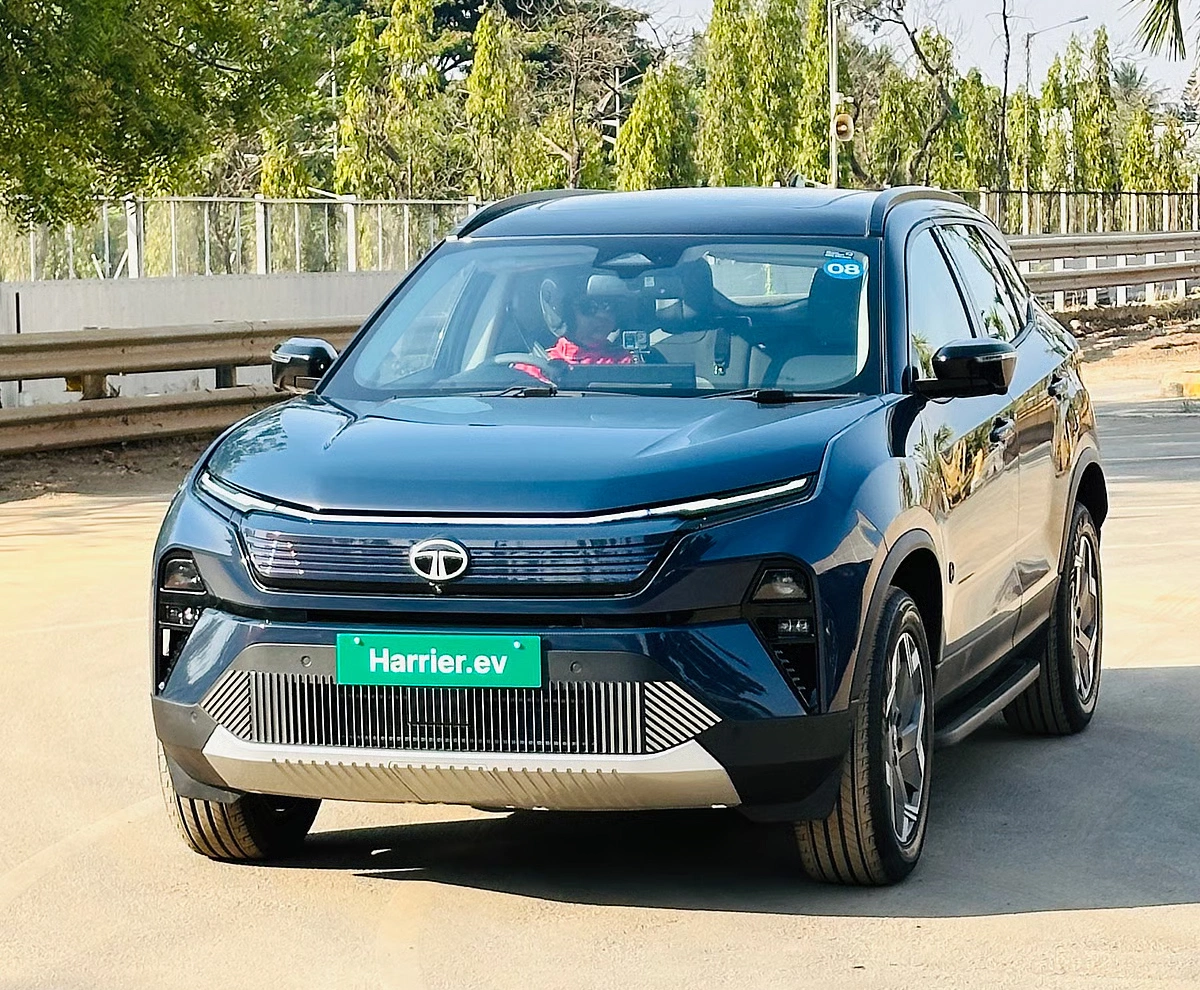 |
Tata Harrier EV in India. Photo: FPJ |
Using electric car batteries for household needs is not an isolated incident. In June, a Tata Nexon.ev owner shared his experience of charging his family's inverter and battery system with his car during a storm-induced power outage. This backup power enabled his family to maintain normal activities and sleep comfortably. Similarly, in July 2025, a Tata Curvv EV owner recounted using his electric car to power a water pump in a field.
The capability of electric vehicles to supply power to external devices is not limited to Tata models. Many global electric vehicle brands, including Hyundai, Kia, MG, BYD, Ford, and Tesla, currently offer this convenient feature.
My Anh (the Cartoq)