The Toyota Land Cruiser 70 Series is a unique phenomenon in the automotive industry, having been in continuous production since 1984 through numerous upgrades. The most recent update reintroduced its classic, nostalgic round headlight design, but also presented a peculiar detail for the Japanese market: body-colored panels occupying the space typically reserved for taillights. Why did Toyota opt to conceal the rear light cluster?
Regulatory hurdles
This stems from safety and inspection standards in markets such as Japan and Europe. These regulations mandate that the integrated rear light cluster must not be obscured when viewed from certain side angles or when the rear door is open.
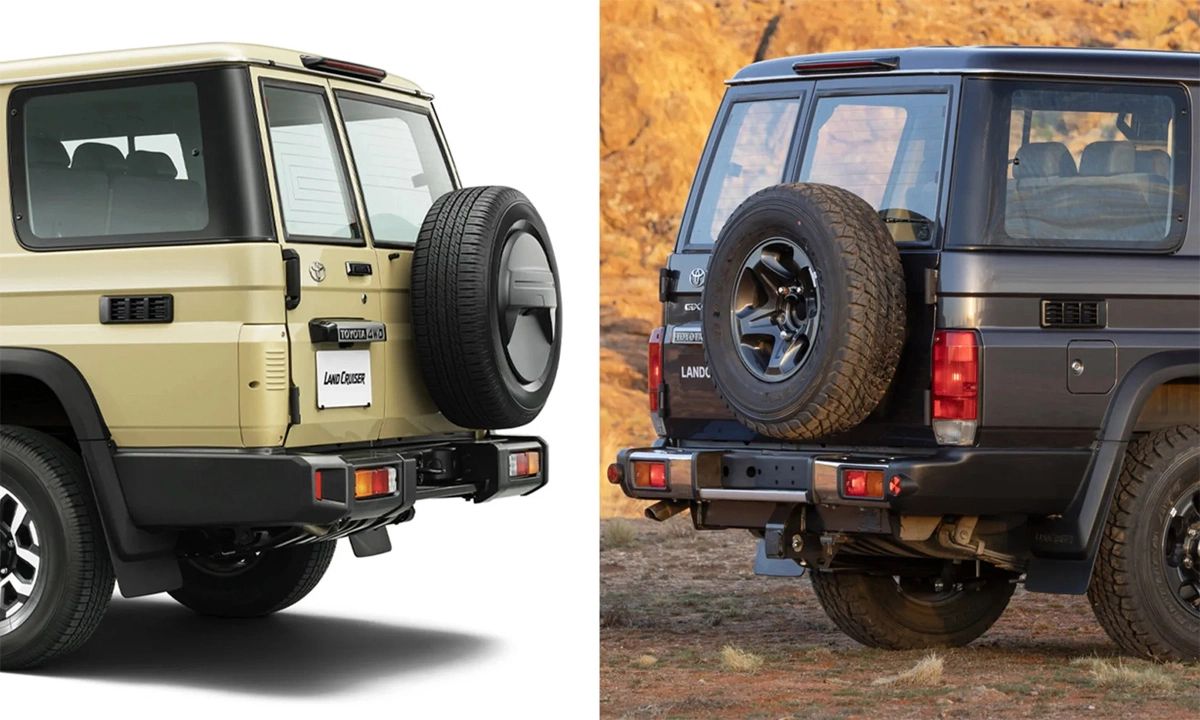 |
Taillights located on the rear bumper and body-colored panels in the original taillight position (left) on the Land Cruiser 70 for the Japanese market, and the taillight design for vehicles in the Australian market. Photo: Toyota |
Taillights located on the rear bumper and body-colored panels in the original taillight position (left) on the Land Cruiser 70 for the Japanese market, and the taillight design for vehicles in the Australian market. Photo: Toyota
The issue lies with the spare tire. Mounting a large spare tire on the swing-out door inadvertently obstructs the light cluster from certain viewing angles. Instead of redesigning the body shell, Toyota chose to lower the functional light cluster to the rear bumper.
In some regions, such as Australia, the lower light cluster operates in conjunction with the upper light system. However, customers in Japan and other Asian countries receive only dummy panels, resembling air vents, in the same color as the vehicle's body.
While the Land Cruiser 70 in the Japanese market has only featured these dummy panels since late 2023, this design approach has a long history within the Land Cruiser series. Main lights placed on the rear bumper previously appeared on some export variants, such as the LJ70 for the European market, from the late 1980s. On these versions, the brake lights and turn signals were on the rear bumper, while the body-mounted positions served only auxiliary functions.
Trend of modifying original light clusters
Since Toyota uses a common body stamping for its global production lines, removing these dummy panels has become a popular aftermarket modification.
Recent tests by Toms Gear, a customization shop in Thailand, show that JDM (Japanese Domestic Market) Land Cruiser 70 models retain the original mounting points behind the panels. The only challenge is the wiring system. Since the manufacturer does not pre-install electrical circuits behind the panels, technicians must run wiring from the rear bumper to the vehicle's side frame.
 |
A customization shop in Thailand replaces the side panels to install taillights on a Land Cruiser 70. Photo: Toms Gear |
A customization shop in Thailand replaces the side panels to install taillights on a Land Cruiser 70. Photo: Toms Gear
Once the wiring is complete, the remaining steps are straightforward. Technicians simply remove the dummy panels, connect the harness to genuine international-spec taillight clusters, and secure them in place. This modification restores full illumination to the rear pillar area, returning the vehicle to its original design aesthetic.
The Land Cruiser 70 is not the only vehicle to adopt this design solution. Suzuki previously moved main lights to the rear bumper on multiple generations of the Jimny, Vitara, and Grand Vitara, converting the body-mounted light positions into reflectors or flat panels to prevent obstruction by the spare tire.
Other models, such as the Mitsubishi Pajero, Isuzu Trooper/Rodeo, and Nissan Patrol, have also employed similar approaches. Even European models like the first-generation Land Rover Freelander placed the main light cluster on the rear bumper to ensure visibility remained unaffected by the spare wheel.
By My Anh (Source: Carscoops)