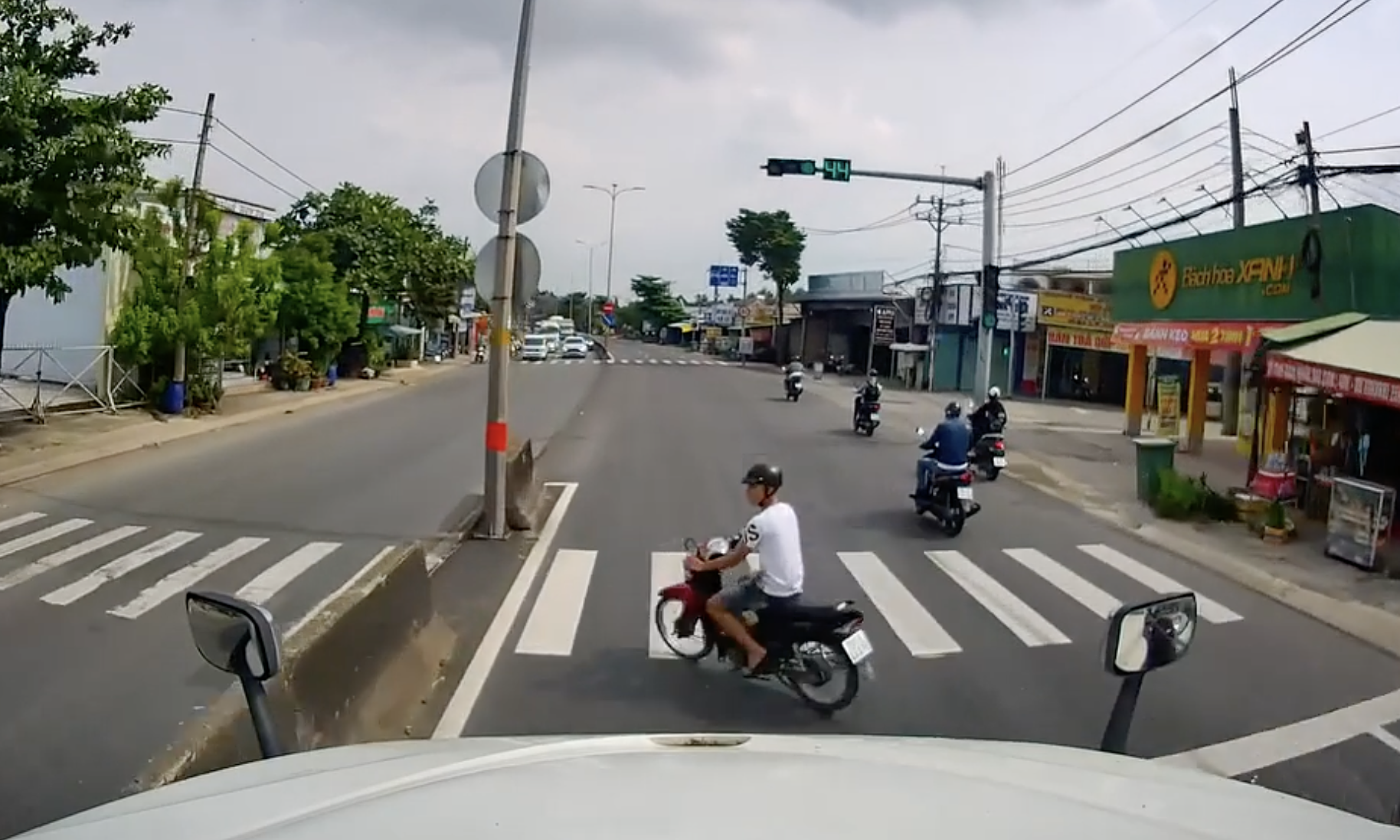
Last week, a car lost control while overtaking in rainy conditions, veering into a field and rolling several times in Vinh Loc, Thanh Hoa. The accident unfolded in seconds: as the car moved into the oncoming lane to overtake, it encountered another vehicle. The driver swerved sharply to avoid it and immediately lost control.
Similar incidents are not uncommon on the road. Notably, loss of control often occurs during overtaking or obstacle avoidance, rather than when a vehicle is traveling steadily. There are several reasons why drivers are prone to losing control when passing other vehicles.
Car loses control while reckless overtaking, veering into a field, 22/2 in Vinh Loc. Video: CTV
High speed causes tires to exceed grip limits
When overtaking, drivers often accelerate to complete the maneuver as quickly as possible, reducing time spent in the oncoming lane. High speeds make a vehicle more sensitive to steering inputs. Under normal conditions, steering remains within the tires' control limits. However, as speed increases, especially from about 70-90 km/h upwards, even a slight, sudden change in steering direction can exceed the tires' grip capability, particularly when combined with adverse factors like a slippery road surface.
There is no absolute figure for all situations, as a vehicle's control capability also depends on objective factors such as tire condition, road surface, and weather. However, drivers must understand that the more they accelerate in situations requiring quick reactions, the greater the risk of losing control when turning the steering wheel.
Sudden maneuvers lead to loss of vehicle control
Overtaking situations always harbor unpredictable factors, especially when an oncoming vehicle appears. In such moments, a driver's natural reaction is to steer quickly to avoid a collision, sometimes combined with sudden braking. However, this combination of actions can easily cause the tires to lose grip.
When the wheels no longer firmly grip the road, the car will not move in the direction of the steering wheel but will begin to slide. This is the point when the driver almost completely loses control, whether continuing to steer or applying the brakes.
Does a lack of driver assistance technology increase the risk of losing control?
Systems like anti-lock braking system (ABS) and electronic stability control (ESC) are designed to help drivers maintain control in emergency situations. During sudden braking, ABS prevents the wheels from locking up, while ESC can intervene with individual wheel braking force and engine power to keep the vehicle stable when signs of skidding appear. Therefore, in vehicles not equipped with these technologies, the risk of losing control during situations like sudden steering or abrupt braking is often higher.
However, even in vehicles with full safety systems, sudden steering at high speeds or on slippery road surfaces can still cause the vehicle to exceed its grip limits. In such cases, safety systems can only provide assistance within a certain range and cannot completely "save" every situation. Therefore, the difference between vehicles with and without assistance technology primarily lies in the degree of risk reduction, not the complete elimination of the risk of losing control.
 |
Electronic stability control on/off button in a car. Photo: Carsome
To mitigate the risk of losing control, drivers must manage their speed before overtaking and only perform the maneuver when visibility and road conditions permit. During overtaking, maintain smooth steering, avoiding sudden turns or abrupt braking combined with direction changes. In unexpected situations, prioritize reducing acceleration and maintaining a stable steering direction rather than reacting with sharp turns. Especially on slippery roads, limiting overtaking and maintaining safe speeds and distances are the most crucial factors to avoid losing control.
Ho Tan