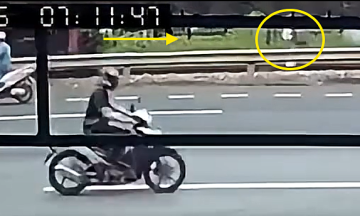
A recent accident on 5/8, which resulted in a young woman's death on railway tracks running parallel to National Highway 1 near Dong Van, Ninh Binh, has highlighted the chaotic nature of traffic in Vietnam. The incident, captured on video, shows road users disregarding traffic rules, opting for shortcuts to save time, but at the expense of their lives.
What many readers and I find particularly puzzling in this video is the presence of pedestrian crosswalks at such locations. I frequently travel this section of National Highway 1 and have often wondered about their purpose. On one side of the road, there are residential homes, but the other side features a barrier separating it from the railway tracks. Adjacent to this barrier is a lane designated for non-motorized vehicles.
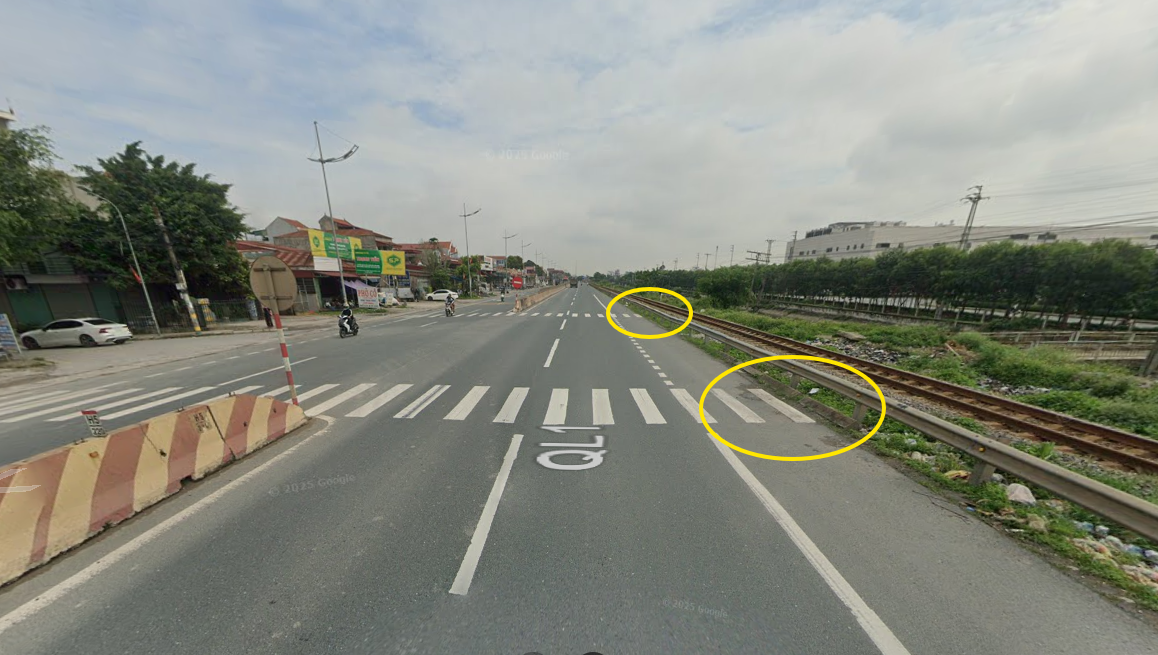 |
The area where the young woman crossed the railway tracks and the accident occurred. Photo:Google Maps |
This raises a fundamental question: why are pedestrian crosswalks marked here? A crosswalk implies that people from one side of the road will cross to a destination on the other. However, in these instances, there is no sidewalk or residential area on the railway side. Furthermore, the lane for non-motorized vehicles is not a suitable place for pedestrians to stand or wait.
If crosswalks are marked in this manner, are we inadvertently encouraging people to cross from one side of the road to the other, directly onto dangerous railway lines? Along this stretch of National Highway 1, there are numerous openings with similar crosswalks, which people can verify on Google Maps.
Therefore, I appeal to knowledgeable readers with expertise in traffic law or organization to share insights on why pedestrian crosswalks are deemed necessary in these specific locations.
Reader Phuong Minh