The Ministry of Finance has proposed a 0.1% tax on each transfer of gold bars. The government will determine the effective date, the taxable value threshold, and adjust the tax rate to suit market conditions.
This marks the first time regulators have considered taxing gold, a move made as the Personal Income Tax Law is being revised. According to Finance Minister Nguyen Van Thang, this regulation is essential for tight management of gold trading, preventing speculation, and attracting significant social resources into the economy.
This policy direction generally garners support from many experts, who believe it ensures fairness compared to other investment channels and aligns with international practices.
Dinh Duc Quang, Director of Currency Business at UOB Vietnam Bank, stated that this initiative aims to curb gold speculation and "surfing." He emphasized that any business activity generating profit, including gold trading, should be subject to taxation to ensure equity across all investment avenues.
Echoing this sentiment, Nguyen Van Duoc, General Director of Trong Tin Accounting and Tax Consulting Company, explained that while gold was historically considered currency, it is now viewed as a commodity. The sale of gold is essentially an asset transfer, similar to selling stocks or real estate. Therefore, he argued, whether individuals profit or incur losses from gold transactions, they should pay tax to ensure fairness of obligation.
Duoc further recommended that regulators should apply the tax only if the transaction value exceeds a certain threshold, and exempt small transactions intended for savings or accumulation.
Globally, many countries, including the United States, China, Australia, and Thailand, also impose taxes on gold. Several of these nations apply taxes based on the profit derived from gold (calculated as the selling price minus the buying price).
Despite these arguments, experts largely consider the proposed 0.1% tax a stopgap measure, pending the development of more effective long-term solutions.
Nguyen Huu Huan from the University of Economics TP HCM calculated that a 0.1% tax on a 100 million dong gold sale would amount to only 100,000 dong. He asserted, "This figure is very low and insufficient to eliminate speculative incentives."
In practice, a tax rate applied to gold transactions would likely be passed on as a "fee" embedded in domestic gold prices, potentially leading to an increase. However, Huynh Trung Khanh, Vice Chairman of the Vietnam Gold Business Association (VGTA), suggested that the 0.1% rate is low and would not significantly impact gold prices or effectively narrow the price gap between domestic and international markets.
From the VGTA Vice Chairman's perspective, the 0.1% tax on transfer value represents a cautious approach in the initial phase. Over the longer term, regulators could consider increasing or adjusting the tax after achieving the goal of narrowing the gap with global prices.
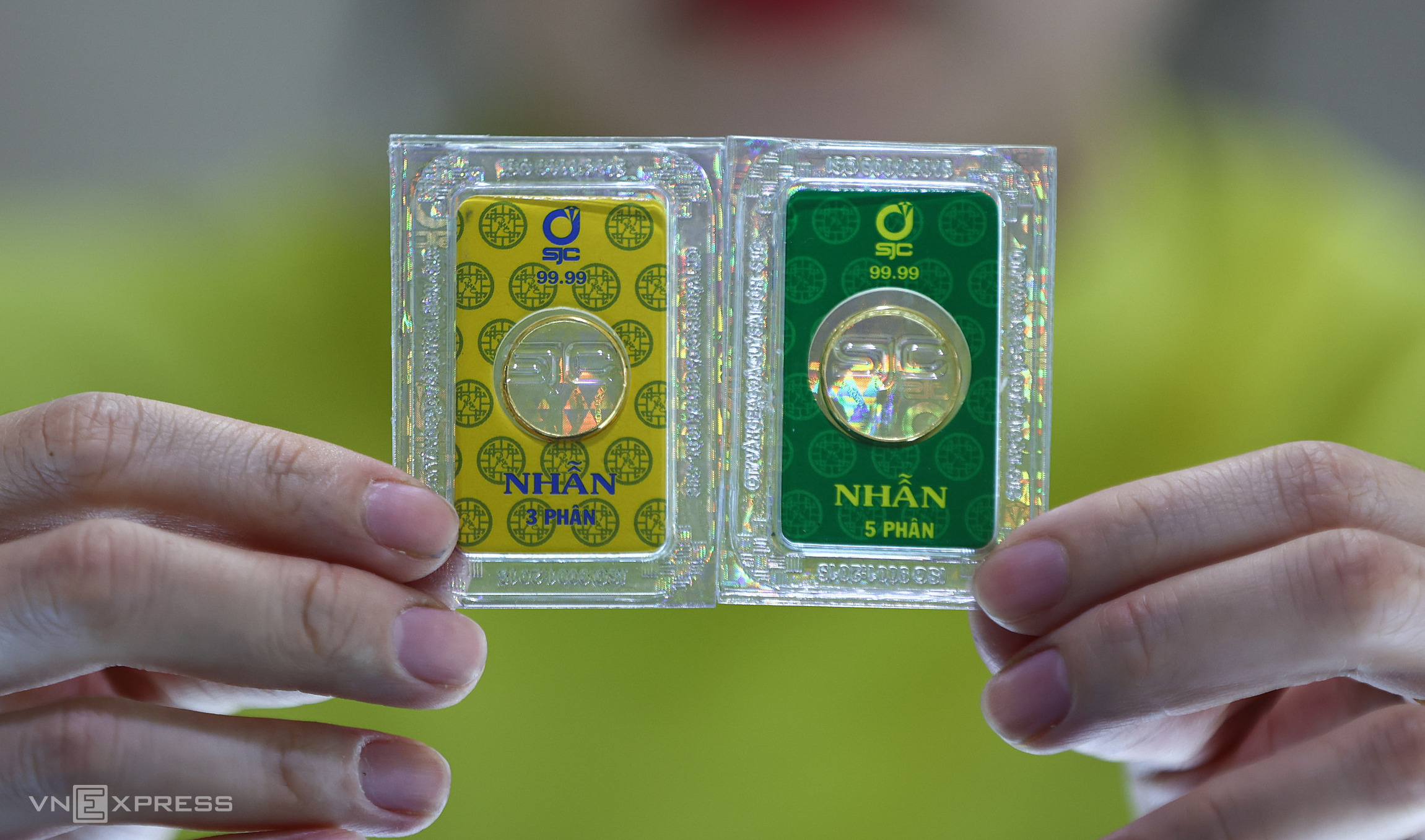 |
Plain gold rings sold at SJC headquarters on Nguyen Thi Minh Khai street (TP HCM) in 3/2025. Photo: Quynh Tran
Speaking to VnExpress, Can Van Luc, BIDV Chief Economist and Director of BIDV Training and Research Institute, noted that the 0.1% tax on gold sales revenue is proposed in a context where stock transactions are subject to a 0.1% tax rate on the total selling value, irrespective of profit or loss.
"This is seen as a temporary solution while awaiting research into a more rational tax policy for gold", he said.
Meanwhile, the Vietnam Association of Financial Investors (VAFI) even recommended applying a 10% value added tax (VAT) using the deduction method for gold jewelry and gold bars, treating them similarly to regular goods to ensure equality in tax obligations.
While experts generally agree that the 0.1% tax rate is insufficient to deter speculation, determining an appropriate higher rate remains a challenge that requires careful consideration from regulators.
During a recent press conference, Shaokai Fan, Asia-Pacific Director (excluding China) and Global Central Bank Director at the World Gold Council (WGC), stated that any tax solution for gold in Vietnam should be designed to meet two objectives: minimizing speculation and preventing people from shifting transactions from formal to informal markets to evade taxes.
"Imposing a high tax on gold would drive people to the black market for transactions, which would be counterproductive and contrary to Vietnam's goal of gold market liberalization", Shaokai Fan warned. He added that if Vietnam imposes high taxes while neighboring countries like Singapore, Hong Kong (China), and Malaysia do not, gold could flow across borders, making smuggling more difficult to control.
Concurring with this view, the UOB expert predicted that a high revenue-based tax could lead to sellers under-declaring gold prices, potentially creating a two-tiered market. Overall, taxing revenue is a straightforward solution given Vietnam's current lack of historical transaction data and a centralized exchange.
To effectively tax gold and gain broad public consensus, Dinh Duc Quang emphasized the necessity of creating a transparent playing field by establishing a gold exchange where individuals can trade directly. Transparent data would enable regulators to differentiate between investment and short-term speculation, allowing for targeted taxation.
Quynh Trang