The Ministry of Finance recently issued Circular 152, guiding accounting record-keeping for business households and individuals. Accordingly, representatives of business households and individuals can either keep records themselves or hire accounting services.
They also have the right to assign parents, spouses, or siblings to be accountants, or have managers, operators, or cashiers/warehouse keepers handle these duties.
Previously, business households paid a flat-rate tax, meaning they did not need to keep accounting records or track revenue. Starting 1/1/2026, the flat-rate tax policy will be abolished, requiring millions of households to transition to declaration-based tax filing. For business households, maintaining complete records and declaring information about goods (inflow and outflow) according to accounting ledgers will be mandatory.
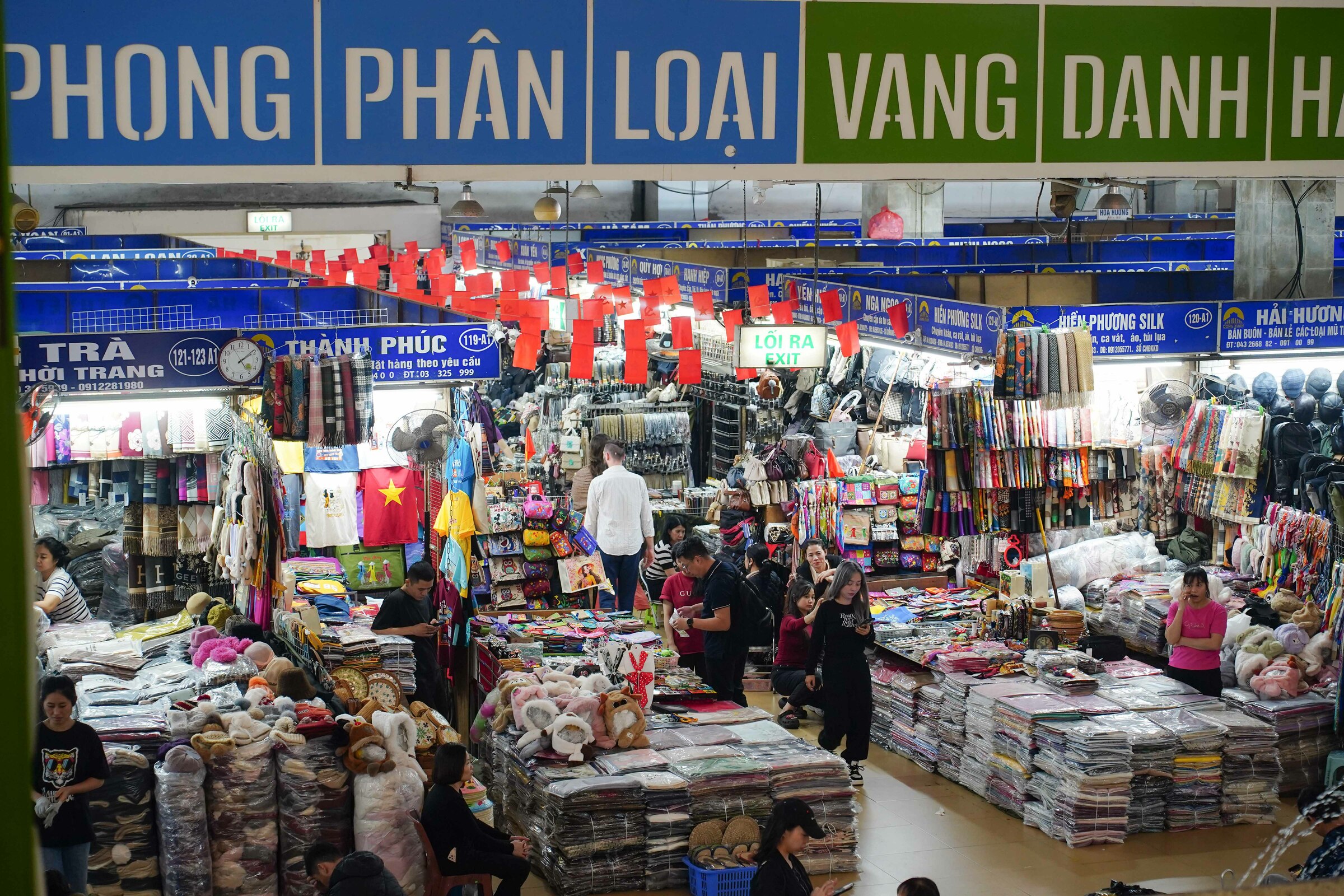 |
A vendor's stall at Dong Xuan Market (Hanoi). Photo: Hoang Giang |
Circular 152 also specifies the types of accounting ledgers for different groups of business households and individuals. Specifically, business households with annual revenue under 500 million VND, not subject to value-added tax (VAT) and personal income tax, only need to use a sales and service revenue ledger, following a template to record dates, revenue descriptions, and sales amounts.
Groups paying VAT and personal income tax based on a percentage of revenue must retain invoices and vouchers, and require a revenue ledger (including explanations of the tax calculation percentage and tax amount) as a basis for tax declaration and payment.
For business households and individuals paying tax on profit (revenue minus expenses), they need invoices, purchase lists, and other documents to determine revenue and taxable income. Additionally, they must prepare four types of accounting ledgers, including: a sales and service revenue ledger; a detailed materials and goods ledger (tracking imports, exports, and inventory); and a detailed bank cash flow ledger (tracking cash and deposits).
Accounting documents (invoices, vouchers, ledgers) must be stored in paper or electronic form for 5 years. Beyond the mandatory templates, business households can design additional ledgers to suit their actual management needs.
In the draft Decree on tax management for business households and individuals, authorities propose dividing them into four groups based on annual revenue. Group one comprises households with annual revenue below 500 million VND – the new tax threshold effective from 2026. These households are not subject to VAT or personal income tax but must declare their revenue once a year.
Households with revenue from 500 million VND to under 3 billion VND annually constitute group two, with the option to calculate personal income tax based on either revenue or profit. Group three includes those with annual revenue from 3 billion VND to under 50 billion VND, and group four is for those above 50 billion VND. Business households in these two groups are expected to calculate personal income tax on profit (revenue minus expenses).
As of the end of 2024, Vietnam had approximately 3.6 million business households and individuals. Of these, 2.2 million were operating stably (both flat-rate and declaration-based households). In 2024, they contributed about 26 trillion VND to the state budget, and in the first half of last year, this figure was 17 trillion VND.
Phuong Dung