Days after the Chinese AI startup Moonshot launched its Kimi K3 model, Raffi Krikorian, chief technology officer at Mozilla, the company behind the Firefox browser in San Francisco, began using the model for many daily tasks.
"Kimi K3 responds more quickly," he said, comparing it to Anthropic’s Claude Fable chatbot. Previously, he used GLM-5.2 from the Chinese startup Z.ai for routine work such as managing his calendar, documents, and emails.
Krikorian exemplifies a growing trend of Americans favoring Chinese AI models due to their lower costs and continually improving efficiency. On the OpenRouter platform, a service that tracks AI model activity, the five most used models in recent months have all been from China.
Market research firm Sensor Tower reported that the Kimi app was downloaded over 930,000 times in the first week after K3's launch in July, a 200% increase from the previous week. In the US alone, downloads reached approximately 86,000, marking a 387% rise.
K3's popularity was so immense that Moonshot was forced to temporarily halt new registrations because demand exceeded the system’s processing capacity. According to AP, the rapid development of Chinese AI models this year indicates that the AI race between China and the US has entered a new phase.
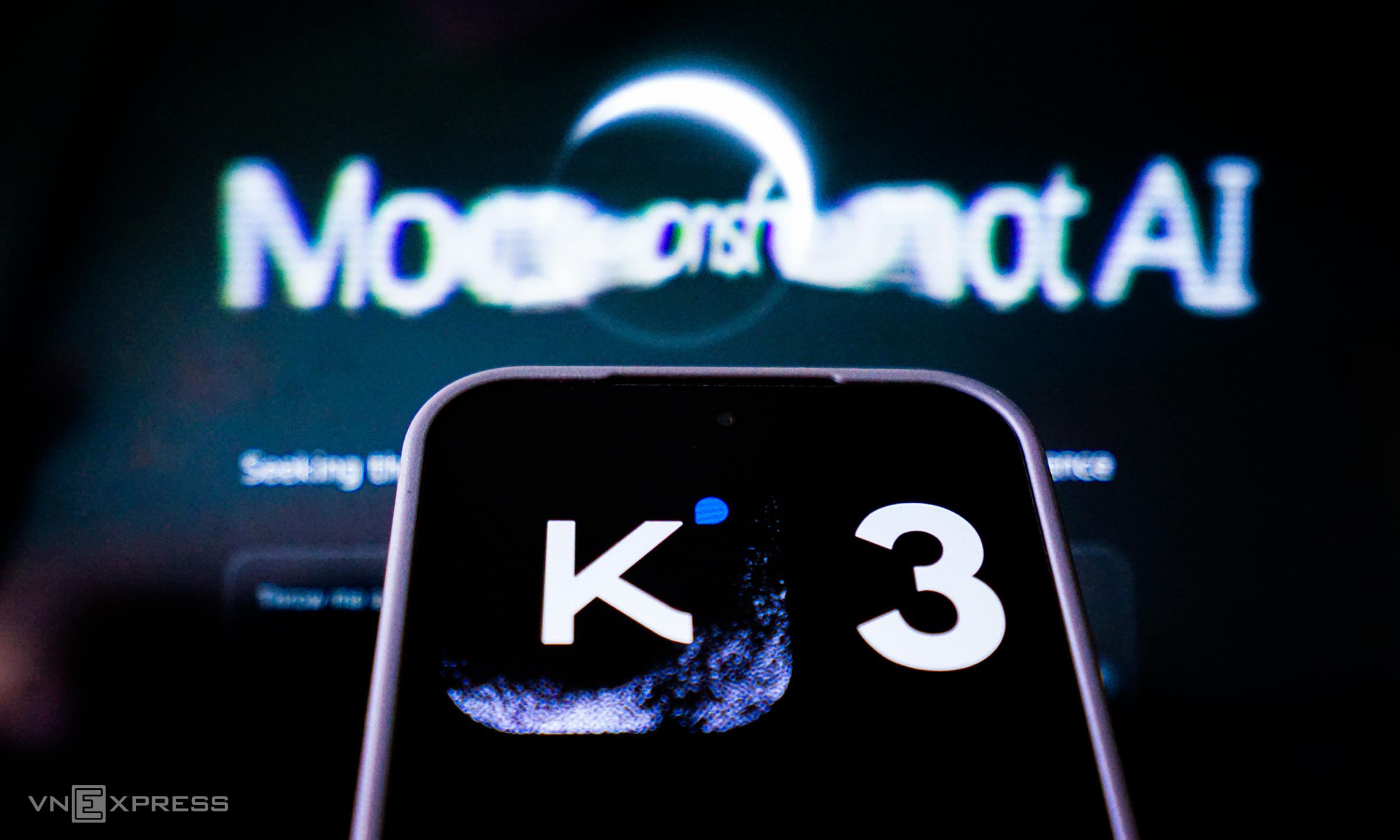 |
Logo Kimi K3 on a smartphone on 23/7. Photo: Bao Lam
Experts acknowledge that the latest AI models released by Z.ai (Zhipu) in June and Moonshot in July have achieved a level of sophistication nearly comparable to advanced models from OpenAI and Anthropic. Also in July, Alibaba introduced Qwen3.8 Max. Prior to that, in April, DeepSeek released a trial version of V4, directly competing with OpenAI’s GPT and Google’s Gemini.
Chinese AI is clearly attracting US customers. Some businesses, such as cryptocurrency exchange Coinbase, have reportedly switched to Chinese AI models to reduce costs. In North Carolina, Curt Meinhold, founder of the digital heritage platform LilyList, stated his preference for using DeepSeek to find potential customers and suggest ways to increase sales.
"Ultimately, over 90% of users don't need Anthropic's Mythos or Fable. We just need a model that's good enough," he said.
Goldman Sachs observes that Chinese AI models are entering a "key phase" for widespread adoption, particularly as the demand for AI agents—AI capable of autonomously performing complex multi-step tasks—increases, making AI usage increasingly expensive.
AI usage costs are currently calculated based on input and output tokens per one million tokens. AI agents consume more tokens per use, widening the cost difference between US and Chinese models.
Alex Colville, an expert at the Australian Strategic Policy Institute (ASPI), notes that Chinese models are currently very close to US models in programming and research capabilities, but at a much lower cost. "If you only have to pay a few cents per million output tokens instead of 30, 40, or 50 USD, then that's more than enough," he compared.
Beyond price, some experts suggest that US technology policy inadvertently creates an advantage for China. Most Chinese AI models are open-source, allowing anyone to inspect, modify, and further develop them. In contrast, advanced US AI models from companies like Anthropic and OpenAI are still developed under a closed-source model.
In June, after the Trump administration imposed export controls on Anthropic's Fable and Mythos models, preventing international users from accessing them, the Chinese startup Z.ai launched its GLM-5.2 model.
"Restricting a US AI model can immediately create an opportunity for a Chinese competitor to step in," commented Anastasios Angelopoulos, co-founder and CEO of the AI Arena evaluation platform.
According to Raffi Krikorian, chief technology officer at Mozilla, as open-source Chinese models increasingly approach the quality of top closed-source models from the US, "the frontier of open-source AI is increasingly being built by China."
Concerned by this, on 24/7, a group of US technology companies, including Microsoft, Meta, and Nvidia, signed an open letter publicly supporting the development of open-source AI models. US AI companies are also seeking to lower service prices, for example, by launching cheaper versions to compete, according to expert Yasir Atalan at the Center for Strategic and International Studies (CSIS).
While Chinese AI models are emerging as formidable competitors, they have not yet caught up with leading US AI firms in overall capability and comprehensive processing of various tasks, according to Anastasios Angelopoulos at AI Arena.
Furthermore, the massive wave of investment in AI is raising concerns about the sustainability of Chinese startups. For instance, Z.ai reported a 132% increase in revenue last year, reaching 724 million yuan (107 million USD), but its net loss grew by 60%, to 4.7 billion yuan (694 million USD).
The US is also increasing pressure to prevent China from accessing advanced technologies, including modern AI chips. Treasury Secretary Scott Bessent warned that Washington could impose additional sanctions to protect intellectual property assets.
On 22/7, the administration of President Donald Trump accused Moonshot of using "secret" methods, though not necessarily illegal, to develop Kimi K3 based on Anthropic’s Fable platform.
Some US politicians and AI companies, including Anthropic, accuse Chinese startups of using illicit "distillation" techniques to extract technology from their AI models. Beijing has dismissed these claims as "groundless."
Phi An (according to AP)