On 23/3, Deputy Prime Minister Bui Thanh Son signed the approval for an updated scheme to implement the Political Declaration on establishing a Just Energy Transition Partnership (JETP). This scheme is linked with Resolution 70 on ensuring national energy security and Power Development Plan VIII.
The scheme aims to transition coal power to clean, green energy sources such as hydrogen and green ammonia, aligning with the national power development plan. Beyond 2030, the government mandates no new coal power plant construction. It will also negotiate the closure of plants over 40 years old that cannot convert fuels and fail to meet the national greenhouse gas emission reduction roadmap.
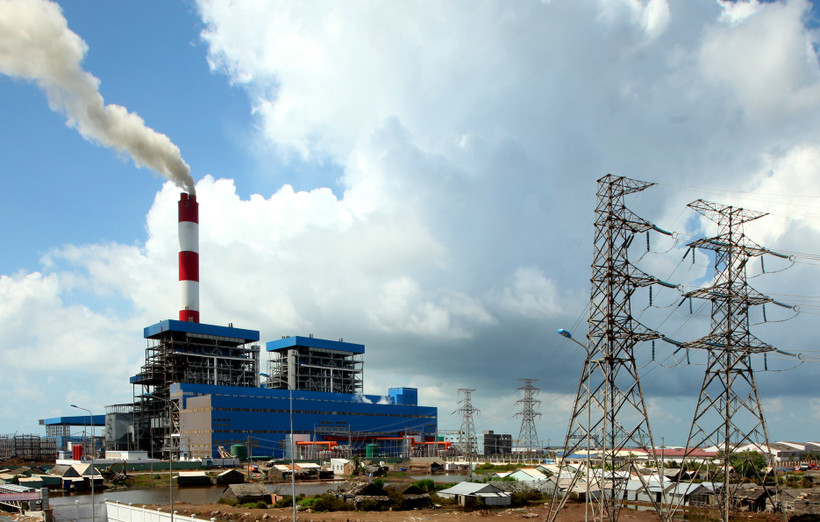 |
Duyen Hai 1 Thermal Power Plant (Tra Vinh). Photo: TTXVN
Additionally, Vietnam will coordinate and mobilize resources from international partners to support JETP projects. These initiatives focus on upgrading and building infrastructure for smart power production, transmission, and operation, as well as developing the renewable energy industry and producing green fuels.
By 2030, two renewable energy industrial and service centers are planned for establishment in high-potential regions. Concurrently, renewable energy sources are expected to account for approximately 47% of the total power capacity, with coal power not exceeding 31 GW.
The power sector aims to cap greenhouse gas emissions at 170 million tons of CO2e, with support from JETP partners. By 2050, the sector's peak emissions are targeted at no more than 101 million tons of CO2e, and renewable energy is projected to constitute 80-85% of the total primary energy supply.
Regarding human resources, the scheme aims to develop a team of skilled experts and engineers in renewable and new energy, supported by international partners. This high-quality workforce will help establish Vietnam as a regional renewable energy hub, balancing emission reduction, economic growth, and environmental protection objectives.
A key objective of the scheme is to enhance energy-saving and efficiency measures across industrial, agricultural, construction, transportation, service, commercial, and residential sectors. To achieve this, technical standards, regulations, and mandatory energy consumption norms will be established for industrial and transportation sectors, accompanied by enforcement mechanisms.
Furthermore, an Action Program for green energy transition, focusing on reducing carbon and methane emissions in the transportation sector, is integrated into the JETP scheme. This program outlines activities for transitioning to electric vehicles, developing green fuels, and establishing charging infrastructure, all aimed at achieving net zero emissions in the transportation sector by 2050.