Clean water scarcity in many rural areas, especially those affected by saline intrusion and high mountainous regions, demands sustainable, low-cost, and easy-to-operate water supply models. Localized water filtration technology initiatives are a viable approach, helping residents access safe water without relying on limited centralized infrastructure.
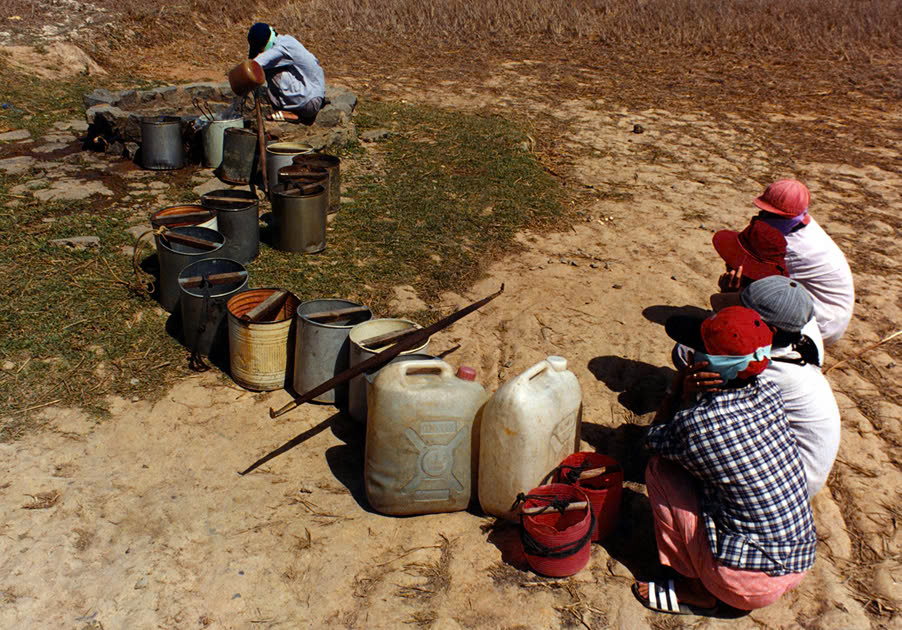 |
Residents queue for domestic water. Photo: Oanh Nguyen |
In coastal delta provinces like Ben Tre, Tra Vinh, and Soc Trang, saline intrusion significantly increases during the dry season, severely depleting surface water sources. Meanwhile, highland communes in Ha Giang, Son La, and Gia Lai face year-round water shortages due to rugged terrain and low rainfall. Deploying large-scale water treatment technologies often proves challenging due to high investment costs, complex technical requirements, and difficult on-site maintenance. Therefore, simple, cost-effective water filtration solutions powered by renewable energy are being prioritized for pilot programs.
One popular model is the solar-powered reverse osmosis (RO) membrane water filtration system. Its design includes a solar panel array to power the pump and filtration unit, allowing the system to operate independently even in areas without a stable electricity grid. A key advantage is its ability to filter both saline and brackish water, with salinity levels up to 5‰, making it suitable for coastal hamlets frequently affected by saline intrusion. With a capacity of 300 to 1,000 liters per hour, it can supply domestic water for residential clusters of 20 to 50 households. Operating costs are low due to renewable energy use, primarily involving periodic core replacement.
Additionally, multi-layer biosand filters are adopted by many mountainous localities due to their simple structure and ease of on-site construction. The filter consists of various layers of sand, gravel, and natural microorganisms that remove impurities, bacteria, and parasites as water permeates to the bottom. This technology requires no electricity or chemicals, making it suitable for individual households or dispersed groups of households. Material costs range from a few hundred thousand to over one million dong, making it accessible to poor households.
Another initiative undergoing trials in several South Central provinces is a portable water purification device integrating ultrafiltration (UF) membranes and a UV sterilization unit. Designed as a compact suitcase or small container, weighing about 10 to 15 kg, it can be placed directly by streams or canals for on-site water treatment. This device suits highland regions where residents must travel long distances to fetch water. These portable units produce water meeting hygiene standards, with a capacity of 50 to 100 liters/hour, sufficient for the drinking and cooking needs of a family of 4 to 6 people. Its strengths include portability and quick setup, making it particularly useful during flood seasons when surface water contamination is high.
For drought-prone and water-scarce areas, non-governmental organizations are also piloting solar still water distillation models. These devices use sunlight to evaporate contaminated water, which then condenses into clean water, removing salts and microorganisms. While their individual capacity is not large, they are durable and require no fuel, making them suitable for the prolonged hot conditions in the South Central region. When combined in clusters of multiple modules, this model can provide sufficient drinking water for schools or medical stations.
Beyond technology, community operation and maintenance are crucial. Many experts suggest that successful clean water models are often linked to technical training for local residents, support for replacement materials, and mechanisms for regular water quality monitoring. Initiatives such as establishing "community clean water teams," training in water source quality inspection skills, or collecting appropriate operating fees are helping these systems operate more stably and sustainably.
An environmental challenge also arises from the large quantities of single-use plastic bottles and water containers generated in many rural areas. Therefore, on-site water treatment models not only help reduce costs but also limit plastic waste, aligning with green development goals. New technologies utilizing durable, recycled, or chemical-free materials, such as biosand filters, biological membranes, or solar power, are highly regarded for their sustainability.
(Source: Ministry of Agriculture and Environment)