Opening the trading session on 24/4, Brent and WTI crude oil each rose by 1% to 106 USD and 96,7 USD per barrel, respectively. In the previous session, both oil types had already increased by 3%. Brent prices are currently at their highest since 8/4.
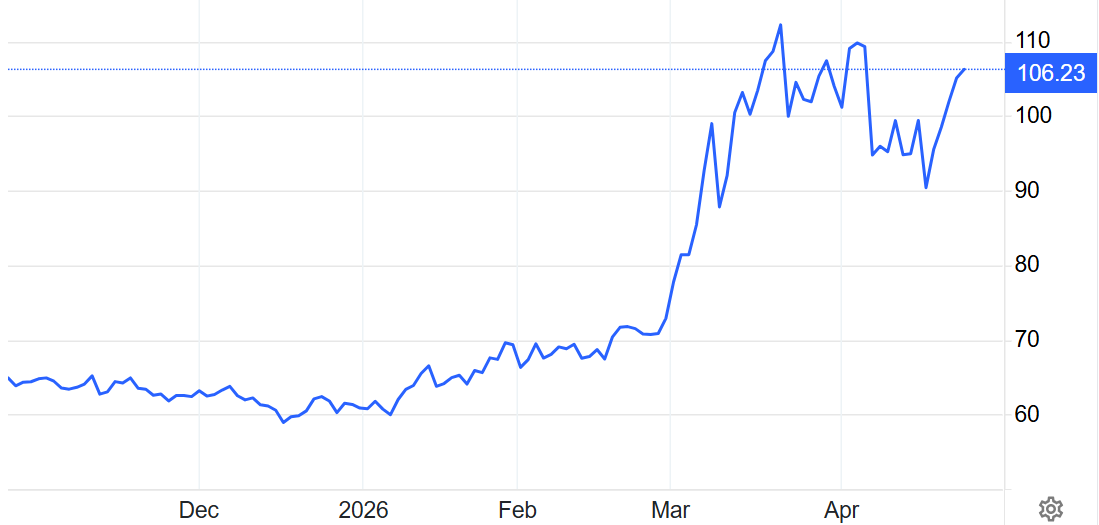 |
Brent price movements over the past six months. Chart: Trading Economics |
The market rose following news of conflict in the Middle East. Israeli media reported that Mohammad Baqer Qalibaf resigned as Iran's chief peace negotiator with the US. This is seen as a victory for hardliners within the Iranian government. Additionally, Iranian news agencies stated that Tehran's air defense systems are intercepting targets over the city's airspace.
In the Strait of Hormuz, Iran continues to tighten control, with videos showing special forces raiding a large cargo ship after peace talks collapsed. On 23/4, US President Donald Trump also wrote on social media that he had ordered the US Navy to "shoot down and destroy any vessel" deploying mines in the strait. The US currently maintains a blockade on Iran's maritime trade.
Despite this, data firm Vortexa reported that approximately 10,7 million barrels of Iranian crude oil exports passed through the strait and left the area blockaded by the US Navy between 13/4 and 21/4. John Kilduff, an analyst at Again Capital, stated that the market is also somewhat supported by news that a ceasefire between Israel and Lebanon will be extended for three weeks.
"There's so much information," he assessed. "I just fear that one day, we will realize how dire the current supply situation is, and prices will reset at a much higher level."
On 23/4, the Federal Reserve (Fed) in Dallas released a survey of 120 oil and gas executives, showing that nearly 40% expect shipping activity through the Strait of Hormuz to return to normal by August, and 26% anticipate it will normalize by November. This strait transported 20% of global crude oil and liquefied natural gas before the conflict.
Ha Thu (according to Reuters)