On 10/8, the Government Office announced the conclusions of Standing Deputy Prime Minister Pham Gia Tuc following a meeting on the Ministry of Public Security's project concerning the "manufacturing, assembly, and pilot registration, circulation, and use of electric tricycles."
Government leaders agreed to the manufacturing, assembly, and piloting of this vehicle type. These vehicles are intended for urban waste collection, postal, and logistics activities in cities, small streets, and narrow alleys.
However, Deputy Prime Minister Tuc noted that the Ministry of Public Security should only pilot these vehicles in several major cities for three years, with limitations on scope and quantity. All implementation costs must be self-arranged by the participating units, without using the state budget.
The pilot roadmap needs to be implemented flexibly, learning from experience as it progresses. This approach aims to avoid wasting social resources and to serve as a basis for legal refinement.
Standing Deputy Prime Minister Pham Gia Tuc requested the Ministry to finalize the dossier and report to the Prime Minister before 31/8. The Ministry needs to clarify the legal basis, practicality, and differences of electric tricycles compared to existing three-wheeled vehicles mentioned in the Law on Road Traffic Order and Safety.
At a related meeting on the project the same day, a representative from the Ministry of Public Security stated that the proposal for electric tricycle pilots stems from the need to mechanize urban activities that still rely heavily on manual methods. For example, current vehicles used for waste collection in many small alleys have limited carrying capacity and productivity. Similarly, the growth of e-commerce and delivery services in the postal and logistics sectors requires mobile goods transportation vehicles suitable for cramped traffic infrastructure.
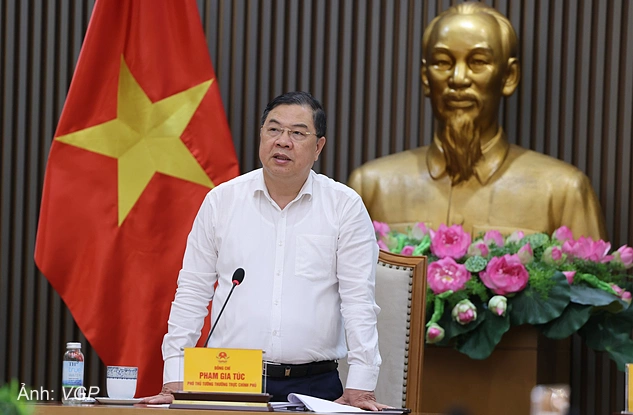 |
Standing Deputy Prime Minister Pham Gia Tuc at a working session with the Ministry of Public Security on 10/8. Photo: VGP |
The Ministry of Public Security also clarified that the research into electric tricycles is not intended to revive the previous model of self-made tricycles. Instead, it aims for a new vehicle type that ensures technical safety and environmental protection. This project also aligns with the orientation for developing green energy vehicles and promoting domestic electric vehicle production.
Representatives from ministries and sectors believe that the manufacturing, assembly, and selection of enterprises participating in the project need to ensure transparency and fair competition. Additionally, a roadmap is necessary to enhance domestic production capacity, enabling Vietnam to gradually master important technologies related to vehicle control, battery management, and operation.
Bao Bao