Vietnam's stock market completed its first week of trading as a secondary emerging market under FTSE Russell's criteria. Foreign investors were net sellers in four of five trading sessions, withdrawing approximately 2,900 ty dong, equivalent to 100 million USD. This activity occurred contrary to expectations of booming liquidity from foreign investment, as the average daily trading value was only 16,000 ty dong, a 15% decrease from the previous week.
Dinh Quang Hinh, Director of Macroeconomics and Market Strategy at VNDirect Securities Company, attributed this development to a phase difference in investment fund trading behavior. Passive funds had disbursed their first tranche, 10% (220 million USD), on friday last week, just before the upgrade took effect, resulting in insignificant trading this week. Active funds, which had bought in anticipation months prior, were now taking profits to rebalance their portfolios.
Another reason for the capital outflow, according to Huynh Tuan Khanh, General Director of KIM Vietnam Fund Management Company, is the impact of opportunity cost and global capital flow shifts. International capital is leaving emerging markets, flowing into areas with superior earnings growth stories, such as technology stocks in the US, Japan, and China.
Vietnam, like many other places in Asia, must compete for capital with attractive global markets. Foreign investors have been selling throughout the first 9 months of this year, with a total net withdrawal of about 3,6 billion USD. This figure is lower compared to other Asian markets also facing capital outflow pressure, such as South Korea (120 billion USD), Taiwan (35 billion USD), and India (25 billion USD).
Analysts at HSC Securities Company assessed foreign investor selling pressure in Vietnam as "relatively light". Even during the sell-off, the market showed positive signals, particularly in its breadth (the difference between rising and falling stocks each session), which remained relatively balanced. This implies foreign investor capital may be reallocating, seeking profitable opportunities in different sectors or market capitalization groups, rather than being completely withdrawn.
"Foreign investors will continue to sell, but the scale will decrease compared to the beginning of the year", Dinh Quang Hinh predicted.
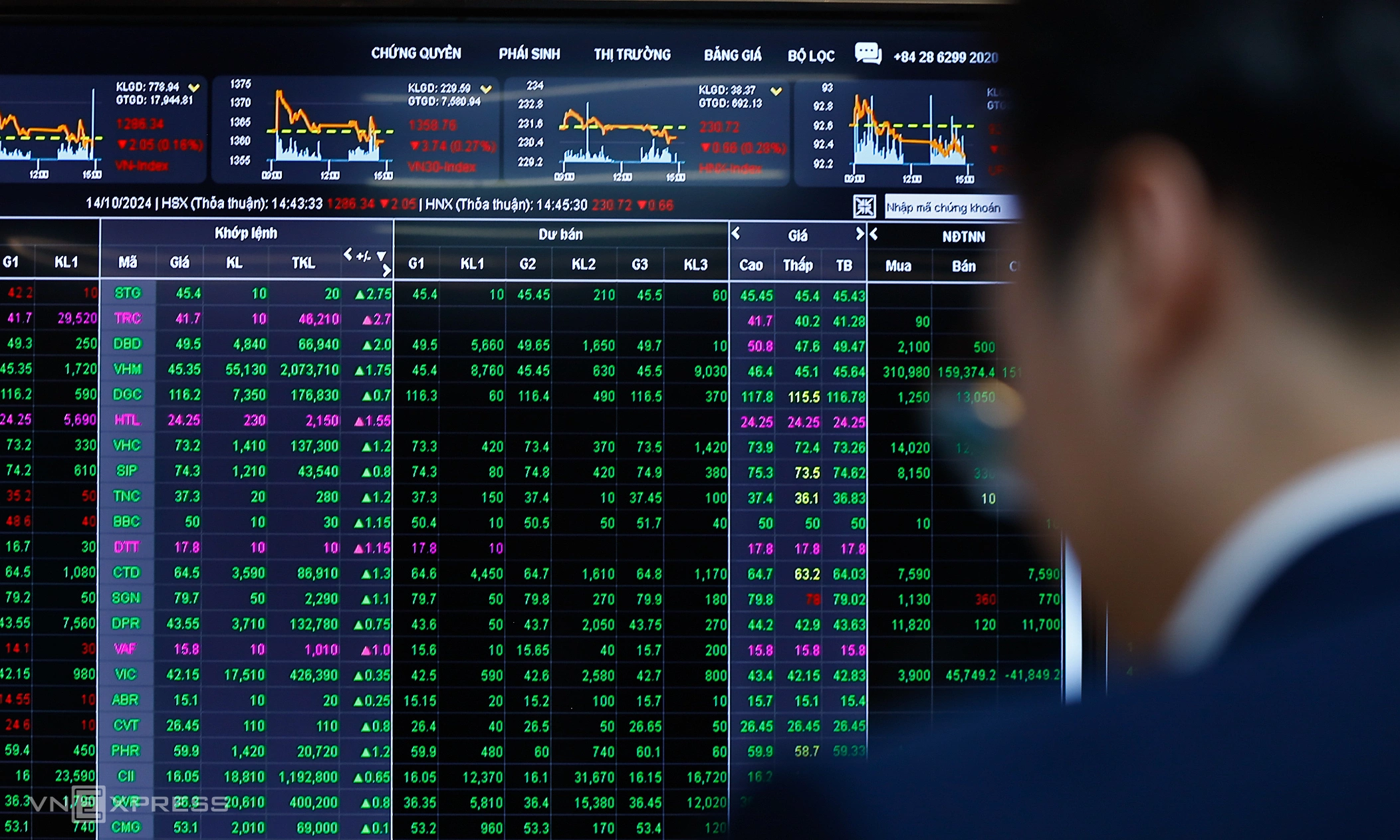 |
Investors monitor stock prices at Rong Viet Securities Company. Photo: An Khuong. |
Experts shared the view that foreign investors should not be assumed to immediately become net buyers after the upgrade date. From the perspective of institutional investors, Huynh Tuan Khanh stated the upgrade serves as a "passport" after FTSE Russell confirmed Vietnam met minimum standards for trading infrastructure. This does not mean capital will immediately flow into Vietnam, as each investment fund has different capital allocation principles and disbursement speeds.
Upcoming disbursements, according to FTSE Russell's roadmap, may help ease net selling pressure. Passive funds tracking the FTSE GEIS index series must make three more purchases in 3/2027, 6/2027, and 9/2027. The total remaining disbursement value is estimated to be up to 2 billion USD. If capital from active funds is included, the figure is projected to reach 6 billion USD.
According to analysts at Tien Phong Securities Company (TPS), active capital typically disburses early and is highly selective, based on industry outlook and corporate fundamentals. Therefore, the actual disbursement value depends on the market's ability to maintain liquidity, improve asset quality, and increase foreign ownership limits.
The greatest significance of foreign capital, according to TPS, lies not just in its absolute size, but also in its quality and accompanying service demands. Unlike individual investor capital, institutional foreign capital is often linked to the need for institutional brokerage, custody, settlement, research, and other transaction support services.
Phuong Dong